Danielle De Jesus
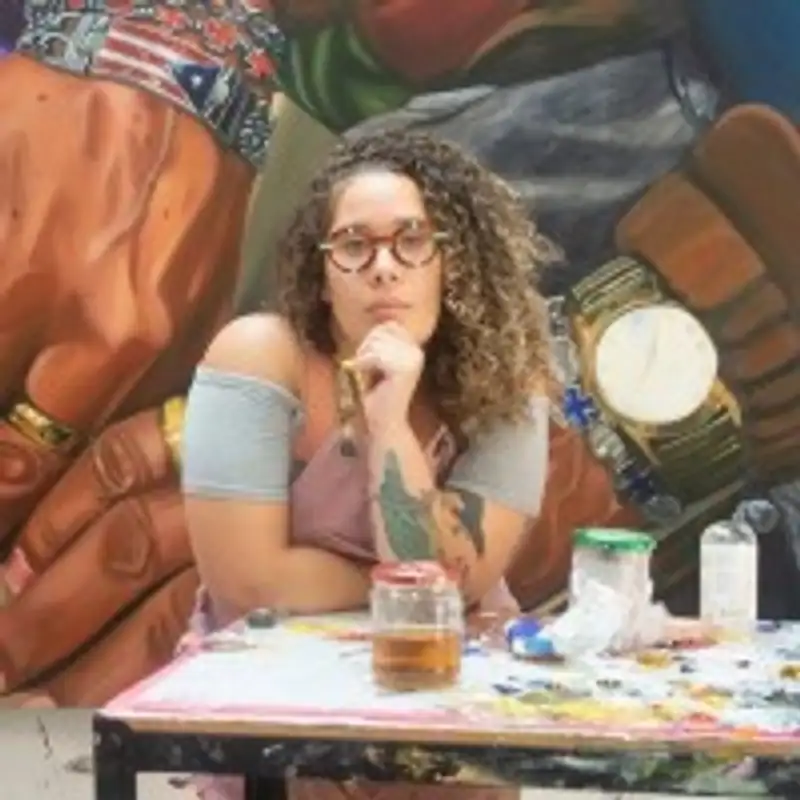
Download MP3Rob Lee: Welcome to The Truth in This Art, your source of conversations connecting arts, culture, and community. These are stories that matter, and I am your host, Rob Lee. Today, I'm excited to welcome my next guest on to the podcast, a New York Rican painter and photographer born and raised in Bushwick, Brooklyn, whose work tells the story of growing up in New York City amidst gentrification and displacement. So please welcome on to the program, Danielle De Jesus. . Welcome to the podcast.
Danielle De Jesus.: Hi, thank you so much for having me. I'm great. Thank you. How are you?
Rob Lee: I am, I usually answer in a really peculiar way, so I'll just say I'm whelmed. You know, some people will say I'm overwhelmed, underwhelmed. I'm just whelmed. But it's a treat to be able to chat with you. After months of sharing bits about the Mets and New York sports stuff, that might be a teaser for a question later. But before we go into the deeper stuff, and I find that generally when we get these bios, I go online and I kind of piece together different things to gather who the person is and what their thing might be about. Their work is one thing, but who is the person at the essence. So I want to give you sort of the opportunity to share who you are, your own words, as an effort to sort of remedy that. Because I find a lot of times those online joints, little corny, little short. So describe who you are in your own words. Give us a little bio.
Danielle De Jesus.: I don't know. I don't really have like a, I don't like to talk too much about myself. I actually meant to bring that up to you because I don't really talk that much about myself. I mean, I'm an artist. I'm a painter and photographer and I'm a dog mom. And yeah, I mean, I've been doing art since I was a child. Since I was about, I mean, my earliest art experience or when I first realized. Like, that I wanted to be an artist was like in the second grade. So I, you know, I've been, it's something that I've been working towards my whole life.
And so, you know, I'm grateful to still be doing it and still be passionate about it. But yeah, I'm from Brooklyn, born and raised in Bushwick, Brooklyn. And I'm Puerto Rican. Well, like they say, New York and right? Because I was raised here, but my, you know, born and raised here, my family's from Puerto Rican. So yeah, New York and Bushwick girl artist.
Rob Lee: See, that was easy. It gets to, and thank you, it gets to sort of like what's important to the person when they're describing who they are. Like heritage is in their background is in their art is in there. Obviously, New York is in there. So if you could take us back a little bit, what was it like growing up in New York? Because I always hear it from different folks, like you're not a New Yorker until you've been there for X amount of years. You're never a New Yorker unless you were born here and all of that different stuff. So what was growing up in New York like for you?
Danielle De Jesus.: Yeah, I would say that I would have to agree with whoever says, like, if you weren't born there, you're not a New Yorker. Like that I'm going to die on that hill. Like, if you're not born there, I don't care. You've been there 30 years, like you're not a New Yorker. Like New York is are born there and they're raised there.
But that's, you know, that's, I guess that's my hot take, right? But yeah, I mean, growing up in New York, I wouldn't trade it for anything. Like growing up in Bushwick specifically, I wouldn't trade it for anything in the world. I mean, it's it's what made me the person that I am.
It's what molded me into like the political, you know, with my politics, but also like, you know, my art and my consciousness is like it was all built in Bushwick, Brooklyn. You know, my mom was a single parent and, you know, she raised me there by herself. You know, dad was around in the way that somebody with his issues can be around.
But, you know, my mom did it by herself. And so, yeah, I mean, there's nothing like, you know, growing up in Bushwick in the 90s and 2000s. And just seeing what has become now is just it's really heartbreaking. But, you know, whenever I walk around there and I see little like glimmers of what it used to look like or what it was or what, you know, I realized like, we're still there.
You know what I mean? They can try to change the landscape as much as they can. But our stories, our experiences, our people will still be there and still thriving and holding on to whatever we can hold on to.
Whether it's like killing on the stoop or going to bodegas or, you know, knowing, you know, your neighbors and things like that. That part is is really hard to erase because it's a part of us. And there's less of it, but, you know, we're still there.
Rob Lee: That's great. And I have a follow up question to that, but I must insert that I wanted to, okay, I'm going to share this. This is embarrassing. I don't want any of this New York judgment. Specifically, this Bushwick judgment, right?
Danielle De Jesus.: So I would go into the house of yes.
Rob Lee: No, I'm just kidding. I saw what up. I went up and this is the first time I was by myself and I was like, I'm going to go on the train. Usually I had money. So I was like Uber and everywhere, like a noob. I go on the train and I was supposed to be meeting someone and they told me like, yeah, you know, I'm in like, I know they said that side.
I heard Brooke, I heard Bushwick. So I got off and then immediately freaked out. I was like, I don't know where I'm at. There's so much noise here.
So many things happening. And so subsequently over the, like, say, following three or four times up, I made an effort. It was like, I gotta go and try to learn these damn trains.
And the last couple of times I've been out there, like, I think I was sharing with you a little bit when I was up for an AirFest back in February of 2025. I was just like back and forth, back and forth. I was like, yeah, man, I'm feeling like I'm still, oh, this train's a little late. You might have to get off and get on that one. Yeah, yeah, I feel like I learned something. I tried to learn the public transit of any city that I go to. And it's because of that, that experience, confusing Bushwick for that stuff.
Danielle De Jesus.: Well, I mean, to be fair, they are, they touch, you know, so it's not like you confuse like Bay Ridge and Bushwick, you know what I mean? It's Bushwick and Bed-Stuy. Like they're, they touch, I was literally born in Bed-Stuy, but you cross the C and you're in Bushwick. So it's like, I was born in Woodhall Hospital and it's, it's on the Bed-Stuy part of Brooklyn. And then you, like, I'm not even kidding. You cross the C and now you're in Bushwick. So you weren't that off, to be fair.
Rob Lee: That's funny. I was like, yet another B to add to. That's what I was like, oh, another another B is like, Brooklyn, Brooklyn, Bed-Stuy, Bushwick. The sort of follow up that I had in it, is there a memory that really sticks out like really distinctly that, you know, perhaps is indicative of like growing up or indicative of sort of, you know, you as a young person engaged in art. Like, I can think back to me making up stories about a movie that I commonly watched, looked at the cover and that people were listening. So I just made a whole story up about a movie that I'd never seen. And attention to my story telling. It was a lie. But that's probably one of my earliest examples.
Speaker 3: Like pertaining to art. I don't know. I mean, like I said, when I was in elementary school, like all the kids would like ask me to draw their book report covers, you know. But as far as like core memories of Bushwick, like I was always the art kid.
But just like being aware of my environment and then using that as inspiration. When I was in high school, I would walk around Bushwick and photograph like the abandoned buildings or the like construction that was beginning to start happening. I would photograph like, you know, my neighbors and my friends and just, I didn't know at the time that I was like making, you know, making a record of something that was no longer going to be around or, you know, be erased eventually.
But so I wasn't like conscious about that, but I was just making art, you know what I mean? On the community that I that I that I knew the only place that I knew. But if you're asking me about like one of my like fondest memories in general of growing up in Bushwick, I'll have to say that there was this empty lot on my block all the way at the end towards the Wilson side.
And my friends and I was always this little like kind of like tomboyish girl and I would have played with the boys and stuff. And and there was this lot and it was empty, but it was it was empty in the sense that there was no house. It was just like a lot and it was but it was filled with like and like abandoned cars and dirty old mattresses. And just like it was just like a junkyard, essentially. And I just remember playing with my friends in there and just like having zero worries in the world, like pretending that we were driving into like driving, you know, into wherever, like, you know, one of them would get behind the wheel and I'd sit in the passenger seat and we'd pretend that these cars are actually taking us somewhere. And we used to jump on the mattresses, they go on the hood of the cars and then put the mattress right next to the to the car and then jump down and man, you know, like, I'm surprised we didn't get like hepatitis or something. You know, playing in those lots. But yeah, it was like a really special memory that I'll never forget about growing up in Bushwick.
Rob Lee: Thank you for sharing. It's always cool to go back a little bit and just think of those those fond memories, those those memories just like growing up and things felt a bit more pure. They don't really worry about like, oh, bills.
Speaker 3: I want to move ahead a little bit. So part of your story includes Yale. I've never interviewed anyone with Yale in that background. So, you know, that's where that sort of like, let me put on my, I was wearing a suit earlier and I was like, no, I got to keep a G and we'll put this track suit on. But what did Yale perhaps change or confirm within your creative practice? And what did that experience actually feel like being there at Yale and sort of going through your program?
Danielle De Jesus.: Well, I guess I should like preface by saying that Yale was the first school, the first art school that accepted me on the first try. So that was like something that just it kind of confirmed that like I am worth, you know, unworthy of, you know, I have it, you know what I mean? Because I, you know, trying to go to high school, every art high school in New York City rejected me. So you have like art and design, LaGuardia fashion industries all said no to me. I ended up going to like my own school where I picked up photography. And, you know, they didn't, the kids kind of, it was one of the worst schools in New York City. The kids didn't really care too much about like, you know, the program or anything like that. Like I had my one of my best friends in high school named Leslie and she, she was like, come to my photo class and, you know, and I ended up going and falling in love with photography.
Thanks to her. But then going into college, I, you know, for my BFA, you know, because my grades are so bad in high school, I really didn't think that I would have a shot at getting into college. So I didn't apply. I was in going to college.
I wasn't planning on going to college. Like I was working at Bed Bath and Beyond. And then I met my ex-boyfriend and he was like this kid from the hood too that was like going to like, you know, Hofstra University. And like, I was like, damn, I can't, you know, I can't be with this guy and, and, and not have anything going for me.
And so I was like, what am I going to do? Like I want to go to school. Like I want to study photography. And so I knew I wanted to go to FIT to study photography, but I didn't know where to start because I almost didn't graduate high school.
I know my grades wouldn't get me in. So I went to community college and I brought my grades up and then eventually got into FIT. And then, you know, while I was at FIT and two weeks before my senior year, I got a job working at a production studio. And so I was doing what I was going to school for. So I took a break for a seven year break from school. And then while I was working at a production studio, I just like, I picked up like, you know, I was just doing painting as a hobby. I was like, I've never been good enough to go to school, you know, get the opportunity to be taught how to paint and draw. So I took the time to teach myself. And I was like, I love this.
What am I, what am I doing with myself? And at the time I ended up like a few years later, ended up getting a roommate who was like a professional painter. And she inspired me actually to go to Yale and because she had gone to Yale and she was a black woman.
And I was like, wow, there is a space for black and brown people at an institution like this. And I would have never thought that it was possible. And then I was like, why don't I give it a shot?
Like, why am I not, you know, why am I not worthy of doing it? And so I went back to school and I finished my last year of my bachelor's. But again, I had taught myself how to paint.
So I didn't have like a traditional kind of education on how to make up a paint, a painting with, you know, with the technical advances in education and painting. And so I eventually, you know, I put together a portfolio that I thought was pretty good. And and I applied for grad school, but I had to finish my BFA.
So I went back to FIT and I finished my last year and I and I and I took the risk, you know, I quit my corporate job. And I was like, I want to I want to go to Yale. Like, and if I don't get into Yale the first time, I'm going to try over and over and over. Like FIT rejected me three times before I actually got in. And so I applied and did not think I would get in. And and I got in. And so it was the first try. And and I was like really, really surprised because I was like, this is the first school that actually took me on the first go.
Rob Lee: That's that's I mean, that's that's I open and it sounds like perseverance and just kind of self discovery as well. Yeah.
Speaker 3: That's amazing.
Danielle De Jesus.: You know, you don't expect, you know, this, you know, I grew up in Bushwick. I would have never thought that I wouldn't have that kind of opportunity. And and it's just crazy how like, sometimes life lines things up for you. Like if I would have gone to like high school for art, I probably wouldn't be an artist today.
You know what I mean? I probably would hate art. Um, but yeah, I mean, I picked up a camera at 14 and, you know, kind of it took the direction that it needed to go.
And like being at that job is great. But like, I felt like I needed something more. I feel I felt like I needed I needed to do something more. And that's where the painting came in. And I was like, I'm going to teach myself like I'm going to continue making a bunch of shitty art until I make something good enough. And and I got there, you know, I think it's just a matter of sticking to what it is that you want to do.
Rob Lee: It's those those reps I had. I was I used to draw. I used to do the sort of illustration. I wanted to be a comic book artist. It was also the arc where I thought it was going to be an astronaut to I was a. I was going to run in a rocket.
It was going to be great. But I ended up going to taking the sort of entry exam to go to one of the art schools you have here in Baltimore. And I didn't get into it. It didn't get in. It was the sort of rejection. And I was like, 11, maybe, you know, it's kind of cartoonish.
Like it literally is Wolverine from the X-Men. Like that means I pass, right? And so I didn't get in and I went to a different school and using sort of my brains versus any creative talent that I may have been, may have had. But I always would draw and write and write rhymes. I keep talking about that period when I was a rapper.
I will not share any of these songs. But I find in doing this, I was able to find my voice. So that took a notion of perhaps not being at a art school because this is a literally arts high school was probably good for me. Now, this is where I'm a little petty sometimes, right?
Well, a lot of petty. I had the opportunity in the last two years to teach podcasting. And one of the places I taught was the school that rejected me when I was a kid. It's like faculty.
I was like, what it is, you know? But there's something that was a lane that was very much self taught. Like, you know, I've been podcasting since 2009. So taking sort of these skills that I've developed over this time and being able to come back to sort of the knowledge of that. To the point, would I be a great comic artist if I actually went down that path? Probably not. Yeah.
Danielle De Jesus.: I mean, I feel like, you know, what's meant for you is always going to be a map for you. Like whatever is written in the stars is already written. So if you know you're doing exactly what you're meant to be doing. And, you know, sometimes you have to take the longer route and sometimes life throws curveballs where you're like, whoa, like, you know, where did that come from?
You know? And so it's just, it's just a matter of how much you want it and what it is that you want, you know? And, um, yeah, and sometimes it takes in another direction that you're like, like, I would have never thought that painting would be the thing because I never felt good enough. I never felt like my work was validated through, like, you know, schools and things like that. And, you know, like when I was in middle school, getting ready to prepare for my portfolio for high school. Like, I didn't really have any teachers that were, that were like really guiding me or telling me like, this looks good.
This doesn't or teaching me how to draw like perspective and how to shade or do anything. Everything that I did, it was just, you know, was just kind of like, oh, that's very nice. You know, that's very nice. Like not really like pushing me. And my mom was way too busy trying to keep a roof over her head. It's like my mom could barely go to open school night ever because, you know, I kind of essentially raised myself because she was always working in the sweater factory, um, trying to, you know, pay the bills and make sure that I did have, like, that's one thing about my mom is that she never, you know, she always made sure that I had, you know, the whatever sneakers, like, you know, were cool or like, you know, a new outfit every, every school year and a new backpack. And she never, she made sure that I never went without.
And so in order to like do that, you know, it's like she worked all of the time. And so she didn't really have the time to take me to museums and to galleries and she didn't, she probably didn't even know of any, you know, at the time she didn't know what Yale was, you know, when I was applying to Yale, she's like, oh, but I do get a MacGill, which means like, what do you need more school for? You know, and I'm like, well, mom, it's Yale. And she's like, yeah, yeah, yeah.
And it wasn't until like I had family come visit her in Puerto Rico from California and my cousin, um, you know, who I haven't even met, but he, um, you know, my mom was like, yeah, my daughter's going to the school. Yeah. And he was like, what? You know what that means, you know? And then, you know, it wasn't that. And now she's like proudly wears her like Yale mom shirt, you know? She didn't really know what that meant, you know? She just, she just wasn't exposed to that. And I don't blame her for that, but, um, but yeah, that's, that's hot.
Rob Lee: I know that, um, this is funny when your parents are making the connection and they're like, I don't know what you're talking about, right? And I got into like city college, you know, city college, high school is one of those kind of like scholastically inclined, like high schools.
Big deal getting into it. I remember one of my parents was like, city, you can be outside. Like, what are you talking about? College. I thought she was just going to high school. I was like, I don't know why they named it like that, but it's kind of a big deal.
God. But once, once the sort of graduation thing happened and all of that, they got on their orange and black and it's just like, you know, city forever, you know, with the ring and all that stuff. The school was the castle on the hill. So we were knights. And I was like, yeah, it's nobility, you know?
Speaker 3: Yeah. So I want to, I want to talk a bit about, you know, specific works and kind of like open up a conversation around like process and things of that sort. So look, I do not speak Spanish. So I'm going to Americanize, bastardize this really poorly. So las manos de Torneita.
Oh, Torneita. Took over 70 hours to complete. I saw that I saw a post about this, right? Yeah. So talk to me about your work. Kind of peel that curtain back, peel the onion back a little bit and just describe sort of the process of like how you work, how you're making your work. Like go a bit deeper than sort of the output, the fun stuff, those anxiety riddled parts. Like I was saying before getting started, I'm nervous and not even the productive parts, but how do you work?
Danielle De Jesus.: Well, that one took a long time because there's like an immense amount of detail in it.
Rob Lee: It's great, by the way. I just wanted to share that. Thank you so much.
Danielle De Jesus.: Yeah, it was, I mean, having to paint each, like the facets in the, in the, in the, in the stones and all of that stuff. That was very, very time consuming. I mean, and yeah, I mean, people, what people don't realize sometimes is that those small dollar bills, because I am known for like painting on dollar bills and using like, Unconventional materials, like tablecloth, things like that. But the, in particular, the dollar bills, what people don't realize is sometimes those take just as long as it would to make like a five foot painting.
You know what I mean? Because even though this scale is different, there's a lot more little small, tiny details that you can't get away with. Like that you can't get away with when you do it on a small scale the way that you can on a big scale. And it's like, with the smaller paintings, I feel like it pulls the viewer in and they're, they're just kind of like reading every, like, stroke of paint and every little detail. And it's just like, you know, we are fascinated by small things, you know? And so I, yeah, so sometimes they take just as long as a large painting would take.
My paintings are stories, they're archives. And so Daniela right now is like, you know, she's a big staple in the Puerto Rican community in Williamsburg. She has like a community center. It's like a social club.
It's called the Caribbean Social Club. And, you know, they mentioned her in bad bunny songs and things like that. And so I wanted to kind of like honor her. She has these iconic rings that she wears, these like very large pieces, like a lion or it's like a frog or it's like a peacock, whatever it is.
But she wears these big, elaborate rings. And so I kind of wanted to like honor her. It was more like, you know, just kind of like an honoring as opposed to like it really being part of like my body of work. I mean, it still fits into like the work that I do. But my work more is about like politics and like Puerto Rican politics, global politics. I feel like my work is an archive of the moments that we're living in that to somebody, you know, years from now is going to be considered like, you know, history, right? And so this kind of like archiving these moments and archiving my community and archiving the struggles of, you know, Puerto Ricans, but, you know, people around the globe.
And so that's ultimately like my, what I want to do with my work or what I am doing with my work. And yeah, so I mean, the Donita thing was very cute. It was just like a fun painting that I made.
But I most of my work, I tried to tell a bigger story. Even things like the bodega painting, you know, the bodegas don't look like that anymore in New York, you know, so there's just grocery stores. Between a grocery store and a bodega. And so they got to usually own the Puerto Ricans at the many kids. There was some time, you know, some type of Latinx or letting know whatever. You know, and very, you know, very specific culture in there, you know, and so that is what, you know, I'm documenting with some of those paintings as well.
Rob Lee: Yeah, I mean, and then I have a few more questions in that same sort of past, but yeah, I leave out with a certain degree of confidence after I leave a bodega. I thought it was like coffee by anybody. I was like, oh, this is this is a mate. Yes. I'm going to make my ear ring even danglier. I'm trying to be like the whole place.
Here's the book. You know, once upon a time, I worked in a Spanish speaking call center and all of the homies were from like New York that came down to like the DMV. It's just sports and shit talking. Pretty much. It's like, oh, right.
I'm just hanging around the Dominican and Puerto Ricans here and just getting this second hand. You got to do this. I was like, what are you saying? You need to have this clone. What are you wearing? I was like, what?
Speaker 3: Yeah, I think I heard all of my coolness at a very tender age of like 22. I was like, I think bully passively. This is wonderful.
Danielle De Jesus.: Yeah, possible day of culture. Yeah.
Rob Lee: So, you know, you touched a bit on the pain on US currency. So I definitely want to explore that a bit more. So I have some thoughts, but I definitely want to hear from you. Why the dollar? What does it say around value, displacement and Puerto Rican life that the canvas like hand or that the canvas just doesn't do justice on?
Danielle De Jesus.: Well, I think, well, first of all, the dollar bills started really silly idea. Actually, my pain is I was a fan of this show called Hamilton, which I'm sure you all know. What was that?
No, thank you. So I was a fan of this before I got very radicalized, I guess. But before I really became aware of a lot of politics, I was a fan of the show. And so, um, I think I'm going to be able to do that. I painted Lin Menor Miranda who was like the writer and the creator of Hamilton. And he, you know, I painted him on a $10 bill and that thing went viral on the internet.
Like it went crazy. Like I had Latina Magazine hitting me up, Buzzfeed, because Buzzfeed was a thing at the time. All these different like, you know, web things, nylon, all this stuff. And I was like, oh, this is really cool, you know? And then I said I was doing a lot of like pop culture, like kind of drawings on there, like one of my favorite movies, like, you know, a bunch of Disney stuff, whatever, like all that stuff, just again, like following on Instagram.
And it was cool. But then I would realize that some of the comments were like, oh, do you know what I can do? You know, silly people on the internet, you know, like, you know what I can do with a dollar?
Wow, what a waste of dollar. But like, you know, it's just silly nonsense, you know? And I was like, man, you know, like people put so much value on a single piece of paper.
That is 70% cotton and 30% linen. And like, it has no actual value except for being able to trade it for something else. Like you can't eat money, you know what I mean?
If nothing else existed in the world, we'd die if money was the only thing left, you know? And so, yeah, I mean, that was, it kind of changed my relationship with money. And I realized, like, you know, how can I force my viewer to pay more attention to what is on the dollar bill and take away the actual, like, value of what this piece of paper is, you know, the value that we put on it as people, right?
And give it a new value with a purpose. And so I started painting a lot of, like, more like political things and speaking about Puerto Rico and Puerto Rico being a colony and, you know, speaking about the school closures and, you know, the fiscal control board that was put on there during Obama. And, you know, it's all of that stuff. And so just speaking more about the political side of things on the dollar bill and enforcing my viewers to have to think differently when they're looking at a dollar bill, think about the stories that are being perceived on there as opposed to, like, oh, I can buy, like, a dollar chicken burger or whatever the fuck from, sorry, to be encouraged.
Speaker 3: You know what I mean? Like, so, you know, it's like,
Danielle De Jesus.: people don't think about, you know, the important things in life. So that was my way of, like, kind of taking that value away from money and putting it towards something that is actually important by, like, repurposing the dollar bill.
Rob Lee: See, I like when the guest is cooking, you know, what you were doing right there. I like that. I was just like, all right, go on, go on. Say more. Say what? When I let the guest cook and they just are answering other questions. I love that. So I'm going to backdoor into this question because I think it's very timely.
Considering that it's very expensive to live in New York. And I think artists, you know, have done over 900 interviews at this point. They're always a class that's squeezed. It's like, never enough funding. You know, our market is down.
Sales are goofy. I do something slightly different, but also I'm seeing the pinch as well. I can't travel as much.
I'm completely self-funded right now. I'm curious for those that may not discern it. I got a taste of it when you were kind of talking about the chicken salad in the country. What is your relationship with money?
Describe your relationship with it now. Like, it's a trade, I agree. But like, you know, some people are bad with money. I'm really good with money. I'm bad with money.
Danielle De Jesus.: I'm so bad with money. Um, I live way beyond my means. Like, I, you know, I have my studio, which I don't know how long, how much longer I'll have it for because I can't afford it. Um, but it's my space to like get away from everything.
And so I'm doing everything that I possibly can to try to like keep it. Um, I think moving back to New York from New Haven after grad school was probably one of the worst financial decisions that I could have made. But New York City is like home.
It's like where my heart is. And I found myself feeling very disconnected from my subject, which is primarily in New York City, New York and Buttericans and things like that. Being in New Haven, I felt like I was starting to become so disconnected from that. And so I wanted to come back home. And, and so I did when the opportunity presented itself. Um, and I was doing really well.
And then the art market, well, I mean, it's the art market, but also like political, the political climate also affected me tremendously. Um, but now I'm like, you know, I feel like I'm just barely surviving. You know what I mean? Like there's times where like, I have a fucking Yale degree.
Like there's no reason why I shouldn't afford a coffee. You know what I mean? And it just goes to show like, damn, what do these things actually mean? You know what I mean?
Um, these pieces of paper, uh, it's a, it's, it's a flex, but it's like, is it really when you can't even afford a coffee? And, um, and so yeah, I mean, I am struggling because I want to be home. I want to be here. I want to be, this is where my work is drives the most. And for, you know, it's a place that inspires my work the most.
Um, but the shit is hard. Like my mom lost her apartment to gentrification in 2017. And so she has to move to Puerto Rico, um, to be with, you know, her family so that she could even afford to, you know, and everything I've ever done in my life has been like, oh, I'm going to help my mom. I'm going to help my mom. And I was helping her for so long. Um, and then she just hit the fan and I haven't been able to, I've been barely able to help myself.
And so, um, yeah, it's hard. I mean, I have an apartment that I pay for by myself and then I have my studio that I pay for by myself. I don't know how long I'll have either one, but, you know, I think when you don't, you know, I think that a thing, you know, when you don't come from money, you know, like, and you end up at an institution like, yeah, people expect like, you know, it's going to open a door to everything for you. And, uh, that's not always the case.
If you don't have like a foundation to like hold you down and have your back, like it doesn't matter where your degree is from, you know, it's, it can be really difficult. And so, yeah, that's where we are.
Rob Lee: Thank you for, for being so transparent. I kind of played with that question back and forth on, is it too invasive? Is it, is it a stupid question? Is it a real question and so on? And I just thank you for indulging me in that, that area. And I, you know, and that's, and that's sort of, I thought it was kind of like timely with some of the state of affairs that's happening. And, you know, I just see these different things. Like, you know, you talk to someone who's like, Hey, I've been doing this for X amount of years.
It's always some grift that's popping up. Hey, bro, I can 10 extra podcast business and you'll be the next. I was like, I don't want to be that. And even when, you know, I remember, um, sort of in 2020, you know, five years ago, at this point, but in 2020, right after I started, I was like, I'm all right. You know, I make it okay.
Living, right? And, you know, it's goofy. People think it's disingenuous, but it was a real thing. When that, uh, stimulate the, the STEMI hit, I was like, I hit up a bunch of like artists that were here locally who I knew were younger than me and who were in like, sort of different spots. I was like, yo, can I give you some money to buy paint and stuff? And it was an honest, pure thing. And I, you know, always look with a fair amount of respect when someone is just like, nah, that's, that's, I, I appreciate that, but I, you know, I don't do that.
And then so on. But sort of, you know, there were some that was just never like, yeah, can I, can you do that? Because I'm in a bad spot. And I know some of the smaller sort of like arts institutions here were figuring on creative ways to help folks because they knew that them creating was at risk.
Their lives were at risk. And it's sort of a real thing that often is missed. I have a formula. I have a process that I'm able to do my creative stuff. And my studio is a few pieces of equipment and my home, my second bedroom that I converted, but, you know, I know a fair amount of folks, you know, you, you being one that you have sort of two rents, you know, that's the thing right there with the studio and then home. And it's a very tough thing. And I feel like the creative economy is getting squeezed so much, whether it be, hey, you know, I'm not getting the engagements for folks to see my work, to eventually go there and maybe buy a print or buy something, or just the whims of the, the market of, oh, we're liking work that looks like this. And this is what's selling. So it's like all of these different ways that are being squeezed squeeze and at the end of the day, it's just less money, less attention, less opportunity that's come in the way of folks. And it's, it is really sad.
Danielle De Jesus.: Yeah. Well, I mean, I think I, I, I made a post on my Instagram the other day where I mentioned, like, you know, I think as artists, we sometimes we can be prideful, especially when we're so used to working so hard for everything we have and not relying on other people. It's hard to like reach out to your community and, um, and ask for help. And so, um, you know, I was so like right out of grad school, like I was placing my work and getting my work placed in, um, and, you know, with these collections that like, you know, with these people that have like, you know, millions of dollars worth of artwork and whatever. And like, you know, and I thought that was like my, like, I'm so sorry if you can hear my dog, like making all these grunting sounds.
He really wants me to pet him. Um, but, um, yeah. So like I, you know, I was so caught up in that and like, oh, I'm doing, I'm making it, I'm doing it.
I'm doing it. Like I'm selling, you know, in major collections and, and, uh, and, um, it was just like, I thought that that was what I needed. And granted, it's nice, you know, what I mean to like be able to survive and pay your rent and bills and not have to worry about anything.
But if it comes at the expense of selling your soul and it's not worth it. And then I found myself having nothing after like, you know, just a political thing, you know, political, it was an issue. Whatever.
Go to my Instagram. But, um, but, you know, like after, you know, um, I realized that like, you know, I dropped this print, you know, if it was my first print on my own and I did it not knowing what would happen. Like I literally spent my last $700 or whatever, like printing these. It was such a gamble. I was so nervous because I was like, I'm literally like spending my last couple of dollars hoping that people will support me.
And guess what? You know, who came through for me, like my community, my, you know, people have written to me on, on Instagram and been like, Oh, I love your work. And I wish I could afford your work one day. And it would break my heart because I'm like, you know, I'm selling to these people that my work doesn't even really speak to. Like I should, you know, my, this work is for my community. Like how can I make my work more accessible to them? And those are the people who came through for me.
You know what I mean? And they, they purchased a print and they, you know, they told me how much they love the print and how much they, you know, they love the work and they have a little piece of my work in their homes now. And so like just knowing that your community has your back, I think, um, we can't, we can't forget that, that, you know, those are the people who, who make us and, um, and, uh, and we have to be grateful for them all the, all the time and every way. And, um, yeah, I just, I was really grateful for their, for their support.
Rob Lee: You know, that's, that's really important. That's, um, it was really good. Cause I think in, in going into this year, like, you know, the podcast started in 2019 is kind of a, you know, middle finger to just people that have this narrative of a bad city, cause they really mean something that's kind of racist and specifically like the Trump of it all. And, um, and I was like, you're not talking about the street lights. You're not talking about the infrastructure.
You're talking about the people, but you're too much of a coward to actually say that. Yeah. And, you know, so it's had that bent. And, you know, as we are back to sort of the same hell escape, but a worse version of it, I have been saying to my blue in the face and I'm, I'm, I'm a fairly brown skin individual, uh, that community is so important. And like the true sense of it, not this silly thing that is masquerading, but sort of really helping out each other and being sort of connected in that way. And showing up and I just keep really trying to push for that, like showing them, doing what you can, whether it be, you know, just, Hey, I'm doing this thing or Hey, it's this real connection or Hey, I'm putting your name out there and really using it, but doing it with a true intent and a pure intent. I just think it's just super important now because sort of this notion of being online and being sort of in this.
Marrage of stuff. It's not really helping us. It gives us the sort of comparison thing and that's the thief of joy. These different things that really aren't helping us.
So getting back as the kids are saying touching graphs, but being able to connect with folks and being able to really substantively support folks, whether it be by and prints, whether it be sharing, leaving a review, whatever it is.
Danielle De Jesus.: No, absolutely. I mean, it's, uh, yeah, it's really, it's everywhere. Every like, every comment, every share, you know, all of that is support. You know, um, yeah, I was just really grateful and it really opened my eyes. I don't want to be these, I'm one of these artists who's like, fucking, I don't need to live in a fucking fancy house and have, you know, a million dollars and whatever the fuck, you know, I don't care for any of that stuff. I want to tell stories and I want my art to outlive me and I want to be able to pay my rent and buy groceries. Like that's it. You know, I don't need the art star luxury life.
You know, I, if I, you know, if I could have a house with a pool one day, great. But, you know, the reality is that to me, what matters more is telling our stories and that my work outlives me. Like I want people to talk about my art when I'm long gone.
And, uh, and I don't care too much about all the money that comes with being an art star and all that stuff. Um, and my community came through for me and, and then because of my community, I was able to pay my rent or, um, you know, I was able to buy some groceries and treats for my dog, you know, and that thankfully the print sold out, you know. Um, but I, you know, it's like we have, we can't forget, no matter how high we climb that our community is what comes first. And they're always going to have your back as long as you have theirs and you don't forget them. And so that's really important.
Rob Lee: 100%. And, um, I got one last real question and then I got a couple of rapid fire questions for you and sort of, I just want to comment real quick on, yeah, sort of having an idea of like what success looks like for you and what you really want from your work, want from your creative and devil from your art. You know, there are so many opportunities to come up. And like I said earlier, I have, I joke about all the time, it's always some five foot eight white dude that comes to me and say, I could attend extra business, bro. I was like, Oh, I don't, I don't want you to do anything for me. I realized that my integrity and sort of my independence matters so much for me. Cause it's like, I still have to do the thing. You know, when someone else is there treating me like, you know, hand in my ass puppet style, I don't want that in going to the sort of land the plane and full circle it. People are trading that, that could have really priceless commodity for that paper you were talking about earlier. And that's just, it's not, it's not a good look.
It's just not a good look, frankly. So I got this last question I want to run by you and it's sort of this, it's, um, two of the things that I see that come up over and over again through the research is, um, you know, displacement and it centers people, right? Like the stories of people. So like in this podcast, I believe the stories matter. And I think in displacement, stories can be lost, right? Like, you know, a lot of times like this is the archive, you know, that's ultimately what it is. So could you share a story that perhaps you're, you're carrying through your work or a story that you learned of that kind of you look back at, and it's just like, it holds like, you know, as an adult, it holds like a lot of, um, like a steam for you and a lot of like you look on as like, this is important, you know, being able to carry these stories and sort of the lives of people and sort of these, these things that matter. Like, like talk a bit about that, like the, the importance of stories occurring stories.
Danielle De Jesus.: Well, yeah. I mean, I, one story in particular, there's, uh, a man named Carmelo who was like a family friend, you know, of my mom and I, and, uh, great, great man, you know, I mean, there were a lot of creeps and Bushwick, you know, so you had these old men who like look at you and be like, you know, they've just been creeps and stuff, but this guy was just like an angel. He was such a great human being. And I remember they were trying to get him out. He was living in a basement apartment across the street. And, uh, they started to like do construction in his building when he was, you know, when gentrification was, was, was really at its high point.
Um, and it still is, but, you know, when it was really starting to be noticeable. And so they had, uh, they were trying to get him out of the, the apartment. And, um, I knew his days there were numbered because they had completely gutted the entire building. So it was just kind of like an, like, uh, like a skeleton of what the building was. So there were no walls. It was just like beams everywhere.
Like you can look from the first floor all the way to the third floor. And so I brought my camera and I wanted to document him, um, in his basement apartment before he, you know, would ultimately be thrown out because it was going to happen eventually. Um, and so I documented him. I brought a floodlight and I took his photographs and, uh, and then we went upstairs and it was just, I was just photographing him amongst just like beams. It was just like nothing but a wooden structure of what apartments would eventually look like, um, because they had gutted it completely. And then like two days later, he went to go home and they had put like a lock on the door. So he couldn't even access the little bit of stuff that he had, which was almost nothing.
I don't even remember a bed being in that basement. Um, and they had taken all his stuff and they had, uh, thrown it in the trash. So he couldn't even access it before they did so.
And they locked him out and, um, he had nowhere to go. And so, you know, him being a family friend, my mom, you know, she raised me by herself. So like, you know, there was, it was, there was no way that, you know, she would be like, yeah, come live with us, you know, because if we were living in a, you know, two bedroom, railroad apartment in Bushwagon.
So my mom had the key to like the basement and the building that we lived in. And it was disgusting. I mean, that basement smelled like bed rat all of the time. Um, it was just like cold.
It was like moist, um, dark. It was just not livable in any way, shape or form. But he had nowhere to go.
And so my mom was like, Hey, you know, the only thing I can offer you is like, you can go into that basement, you know, I have the key and, uh, whatever, you know, if the landlord doesn't see you, then, you know, just stay down there. And he stayed on there for a couple of months. And eventually like he would, like when the spring came, he made a little garden in the backyard.
Um, it was really sweet. And you know, he grew like tomatoes and things. But he lived down there in that nasty cold basement. Um, until finally the city gave him a home and, um, he got an apartment and, uh, and then we didn't hear from him for a little while and then turned out that like shortly after he, he passed away. And so just like these stories of like people being displaced in their homes, it's just, you know, they kind of stayed with you.
Um, and they kind of, you know, this guy was an amazing person. And he didn't deserve that, but, you know, that's just the effects of gentrification. And people just think that these apartments are waiting for them. Oh, look, this neighborhood is like, it's just willing, you know, it's ready and empty for us, you know, to come and live.
And, and they don't think about the, the families and the people that were removed in order for them to live there. Um, I blacked the fuck out the other day. I went to the footer weekend, they parade. I haven't been able to walk by my mom's old apartment ever. Like I have like PTSD. So I haven't walked since she lost her apartment. I haven't walked on my old block and I, during the, uh, putter weekend, they parade in Bushwick. I had a little bit too much to drink and that my friends, you know, with my friends and I was feeling good and they decided to turn on that block, not really knowing, they, none of them knew that that's where I grew up. Um, and we turned on there and these girls were coming out of the building.
Worst timing ever, but they were coming out of the building where I grew up. And, um, and I just fucking lost it. You know, I was like, you motherfuckers, like this is, you're the fucking reason my mom lost her apartment.
You pieces of shit. You know, like I just lost it. I just lost it. And the girl was like, I'm just trying to live, you know, and I was just like, Oh my God, like the things I, yeah, I can't even say what the things that went through my mind, but yeah, it's just, it's, it's just really heartbreaking. They don't realize like the, the, the tragedy that comes with their, with their comfort. Yeah.
Rob Lee: And it's, it's tough hearing that it's really hard. It's heartbreaking hearing that just the full scope. Um, because the, the human element is taking, taken from it. It's just like, Oh, you know, efficiency, productivity, big business. And exactly.
Oh, that's it. It, it sucks. It's like, you're not in, you're not improving the community that's there from an infrastructure standpoint. It's just you're chasing that, that, that green paper yet again.
Exactly. And so, so thank you. Thank you for that. Um, and thank you for like, sort of the conversation thus far. This has been going well and I appreciate your dog for giving us the time.
Danielle De Jesus.: Oh yeah, I can just go looking at it.
Rob Lee: Yeah. I want to like, kind of shift gears into the rapid fire portion of the podcast. And, uh, this is the, sort of the fun, lighter part of the podcast and in it, let's just give sort of the new instructions because folks always get tripped up is either a really short sentence or sort of one word is sort of the type of answers I'm looking for. I got three of them for you. Oh gosh, I'm nervous. The first one you're going to like. Okay.
Danielle De Jesus.: But what if I can't answer it?
Rob Lee: Absolutely answer it. Okay. Uh, here's the first one. Who is your favorite met? Lindor. Boom, boom. Right. Exactly. So you're doing well. You don't, you're crushing it already. So it's going to be a theme here. Uh, so we're both baseball fans.
You know, you, you have a team that has orange and I have a team that has orange. Uh, baseball has superstitions and rituals. Do you have any personal superstitions or rituals?
Danielle De Jesus.: I do not, but I know a lot of my friends do, you know, it's like, well, there's like, you know, the, there's like the grimace thing. There's the, you know, there's all that stuff. I, or like, um, I don't know. I feel like there's so many superstitions. I don't really follow any of them. I'm not, I'm not like, yeah, I'm not like, no. Yeah. The answers. Okay.
Rob Lee: Those superstitions. All right. Uh, this is the last rapid fire one. And then we're going to close it out in a moment. Um, so this is a goofy one, but because art is, you're an artist. Uh, which color combination describes your current mood?
Danielle De Jesus.: Color combination. Yeah. Two colors. Well, I always like orange and teal.
Speaker 3: Uh, you see? Yeah.
Rob Lee: As soon as you said it looked directly at your glass, isn't she on brand?
Speaker 3: Very, uh, it's like a, it's like a thing. You see, there's like the, this is kind of teal. It's like a dark teal. This, you know, my little oranges, my pumpkins and things.
Rob Lee: When I see those two colors, I immediately think Latin X is like Florida, Miami. Good temperatures.
Speaker 3: I don't know. I'm not sure. The witness stuff. Yeah.
Rob Lee: Oh yeah. That's, that's a good, you did well. So shout out to you. So you crushed it. What are you talking about? I don't know.
Danielle De Jesus.: You're going to ask me all something, something all philosophical and shit.
Rob Lee: So in 2005, David Wright, his dad, I can troll if you like. Um, but this is the, this is the last question I got for you. This is the sage advice question.
Danielle De Jesus.: And, um, oh, you can see, look, look at what my, my dog's playing with right now. Nice.
Rob Lee: I don't love the Mets chew toy. Um, so this is more of an open topic as we close out. Okay. What's a, a common topic like in your world, you know, in, in art and in Bushwick, you know, Puerto Rico, all of the stuff, right? That's, that's there that makes it sort of your back where your world overall. What is a common topic in your world that isn't discussed enough? And could you like introduce it? Could you share? This is sort of that soap box moment. Here's the thing I need to know more about.
Danielle De Jesus.: I feel like not enough people talk about like what happens after you go to a place like Yale, you don't have money. Like you don't come from money. Like not enough people are talking about like, I mean, I guess it's because so many people that go to these institutions do come from some sort of financial, you know, back, you know, good financial background or whatever. But I feel like what happens to those of us who don't, you know,
Rob Lee: so just something that you're, you're introducing that this sort of notion of people are not talking about folks when they go to sort of the big name schools or sort of these institutions with a certain degree of prestige.
Danielle De Jesus.: It doesn't get, it doesn't guarantee you to be making the big bucks. It doesn't guarantee anything actually, you know, um, so I think that's a conversation.
Rob Lee: That's good. That's good. I think that is something that people need to, because it's like, Hey, man, I did Parsons. Yeah. Hey, man, what's a Wharton? This is cool. And it's just like, I'm broke. Like, I had this sort of really big job, you know, at a point and then I got ripped as a reduction in force. I was unemployed for like a year and a half and I was in a non-compete.
So I couldn't get work in my industry. Yeah. I was like, well, I'm gonna go down the black eyepath and do something that might be a little bit more illicit. And figure it out to survive. And in the surface, it's just like, Hey, you were working at a Fortune 100 company and a big corporate job. You should ask them to fall back on. Yeah.
Danielle De Jesus.: But people don't, you know, they don't realize that it's a struggle, man. It's a struggle for all of us. Um, you know, especially when we don't have that, that, you know, family background of, of having, you know, the backup. Yeah.
Rob Lee: That's, um, that's tough. But you're, you're a tough cookie. So I know you got that. I know you got it. And, um, so, and I don't say that in a facetious way, by the way. So, um, as we, as we close out, I want to open it up and give you sort of the two things I want to one, thank you for coming on and spending some time with me. This has been a long awaited treat. So thank you for being a part of this, this podcast. And in two, um, I want to invite and encourage you to share with the folks where they can check you out, your work, social website, all of that good stuff. Um, I was just on the site, you know, I was like looking at a few things, you know, have my eyes on some things because, you know, your man gets paid tomorrow. But, um, but where can they check you out? Yeah.
Danielle De Jesus.: Um, so my website is Daniel, the hisses.com. My Instagram is Daniel, the hisses number one with not spelled out, but the actual number one. Um, and, uh, yeah, I think that's it. And then I guess you can just Google my name and see what comes up. Um, you know, and things like that. So, yeah.
Rob Lee: And there you have it folks. I want to again, thank Daniel, the hisses for coming on to the podcast and showing a bit of her story and giving us an insight around her work. And for Daniel, I am probably saying that there's art, culture and community in and around your neck of the woods. You just have to look forward.
Creators and Guests