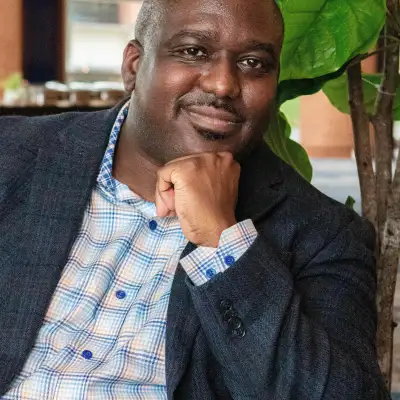
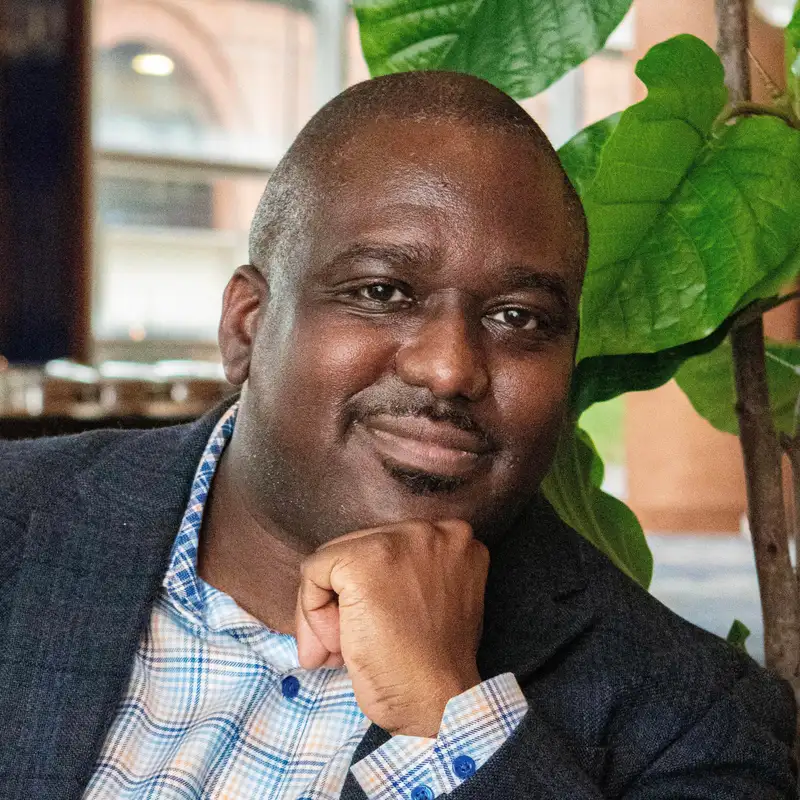
Dr. Lawrence T. Brown (The Black Butterfly: The Harmful Politics of Race and Space in America)
Download MP3Rob Lee: Welcome to the truth in this art, your source of conversations connecting arts, culture, and community. These are stories that matter and I am your host, Rob Lee, except no substitutes. Today, I'm excited to welcome my next guest on to the podcast. He is a scholar, curator, game designer, and urban futurist. My guest is the author of the Black Butterfly, the harmful politics of race and space in America.
He works as a research scientist in the Center for Urban Health Equity at Morgan State University. Please welcome to the program Lawrence T. Brown. Welcome to the podcast. Hey man, thank you for having me. Thank you for coming on. Thank you for making the time. It's truly a pleasure to kind of follow up. I mean, you know, what was it a couple months ago when we met formally in person, low inside baseball, formally in person, so now being able to like go back and kind of show off my thing a little bit and have you, you know, talk about your thing a bit, I'm really looking forward to it. Excellent.
Me too. So, you know, to start off, you know, going back just to Scosh, this first question I have, sharing our story in our own words, I think is vastly important. So while I, you know, gave that bio for you, I'd love it for you to introduce yourself in your own words. I have two follow-ups, but I at least want to start off there.
Dr. Lawrence T. Brown: All right. Well, I'm Lawrence Brown. I am a research scientist currently at the Center for Urban Health Equity at the mighty Morgan State University. And let's see, I've been with Morgan since September 2010, which interestingly, I interviewed in January 2010, and that was the last big snowstorm apparently that we had here in Baltimore, and we've had another one this past weekend. So, sort of, I was gone for one year. I was in Madison, Wisconsin during 2020 and came back, and it's just been a real ride, a real thrill.
I'm originally from West Memphis, Arkansas, and I think coming here to Baltimore in 2010 really grounded me, gave me a chance to grow as a person, grow in my career, and gave me tremendous insight into the topic that I'm really passionate about right now, which is like racial segregation and the impacts of urban apartheid on, in my field, which is public health, but I think generally speaking, well-being and welfare, particularly black neighborhoods.
Rob Lee: Thank you. And I think it's very important, very timely to, one, always sort of revisited, and I feel particularly privileged to be able to have the conversation and kind of pick your brain a bit. And so, going back, you mentioned where you grew up, right? So, you know, kind of coalescing a bit of sort of your background, research, scientists, and all. What's an interesting piece of data about your hometown?
Dr. Lawrence T. Brown: Well, my hometown, West Memphis, Arkansas. You know, it's just like a town of around 30,000 folks. I believe it's actually declining in population. I mean, Arkansas in general is a really rural state, aside from maybe Little Rock, the bigger city, but it's a fairly rural state, and like many small towns, you know, there's more opportunity elsewhere for young folks, and so when they get a chance, they usually leave. But it's a very, you know, there's like a history of the blues, blues musicians coming through there, and, you know, it's on the other side of the Mississippi River from Memphis, Tennessee. So, it has this, you know, sort of weird, in any other sense, it would be a normal suburb of a larger city, but, you know, it's really kind of its own place, and the small city feel, you know, that where my, a lot of my folks and family live and where I come from. So, it's a place that's near and dear to my heart.
Rob Lee: Love that. Love that. It's always important to really, you know, get an engage on where a person is from, and sort of, you know, setting that trajectory, I suppose. So, this is another thing that I gained or gathered from meeting a person, chatting with a person I thought in the background, so I must ask. What do you think about the term Afrofuturism, and what does it mean to be an Afrofuturist?
Dr. Lawrence T. Brown: Well, I mean, Afrofuturism to me is a very compelling term, because I think it's usually sort of defined as the intersection of like science, technology, race, and visions of the future that are grounded in black culture and the black experience. And, you know, I think for me, did you say, what do I feel about, you know, some being one or?
Rob Lee: Yeah, so to guess, you got the term across, so that's great. So, what does it mean to be one?
Dr. Lawrence T. Brown: Well, I mean, for me, and you know, some folks talk about being like a practicing Afrofuturist. And I think, you know, Afrofuturism can actually, I think, is usually associated with like film, media, but I mean, it can also be music. And I think the other thing is it can be literature, you know, it's associated more and more with fields outside or just like film.
You know, the classic, of course, preeminent example right now is probably Black Panther, the 2018 Marvel movie, and then Black Panther will come to forever, the sequel. But, you know, Sun Ra, being a jazz musician, I think is the iconic Afrofuturist, you know, Octavia Butler on the literary side, you know, iconic Afrofuturist. For me, I think I try to practice Afrofuturism through public health and thinking about like, how did we get where we are today, especially in terms of black neighborhoods, and where can we go? What, you know, visions of the future can we achieve in terms of, you know, having healthy, happy, whole black neighborhoods, you know? And I think that is informed for me by, you know, when I look at these productions, like when you look at Sun Ra, Spaces of the Place, you know, his spaceship comes to Earth, and he's talking about taking black people to another planet because the notion is, you know, black folks are going to be able to find justice on Earth, and, you know, it's a place where there's music, where there's joy, where there's, you know, magic. And so he's talking about transporting black people to a different land, a different space.
I mean, space is the place, and Earth ain't it. You know, I look at, you know, when I watched Black Panther in the theaters, I must have seen it four or five times because I kept going back. I wanted to see like the landscape, the skyline, you know, looking at the buildings, the architecture, the urban, you know, the levitating magnetic trains that were hovering and flying through the background. And there's a scholar, a lady named Michelle Melody, I believe she's South African, and she talked about, you know, the Afrofuturist City, this concept of an Afrofuturist City. I think in public health, I think for Black neighborhoods to be healthy and whole, we have to sort of conceive of an Afrofuturist City, a concept of a city that will overcome urban apartheid and create vibrant futures. And so I think you see that, you know, I created a comic book called Journey to the Abolition of Democracy, where we envisioned Baltimore as an Afrofuturist City and really tried to depict not Wakanda, we didn't want to Wakanda-fy the city. So we wanted to say, if we're in the year 2064, where the story is set, you know, West Baltimore, where the story starts out, has these row homes with cherry blossoms on top. There's green infrastructure on the window, there's green shrubs or boilage on the window seals, there's cars levitating. You know, you see the oriole as a mural, a raven on a mural, in reference to our sports teams and a greenhouse where food is being grown. And you have these solar panels that are in the place where you might find a nightlight on the side of the sidewalk next to the street. And so it's still very much West Baltimore, but it's visually, it's advanced.
It's futuristic. It's power, solar power, green food, green infrastructure, you know, a more vibrant neighborhood. So I think that's the challenge that I've tried to embrace as the affer features in my own practice is how do I, you know, partnering with my artistic, the guy who drew the comic book, Jordan Jackson, who is a tremendous, amazing artist here, you know, partnering with artists like him to sort of create that vision of the city so that the young people who are hopefully reading that can say, this is where the city needs to go. This is what we aspire to create in the future. And so I think that's what I want to do as an affer features is actually create the vision of where the city can go. And then hopefully young people will have that in their minds as they go about manifesting the future that we need to create for our city.
Rob Lee: That's really good. I think, you know, having a visual, having some representation of what it can be, it is aspirational, but also is aspirational with intent. But they often, you know, I talk about it from a media lens, like, I want to see comedy. I don't want to see the drug story. I want to see the sort of negative piece of it, you know, in a real story, you know, it's not like, but I think it's a bit more well rounded.
But I think having sort of the the breadcrumbs, the here's an example of it, you know, is is important. And before I move into this, this next question, you know, I go back to an interview I had with one of the creators of the show Southside, that's based in Chicago. And, you know, Chicago, Iraq and all of that. And it's like, you did a comedy show that still feels rooted in the identity of Chicago is super black.
And we're chatting and he mentioned to me off Mike after he arrived, he's like, so you're going to make one about Baltimore. And that's sort of the thing. Like, here's the blueprint of what this could look like similar to the similar rep, take reputation, similar demographics, I suppose, the smaller size. And it's like, maybe that's something that shows that it could be this as well.
Dr. Lawrence T. Brown: Absolutely. You know, there's that saying, you can't be what you can't see. And I think you can't create what you can't ideate what you can't manifest what isn't visualized before you.
And so I think that is absolutely I think that's the mandate of the Afrofuturist is to show people the possibility so that they can go about creating it. You know, because I think futurism, I mean, I've been a, I think I've probably been a futurist since I've been in the crib. You know, my mom told me I used to enjoy like Star Trek, you know, when it was on the screen as a kid.
And as I grew up, you know, I'm a huge trekker, I've watched Star Trek like all my life and always thought about, you know, like that vision right in Gene Roddenberry's vision of like a future where humanity is getting along and exploring space. And it just seemed like, you know, and that wasn't Afrofuturism, but it's a futurism, the former futurism. And so, you know, of course, there wasn't a lot of black folks there, especially in the original series.
But it was, you know, a hero, a hero still there, you know, still great to see the black guest stars that come on. And it's just like race isn't the stigma. It isn't the marginalizing, demonizing factor that it is today when you see that. So I think, you know, that's futurism in a broad sense. And then Afrofuturism as a subcategory of that, I think it's been a huge influence in my life.
Rob Lee: That's great. I joke about it on occasion of like, man, when I'm going to get my like flying car, can we get past the racist thing person and give me my flying car? Like, can we get there?
All right. So switching gears, a skosh to sort of like focus it a bit. So we have had that, which is like just wonderful, some, some background and get an idea of like, some of the stuff that makes you take. So what got you into research science, like starting off, like we all have our different stories. So what is there defining experience or people that influenced you along that way? What's that path for you? Well, I think for me,
Dr. Lawrence T. Brown: I was a student at the University of Houston. Well, even before that, that was my master's degree. But I was a, in my undergraduate studies, I was at Morehouse College and my degree program was African American studies. So I was pretty certain back at starting in 97 that, you know, I want to do something in connection to like the black community writ large. And then in my master's program, my study was, I was receiving a master's in public administration.
So I had the urban, the city, you know, government sort of angle to the mix I wanted to add in there. And I was sitting in one of those classes and I looked at the professor and I said, man, I could do that. Like, this is like, you know, I could be teaching, I could be a professor one day.
I think I want to go get a doctorate. Now, lo and behold, I had no clue that the guys that I was looking at at the University of Houston, they were very much relaxed and always looking like they were having a great time because they were senior professors. So, you know, they had already climbed the hill, earned tenure, you know, they were living the high life. And I didn't realize that there was a whole mountain that you need to climb as a professor from a junior level, you know, to earn tenure. And that, that was very stressful. You know, it's like, you don't earn tenure, you get booted from that university and you know, you're probably going to be an itinerant, you know, adjunct for life or something like that. So it was all or nothing for me.
You know, unfortunately, I was able to earn it tenure Morgan State. And it's funny because I was, I was in the movie theater at the Senator theater watching, I believe it was Pirates of the Caribbean. And I opened up my phone after the movie was over, while still sitting at the theater doing the credits. And I saw an email from the president, David Wilson saying that I earned tenure. And I sat there, I don't think I was fully sobbing, but I had a few, I had a few tears come down my face. I was out the release of, okay, I did it.
Rob Lee: Wash upon me.
Dr. Lawrence T. Brown: Yes. Yes. It all hit me in that moment. So, but yeah, sitting in the classroom, I was like, you know, I can do this, I can teach, I can write. And I didn't realize a lot more that came with it. But that was, I think the moment when I said, you know, I want to do that, I want to be in the classroom at the collegiate level.
Rob Lee: It's good. It's good. It's good when you have those, those sort of moments and those periods where you, you put in that effort, you put in that work and it's always glamorous. It's not always like when we have that point, like, you know, the point where you and I are having this conversation, obviously years, nights, sleepless, all of these different things, these different challenges go into it. And the same thing from, in a different level from here, like when I get to doing an interview or having a conversation with someone, folks say, man, how do you draw that out of a person?
That's like, I've been doing thousands of interviews or thousands of podcasts over the years. And not all is good. Not all is the, you know, sort of the best experience. And, you know, but once you get there and you're able to, to have the conversation and get to that, that stage, you get that, that feeling of being washed away with, maybe it's in the movie theater, maybe it's a few thug tears coming out, but it feels really, it feels really cool and it feels really good. And so moving into, you know, the phrase and the book, let's talk about that of that. Because I mean, it's not often, I mean, I'm in this lane of being called a philosopher.
I like to come up with my own philosophies, philosopher, fake philosophy. I'm not even handing by this corn phrase on. So if you will, tell us a bit about, you know, to open up a bit about Black Butterfly, like the phrase and the book, what does it mean to start off with like sort of the phrase and why make the book?
Dr. Lawrence T. Brown: Well, the phrase itself came about, I was looking at a racial dot map. That was the name of it produced by a guy named Dustin Cable at the University of Virginia back in 2015. And I looked at the map and I said, okay, East and West Baltimore, on the map, green dots represented African Americans. And these green dots, they were concentrated in the East and West Baltimore, and from the central part of the city and then flaring out to the edges of the city. I said, well, that looks like a butterfly. And I said, well, I'm going to call it the Black Butterfly. And at the time I was a social media warrior. So I just started using the term repeatedly, you know, and post on Facebook post, eventually on Twitter, when I joined later. But I named it that because I believe the year before 2014, Kendrick Lamar had released his album to Pippa Butterfly.
And the Black Lives Matter movement was in full swing. And I knew, you know, his notion was that something beautiful can be exploited, you know, this butterfly. So I knew that the butterfly was like in the culture.
And this, you know, from that album. And so I said, when I named it the Black Butterfly, I figured it was something that had a chance of resonating. And it did, although what took me by surprise was the way that local artists in the city, you know, embraced the concept. There were graffiti artists and muralists who would put the phrase, you know, on the side of a building next to 83, a graffiti artist put the L and the butterfly, you know, I believe in 2016. And you know, these two artists came to my office at Morgan at the time and they gave me this painting they had done of a Black Butterfly and then the shape of an L that was, and in the L there were clouds, it was like the Black Butterfly was floating, flying.
And they had, so they gave me the piece that I could hang in my office, but they had also created as a mural as well. And so that's what I started to see. Like, when artists grabbed the concept and they started running with it, it really, it blew up and became like this ubiquitous concept that people started using because I was told that they could, that it was something that if they grew up in Baltimore, something they had felt and seen their whole lives, but there was a name for it now.
There's a, you know, but it was something that it didn't come out of anywhere. They could recognize that it wasn't just a visual pattern. It was something consistent with their lived experience. And I think that for me was, it was always an honor to hear that from folks who grew up in Baltimore. And then for me, someone who didn't grow up, and when I would hear from other people that they were coming into the city, it gave them an introduction, you know, to the racialized geographic pattern of segregation in the city.
So that's really sort of how it emerged. And then by 2017, I was meeting with the editor at Johns Hopkins University Press, and he was like, you know, hey, you should put out this book. And when I was thinking about writing a book at that time, and I think we just had a meeting of the minds that if it was published by them, you know, my editor was saying, hey, this can, you know, it's going to be taken seriously.
And I said, all right, well, you know, I definitely want to be taken seriously. And so I started writing in January 2017. And then the book came out January 26, 2001. So that was a four-year period of 2021. Right. What did I say? 2020?
Rob Lee: 2001.
Dr. Lawrence T. Brown: Oh, okay. Yes. I would have been a time traveling writer at that point. I was just like, he does everything, even time travel.
Rob Lee: Right. Yeah. So 2017 is when I started writing January 2021 is when the book came out.
Dr. Lawrence T. Brown: And so that was actually a pretty momentous occasion or reflection point for me to realize, like, you know, this, my baby came out five years ago. Now it's like the age of a kindergartner. And I can see like how the concept has grown even further since the book has come out. But yeah, I think that it was about, it'll be 11 years this year since the concept was coined, but then the book came out five years ago.
Rob Lee: So, so in that, you know, hearing and thank you for that, because it really sets the stage and it's not like, Hey, you know, this was an idea. And then I was able to do a book like you just, you know, I get some of the goofiest ideas and goofiest offers.
Hey, you should just do a book. I was like, I feel like work goes into that. I feel like research goes into that. Obviously. So could you give us a peek behind the curtain of like, what that process looked like of, you know, bringing together sort of the book from a research standpoint and, you know, I have a follow up regarding like some key findings, but let's talk about some of the process of like bringing it to life from a research standpoint.
Dr. Lawrence T. Brown: Absolutely. Well, I had the great fortune of being able to visit and spend time in Baltimore's libraries and archives, you know, to help pull that text off. You know, the Baltimore City Archives, where I was able to visit an East Baltimore, you know, the place where they have like a lot of the mayor's letters and things they have written in the past, particularly Mayor James Preston. And I believe Mayor John Barry Mulhul, maybe I found a couple of his things there.
But, you know, those are the mayors that were architects of Baltimore's original urban apartheid laws. And, you know, seeing that going to the University of Baltimore Special Collections, spending a summer there, had a fellowship, was able to look at some like EBDI files, East Baltimore Development Incorporated, look at, you know, displacement, the Empowerment Zones, Baltimore Urban Renewal, Berha, the Baltimore Urban Renewal and Housing Agency. So finding a lot of files about the mid-century displacement that took place in Baltimore between like 1950, 1970. You know, so just at the end of Johns Hopkins Sheridan Library or Monument Street, a beautiful historical library there. The Baltimore Municipal Journal is there. So it's just seeing what the city was writing, especially in terms of health and uprooting black folks then and segregating black folks then in the city's official journal.
You know, so that's how it's there. So, yeah, I had the great fortune of being able to dive and spend time into these like wonderful archival collections in the city. And, you know, so of course, and I used to write in this closed now, I used to do a lot of writing over in Mount Vernon Marketplace.
Yeah. So I would walk over there because they had these high tables I used to love. So I didn't have to sit low. I could stand up or sit on the high stool and I did a lot of writing there. And that was in the early days. So, you know, things are buzzing there at the time.
And I like sort of having like a social environment. Oh, and then across the street from there at the time was called the Maryland Historical Society. Yeah.
You know, so yeah, like Baltimore has these rich like repositories. And I just had a chance to kind of be able to dive into them, spend time writing, researching and, you know, over the course of four years to pull the manuscript together. So that's what, you know, since then, like for my next book, on redlining, I've been visiting the National Archives down in College Park, Maryland. You know, taking like over 50 trips there. And I think next month I'm going to visit the Maryland State Archives. So, you know, like being able to dive into the archives, spend time, you know, studying and touching like these old documents, you know, papers and manuscripts that are like over 100 years old.
For me, that's just a magical feeling. You know, it's like, you know, Indiana Jones or something like going and making some crazy new discovery or something that people don't realize, you know, to be able to find evidence of something that people didn't quite know. And now you can show for certain, you know, here's where the government is saying this or here's where, you know, it's an official document. So we can, you know, it's not just something Dr. Brown is saying, you know, those kind of finds are always like a magical discovery, a magical time. So I'm very fortunate, like that my writing process has allowed me to, or I've had the time, and the wherewithal to be able to go to those sort of places.
Rob Lee: It's great. And, you know, it's a thing that popped in my head and I wanted to let you cook, because it was really like getting me because, you know, we're in this era now where someone who's researching learning, studying and putting in, you know, you said 50 plus trips, right?
That's coming up for this next book. And I find like it's really funny, like, I can remember stuff from five years ago. I remember that from 10 years ago.
I might not remember the exact detail, and I'll likely look into it a bit further from reputable sources. But someone will just post something online. It's like, I discovered this. I was like, that's not even the story. Like, what are you saying? But it's for fresh in, I suppose, to hear like someone's like researching. And there's a, it's a follow up question that has to do with this.
But there's a sort of degree of validation or, you know, even further inquiry into, so why is this this way? Let me go here. These are the places like the Indiana Jones things you said is so important. And one of the things that I like, being able to do this podcast and tapping into some of the areas growing up here, there were certain places that because of what I look like, and maybe some of the, the parti component you discussed earlier, oh, I can only go east to west.
That's pretty much it. And then finding these other areas of the city that is so like rich and so full that you don't even know that you can go to. And applying that sort of approach to other cities that I go to, and I feel like it adds to the well roundedness and let alone like interest and stuff that I'm, you know, have the capacity to learn.
Dr. Lawrence T. Brown: Yeah, I mean, you know, education is a powerful thing. And, you know, to be able to, you know, discover and to go through that process of discovery. There's something for me, I think that's just really romantic about that, you know. And, you know, for Baltimore to have so many rich repositories where you can go do that, you know, I always urge, oh, you know, miss, I'll be remiss if I didn't mention the Enoch Pratt Central Library, you know, the Maryland room and African American Studies room, you know, so these like rich repositories all over the city. And Baltimore is a historic city in and of itself, you know, compared to a lot of other cities, especially the cities where I'm from, like West Memphis or Houston, you know, Baltimore is a much older city, you know, going back to the Star Spangled Banner and, you know, the antebellum period, things of that age.
So like Baltimore, you know, it occupies a special place, I think, in American history. And to be able to dive into that, I think, you know, it's been a thrill of a lifetime. Yeah.
Rob Lee: And, you know, kind of like putting a pin on that point there, I was able to go to an event in Ohio like two years ago. And I just remember I did like an intro spiel whenever there's a live talk. I don't know what the hell to say. So I was like, all right, let's do some crowd work.
Let's be a wrestling heel. Let's just diss the city that I'm in, but jokingly. And I talked about Bear City of Louis, Columbus, Ohio. But I talked about Baltimore's history, because I was like, you could probably hear the accent. I don't have it, but I'm sure you guys are going to tell me once you feel like it, once you realize I'm from here. And I just talked about some of the firsts for Baltimore that are often not a part of the conversation when talking and discussing Baltimore.
And secondly, I'll say the sort of archive, the repository, but peace is a consideration in doing this, you know, like the majority of these interviews are based here. It's a moment in time. It's over now. It'll be a seven year period in July of covering these interviews, and it'll hit a thousand interviews soon. And the five, six years ago, when they were doing this in their work and what was happening in the city, to now and where they're at in their lives. So it was really interesting to catch that time and have it documented in the most, the most and my interest is the most authentic way.
Dr. Lawrence T. Brown: Yes, that's if you capture people like before COVID in that seven year period, you know, so much is changed since then. So like you're creating an archive. And I think, you know, when I think about everything that's happening now in our country, I think libraries and archives are some of the things that make America great.
I mean, in terms of whatever is great about America, there may not be a lot that's great, especially from an African American perspective. But I think that having the record Having the documents that show what happened, whatever it may be, you know, I think as long as you have the freedom to investigate your country's history and to tell the truth about that history, there's something that's still great. Now the moment that's gone, you know we're in trouble. I mean, we may be in trouble regardless, but you know, I think if that disappears, you know, which is definitely my concern about the National Archives, will the access be limited or will files disappear?
You know, will staffing be diminished? You know, these are all sort of questions that I have, but I think that having access, you know, being able to maintain libraries and archives, I think it's a tremendous, it's a tremendous indication of whether or not you have a healthy democracy. And so I think that's the powerful thing about libraries and archives here in Baltimore for me.
Rob Lee: So I'd be remiss if I didn't ask this. And you know, I want folks to obviously, you know, check out the book and kind of get the details in the full scope because it's important to read and build out, you know, all these things and have access to these resources. So if you were to kind of pin it down to two to three, like, you know, for the listeners, mostly a Baltimore audience, what are some of the key findings, you know, from making, you know, the Black Butterfly the harmful politics of race and space in America? Like the rhyming there?
Dr. Lawrence T. Brown: Yeah. I think for me, you know, I really highlighted, you know, his historical trauma as this concept, academic concept that a Native American scholar named Maria Yellow Horse Braveheart coined to really talk about how historical trauma has an impact on the initial generation that experiences it and then this intergenerational impact that, you know, goes forward through time where people, the trauma can be essentially handed down. Although it's not necessarily a genetic sense per se, even though the field of epigenetics has some insights about impacts at the molecular level, but how the trauma that I'm thinking about is institutionally handed down. So institutions and structures replicate, you know, slavery becomes Jim Crow and Jim Crow is the new Jim Crow.
So as it mutates, it keeps inflicting trauma on communities, these systems of oppression and domination. And I really tried to highlight, you know, the concept of hypersegregation and the way that being in a hypersegregated city of which Baltimore is included in that category, that that's going to result in devastation for black neighborhoods. And so I took the liberty of using, like, hurricane categories to have category one, the city has a low level of segregation, category two, moderately segregated, category three, highly segregated, and then categories four or five are hypersegregated. And using the convention of social scientists like Nancy Denton and Douglas Massey, and Baltimore is one of eight category five hypersegregated cities. So we're in the most, we have the most intense form of it, along with cities like the one you mentioned earlier, Chicago, Detroit, Flint, St. Louis, Birmingham, and Milwaukee. You know, we're in that category of the most highly hypersegregated cities.
And so it's just talking about, you know, you're going to see the highest, maybe amounts of crime, which is connected to lead poisoning, which is connected to, you know, redlining. And so the pathologies that maybe are usually associated with urban areas, my point was that hypersegregation intensifies all of the negative impacts. So I think between historical trauma, hypersegregation, and really just talking about like Grandmaster Flash, don't push me close to the edge. You know, I want to talk about how black neighborhoods get pushed to the edge. What leads to an urban uprising? I wanted to help explain how do we have, get to that point where there's an uprising after the death of Freddie Gray at the time, and how I felt like we were coming up to some sort of explosion politically in the country. I felt like there was something getting ready to happen. And sure enough, just a few weeks before my book came out, January 6th transpired. And so, and last week, you know, earlier this month, Renee Good was killed.
You know, another young man in Minneapolis. And so we're in this period of intense conflict. And that was another thing that I wanted to explain at the time that I felt like the country was headed there. And I think since the book has come out, you know, it's been manifested.
Rob Lee: Yeah, I think, you know, I'm a data analyst in the day job. And, you know, I tend to think in terms of what are root causes for these things? Like, you know, not saying that it's going to be definite this or definite that, but at least asking the questions and trying to look for it. And I find that, well, some people are just bad or some things are just bad. It's like you're not putting enough effort into it.
You're not using the skills that you're capable to dive into this a bit further. And you can see some of these things. So when I'm in different places and want to have these sort of local pride, you know, being from here, when someone talks really wild or they talk in a way that's not representative of the city. And I get caught because it's like, I know better.
And I apply that same sort of mentality and philosophy to other cities. It's like, there's a story under sort of the official story. So let's hear it from the people. And it's like, you know, going back to as you touched on with sort of Freddie Gray and the response and everything that was happening here. I was part of a podcast network and there was a young lady within the network who was talking really ill about the city. And I was like, hmm, technically a coworker and you're in New York. Why are you talking so wild?
I didn't just burn that bridge. I like difficulty ashes afterwards. And it was just one of those things that's like, this is a real thing. This is not a bit. This is not a social media sort of, you know, talk piece. And, you know, really wanting to understand what's happening in a place. And there are so many things that separate people and it's something.
I think one of the perhaps easiest ways to fix some of that separation is just to empathize and listen and try to not say you're doing your own research, but actually do it with real intent and look for reputable sources and things of that nature to really say, OK, what is happening? Wow, that's like the Chappelle bit. You know, beating up Negroes like hotcakes. It's like, oh, you're just realizing that.
Dr. Lawrence T. Brown: Yeah. And I mean, I think that the, you know, everything that we see happening in America now, I hope it's evident why there has been such an attack on black history, why there's been an attack on, you know, libraries, on archives, you know, Library of Congress, you know, has gone through its changes since last year. So just, you know, understanding, you know, my theory is that the attack on black history is not about black people.
It's about preventing this information from reaching white children because if they learn America's history, they have the numerical wherewithal, the demographic wherewithal to help push this country in a different direction. And so I think that's why there's power in education. There's power in learning the history of the country and having a critical understanding of why things are the way they are. That's very important because that's the thing that's going to transform this country. That's what gives this country a chance to transform and move in the right direction.
Rob Lee: That's really good. And thank you. You actually asked one of my later questions. I was kind of knocked out. I appreciate you on that. So I got two more real questions I want to ask you. And this is one going back into the research piece. You know, at times it seems like we see something as it relates to race, a systematic racism, or systemic racism, rather, in this country. And we're met with sort of hostility and disbelief.
It can't be that bad. That's not what's happening. What's something that perhaps you kind of regret learning, but it was kind of like validating. It's like, I wish I didn't know that, but I'd rather have the information that's pretty validating. And sort of maybe how you look at sort of how you approach research moving forward. Like, sort of some of the stuff that you learn keeping those warts and all in your work. Okay. Well, I think what's been, you said validating.
Dr. Lawrence T. Brown: I think the term I might use is gas lighting that I've learned in the archives, you know, when I see the evidence of how it was constructed, how Dr. Homer Hoyt wrote instructions saying draw a red line around the city where the undesirable populations live, you know, to find that document. And to find the maps that I think are the sort of earliest maps that show red, yellow, blue and green. That pattern with the legend that says the green is the best. Blue is still desirable. Yellow is definitely declining.
And red is hazardous to find, you know, like the earliest version. So I can create an accurate timeline that I think most even scholars have not had. For me, that helps to address the structural gas lighting to show and be able to demonstrate.
Oh, this is not only real, but it was very intentional. And to find the journal articles and the newspaper articles where they were sharing the information where they were patting themselves in the back saying, yeah, we demonstrate these maps. To hundreds of banks that would have never otherwise known about it. You know, so they're taking credit for having spread it to the private industry.
For me, that has helped to truly erase and dispel the gas lighting that I think is so preeminent in our society. Because without it, there's always, you know, a gap. There's always a question.
Well, what about this one? And it's like, now I can just, here's evidence. Right. This is what the government said. Here's a government document. And I think that's that's incredibly, that is affirming. You know, it does make me feel like my work is not in vain.
Rob Lee: That's great. That's great. And that brings me to sort of my last question that aligns with what you were describing there. I believe that there is a game, if you will. I don't know if there's a game as much as like, huh, I left out of there like, this is what's happening.
This is my neighborhood. So I had the chance to play urban cipher, a part of which I like to call the, the LTB extended universe. So someone start calling it all your, it's like, it's an extended universe. So could you talk about urban cipher a bit and sort of other means that you use because I, you know, you touched on the comic piece. So other means that you use to continue the conversation around urban apartheid.
Dr. Lawrence T. Brown: Well, I think, well, my lieutenant, he calls it the black butterfly educational universe. I like it. So I love that pointing of the phrase where, yeah, I feel like, you know, whatever, you know, I want to bring knowledge to people. And I wrote the black butterflies almost 400 pages of, you know, almost strictly narrative text. But it was like everybody doesn't read.
So they may not read a big book. How about a comic book for young people? And that's actually what the artist who came in my office to give me the mural.
One of the gentlemen said, Dr. Brown, you need to get information to the youth. And I was like, wow, you're right. But I didn't have a concept of how I was going to do that. But eventually, you know, as I was getting more and more into comic books after Black Panther came out in 2018, in my 40s, that's when I finally got around to comic books. But I was like, you know, let me check this out. I was just, you know, peeping the medium. And I was like, yo, this is incredible.
Like you can get across very serious, important information through this medium. And so I was like, well, why not create one? So I did that with the comic book, with the board game. I'd often been using in my classes at Morgan State these, I was just rigged normal games like Sorry or Trouble, because they had red, yellow, blue and green pieces. So I was just rigged the game. So I had the concept for quite some time, but I was like, let me monopolize it.
We're not going to fight it. Let me, let me, because now I can show neighborhoods on the board where people are moving their piece around, you know, the red, yellow, blue and green pieces. And it is a, you know, I tell people after they play the game is that you thought you were playing a game. It's really more of a simulation. It's more of a simulation of real life.
Because of course, red and yellow struggled, blue and green flourish. So it really is a simulation. And I find that, you know, of course I can give a PowerPoint presentation. I can lecture all day. You know, that's what I do as a professor, but having people to embody the lesson.
I've found to be just much more impactful. They're not going to forget the red player doesn't forget what it's like to be completely marginalized. And what's really interesting is that people who are from red communities in real life, when they play as green in the game, they don't forget that either. I had one brother after the game, this black man, he waited until everybody left. And he made a point to stand there. And when everybody left, he said to me, I wish it was like this for me in real life.
He had played as the green player. And he was just very earnest about that. Like, what a relief it all came so easily. He could provide, you know, he could make things happen. And coming from a red line community in Baltimore, that was a liberating experience for him. And I thought, you know, like, wow. Well, that stuck with me as far as the green player.
What stuck with me from my most impressing memory from a red player in a date in Ohio, I had the game for a symposium there. And this little girl, while facilitating, they said, Dr. Brown, this little girl is crying. Okay, well, I don't know why she's crying. But she comes up to me after the game and she gives me this sheet of paper. And the sheet of paper says, it has her writing where she wrote, I thought we were going to win.
But we didn't. And then she put no from red. And she had two six figures because she had played with her and her mother as red two six figures and they had tears coming down. And that that is really penetrating my heart. Like, you know, she's like four or five years old. And this little girl, you know, it was impactful to her because he thought most games are fair. So surely we have a fair chance.
And here we are as a red player, we have no chance. And so that was why she was crying. And that really that stuck with me. That in a way, the game is also about empathy. It's about people being in the shoes of that character or that color of the neighborhood. And when it doesn't are well, whatever your lived experience, I think it can have some very interesting effects.
Rob Lee: It was funny playing the game that my I think I was either blue or green and literally my neighborhood, which is across the truth from where we were at, it was like kind of in a red spot. And I think my my partner's neighborhood was in like a nice spot. So whenever there was an opportunity coming around of stuff that I would do, I was like, I'll damage my own community. And I was like, I might be a bad person.
I'm like, I just kind of win the game. But it definitely sticks out as to as you touched on the empathy piece and sort of how it how it relates. And it's powerful in that way because it really illustrates it. And, you know, before I kind of like wrap up on all of the real questions, the last thing I'll say with it, experience is stick with you a bit longer than just seeing it here.
So, oh, that's great. I find that I do a lot of this. I do a lot of talking podcasts, a lot of conversation. I find that it's better when the guest is talking than me trying to steer that ship the same as in the last two plus years doing the lecture, doing the podcast ad junk thing and teaching. I'm like, it's better to do the experiential thing and have the folks who are doing it.
Yeah, I can sit here and just talk about this is how you turn a microphone or microphone on or the stuff that I've learned. But if the folks experiencing it, it will stick with them longer, you know, by just doing it.
Dr. Lawrence T. Brown: And that's the thing I think as a professor, as an educator, what do you want? You know, do you want to just get your point across or do you want your audience or your students to remember what you said? And I think that's why hands on is vastly superior whenever you can use or put a lecture or whenever you can deliver your content in that way. Yeah.
Rob Lee: I want them to be able to wax one wax off. Do that. So I got three quick rapid fire questions and I want to get some sage sage advice from you and we'll wrap up. So here's the first one. So what would be three books you suggest reading? There's one caveat. One of the books has to be a comic or graphic novel.
Dr. Lawrence T. Brown: Well, let's see, three books. I do. Well, I love this. Well, I think one of my favorite books is a W. E. B. Du Bois American Prophet by Edward Blum. Du Bois, I think is the greatest social scientist ever. And Blum's book actually highlights his religious life and his religious sort of self. And I think a lot of people view Du Bois as his austere academic, which he was, but he also had like a religious dimension or prophetic tradition to his work. So I think I love the way that work illuminates Du Bois in a richer sense. There's another book of Fannie Lou Hamer's speeches, which I think is terrific because I think she was like she had this such a southern eloquence, you know, very direct. And, you know, she's probably the flip side of Du Bois where Du Bois was probably trying to, you know, could use all these words academically and, you know, Fannie Lou Hamer's like, she's getting right to the point and it's powerful.
And then I think a graphic novel, I might have to go with Invisible Kingdom, which is a great sort of story that is set in the future, but you can read the corporate commentary as maybe a criticism of or critique of Amazon, if you will, in the story. And I think, but it also has a, it's about a nun who goes into a convent and learns that the convent, everything is, folks aren't as faithful to the faith as she is. And so religion is also, I think, a very central to that story as well. So, interesting. Actually, all three probably have a religious dimension. So, yeah. Good.
Rob Lee: So, this is the next one. And you've mentioned, you mentioned, you mentioned a theater a couple of times. I got to ask, what's your favorite movie?
Dr. Lawrence T. Brown: Wow. Well, Deacon for Defense with the Forest Whitaker. Okay. If I'm not mistaken. I love, because he does this thing where, you know, he starts off like very subservient, upsequious, and, you know, it's just sort of like, he has no spine. And to see the transformation, you know, into this freedom fighter, you know, in the deep south, facing the violence and the brutality of the Ku Klux Klan. And to watch his character transform, that's quite a delight. So, yeah, I think Deacon for Defense, I haven't watched it in a minute, but that's like, very much at the top of my list.
Rob Lee: And here's the last rapid fire one. What's something that you're good at? It can be anything. Something that you're good at, but you do not like doing.
Dr. Lawrence T. Brown: Something I'm good at. Well, increasingly, I like to think that I'm good at CrossFit, which I've been doing. Wow. Tomorrow will be 21 months now. But it's often, it's often, I'm often debilitated.
Rob Lee: Why did I do this?
Dr. Lawrence T. Brown: I mean, the first week I was sore for like five days from one workout. And I still get sore because the workouts are never the same. So it's like, I'm still in sore, which I don't like, but it's part of the process. And I'm usually the slowest one in the class. So I'm not good at it. But if you're measuring by speed, but what I do like is that I do finish. It takes me longer.
I may be three or four minutes after everyone else finishes, but I will finish the prescribed workout. So it's brutal, but I do love the notion of figuring out, especially early on, I didn't know I could do that. I didn't know I could do that.
Rob Lee: As you pause there for a second, your shoulder started hurting. I was like, ah, yeah, exactly.
Dr. Lawrence T. Brown: Right now, right now. My shoulder was like, oh boy, are you sure? There's something about like the positive peer pressure. You know, it's like, if you asked me to do it, if I was just in the gym by myself, I would never do 90% of the things that we do. But like once I'm around other people, I'm like, well, they're doing it. I can do it. If they're doing it, I will do it because we're doing it together. Something like that kind of kicks in.
Rob Lee: I look at it with the side, I'm like, you sure? Because it's the equivalent of we have like an office job or something. We're like, hey, do a trust fall. I was like, hmm, I'm not tall.
Dr. Lawrence T. Brown: You won't catch me.
Rob Lee: This is going to be embarrassing and I don't want it filmed. Right.
Dr. Lawrence T. Brown: And I think that's part of my thing. Why I go slows because our slower as I'm often thinking, well, this is crazy. So let me not injure myself in the process. You know, so let me if I'm stepping up on this box, I need to make sure I'm all the way up on it.
Rob Lee: There's like, Dr. Brown, we need you to do some reverse burpees on a box. You're like, what? Why?
Dr. Lawrence T. Brown: Actually, I do them on the box. But when they talk about flop on the floor, I'm like, oh, I can do like, I'll do them in warm-ups. But then when the real work I come, I'm like, give me that box. I do not want to hit the floor for 50 burpees, 50 burpees.
Rob Lee: Can't fade it. Can't fade it.
Dr. Lawrence T. Brown: Oh, man. I'll do 10. I do my 10 and then I'm like, all right, I'm doing the rec elevated on the box.
Rob Lee: Here's the last thing I have for you. This isn't that wheelhouse of sage like advice. So in 2026, I think just what my observation has been, there's a malaise, folks are retired and anything outside of the normal day to day seems like a project. It's like, I get up and do that.
I don't want to do that. What is something for in sort of the vein of the conversation we've been having today? What's something that listeners of this podcast can do right now to be more community, civically, socially, racially engaged to kind of help envision sort of a better situation? I mean, you said malaise.
Dr. Lawrence T. Brown: You know, I think about when I look at what's happening with ice and these portations and everything over the past year. You know, I think a lot about the black community by and large. They're always exceptions, but by and large, I feel like I don't know if it's malaise as much as what I'm calling strategic silence. It's the FAFO.
Rob Lee: Yeah, that's that's that's that's that's okay. We we voted in a whole different direction. And now Americans have got to find out. You just got this is what you voted for.
So you're going to have to experience these consequences. So I think, you know, I what I wrestle with are and maybe the sage advice that I that I do offer is that some point I think we're going to have to engage. I think at some point we're going to have to flex. It's probably not time yet. I think it's so it's a weird.
It's a weird stage of ice. It's weird to say less. Let's stay on the sidelines a little while longer. But in the meantime, we should be, I believe, you know, preparing our communities preparing our finances. You know, strengthening our relationship with our neighbors. We should be engaged in sort of a mutual aid operation. You know, how do we survive if the grocery store is fall down or if the shipping and logistics, you know, like what are we going to do if certain things go awry?
I think people should be planning. Unfortunately, I mean, I'm at the notion where I feel like unfortunately we're on the precipice in this country. We're on the edge of something. And I don't know which way this thing is going to go.
So I think the, you know, this national stage advice, the audience is safe device to myself to like, you know, hopefully to, you know, get prepared, be prepared. I think we're in for a wild ride here in 2026. I think the whole democratic experience experiment, you know, is on the line, you know, whether or not we're going to have midterm elections this year. You know, whether or not we're going to persist.
We who believe in freedom as the song goes. So I think, you know, we're in perilous times. I think, and that's one reason, honestly, that's one reason why I'm in CrossFit because like I want my body to be better prepared. You know, I want to, I think we should be getting fit. I think we should be, you know, doing what we can and strap in.
That's my stage advice strapping because I think we're in a quirky space as a country. But I don't think we're at the point of no return yet. I think there is still hope. And I think when I see folks protesting in Minneapolis, and I think even the way they push back on some of the narratives that are out there about the people that they are. And I think they lost in the way they were being demonized and vilified in the media.
And the way that they've been able to say, no, that's not who they were. This is the truth and stick to it. I think, so the truth, we have to keep speaking the truth.
We have to keep pushing, you know, evidence. Back to the, you know, that's the thing that a researcher will aim and strive to do. And I think, you know, that's where when you see people, you know, using their cell phones to capture footage in the midst of conflict, you know, evidence is very critical. So I think, you know, being prepared to do things, you know, capture evidence to being prepared physically mentally. I think we have to sort of strap in and be ready to be resilient to sort of persist even in such a pressing moment.
Rob Lee: I relate to that so much. And, you know, as I've said, I don't know if I said it to you previously, but, you know, this podcast was born out of that regime that's there that said a lot of wild things about this city, Philadelphia.
And I would just say in sort of my simpler terms, just black cities, because you're not talking about the infrastructure. And, you know, and when this sort of as they say, he spun the block, and I was just like, we got to have a degree of stoicism with it, but also strategize and be ready. You know, it's like we've seen this before, but we, you know, as a country, we bought the same trial package. And, you know, you're right. It's like, you know, you, you, what's the word? What's the phrase?
You stay ready, see how to get ready. And I think being able to organize these things and being aware of sort of the health thing, all of the things that lead to this full population situation that's all been turned in a bizarre world sort of way. You know, we have a weird food pyramid now.
We all these different things. And it's almost like, you know, literally in a real legit way, doing your own research is the thing that's going to save you in some ways. And I think that's so important and I relate to it in such a way is really, really important. So that's kind of it for today. So thank you, Dr. Brown for coming on and spending some time with me. This has truly been a treasure, been a treat. And in these final moments, I'm going to invite you to share with the listeners where they can follow you, check out your work and all of that good stuff, website, social media, any of those things. This is the shameless plug portion. So the floor is yours.
Dr. Lawrence T. Brown: Well, you can most readily find me on Instagram at black butterfly dream lab. All one word black butterfly dream lab. Check us out. You know, you can see a lot of, you know, you see the video game. I mean, the video, we want to have that one day too, but you can see the board game. You can see the the comic book. You know, you can see a lot of what we're doing. You know, I'll be posting about the upcoming book that I'm working on with red lining, but at black butterfly dream lab. That's the best place to go.
Rob Lee: They have it folks. I want to again, thank Lawrence T Brown for coming onto the podcast and sharing some insights and his background with us. And for Lawrence, I am Rob Lee, saying that there's art, culture and community in around your neck of the woods. You just have to look forward. Yeah.
Creators and Guests