Glass Artist Dany Green on Chaos, Order, and Letting Things Break
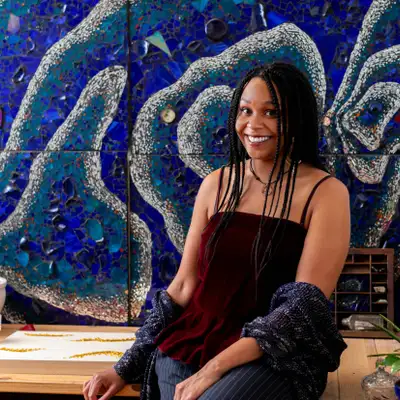
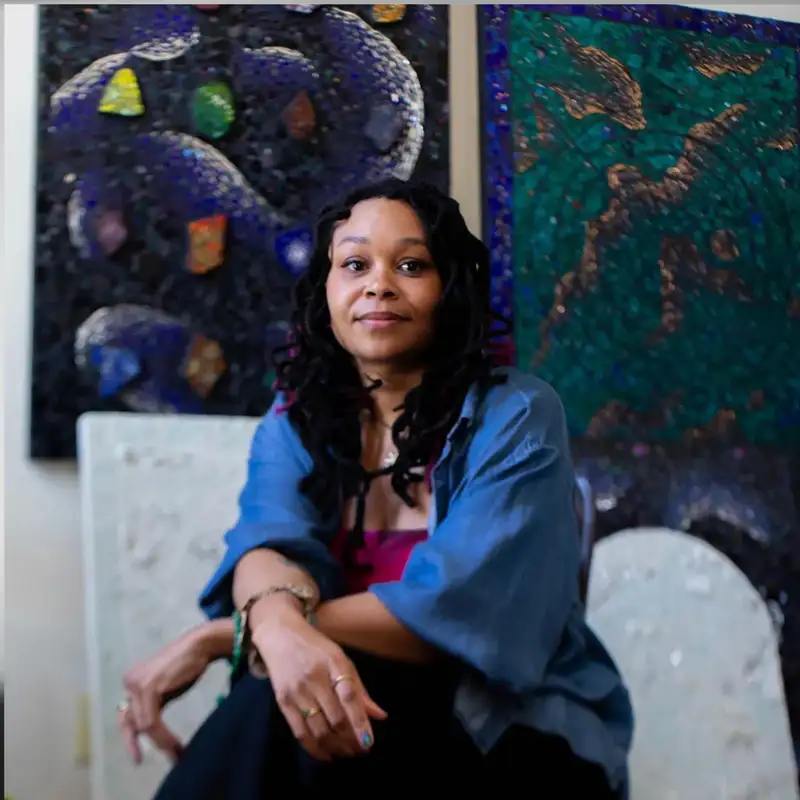
Download MP3Rob Lee: Welcome to the Truth in this Art, your source for conversations connecting arts, culture, and a community. These are stories that matter, and I am your host, Rob Lee. Accept no substitutes. Today, I'm excited to be speaking again with a self-taught abstract glass artist based in Baltimore, Maryland. Working outside of traditional mosaic training, she's developed an avant-garde technique she calls glass painting, building each piece a shard by shard of response to light, chaos, and the intangible. So joining me once again is Danny Green. Welcome back to the Truth in this art.
Dany Green: Thank you so much for having me back. I'm very excited. Like I I think it's been, I don't
Dany Green: know, like five or six years or so.
Rob Lee: That's you're that means you're one of the that early, but like as I get closer and closer to 1000 episodes, I'm like, oh right, ghosts of creativity past in some ways. Right.
Dany Green: I know. It's been a whole world away, honestly.
Rob Lee: But um one of the things I like to to do when I um start out these pods and and go into sort of you know those first questions as I start peppering them in your direction. Um since it's been a bit, I would love it for you to reintroduce yourself, reintroduce your work to the folks who may have unfortunately didn't listen to the first interview. Shame on them. But um tell them who you are and what you're doing these days.
Dany Green: All right. So I am Danny Green. I am a mixed media abstract, fine artist. Um I primarily work with stained glass. Um I use a lot of mirror, found objects, and you know, most of my artwork is themed around cosmic themes, themes that deal with the celestial bodies and um natural bodies, um, natural um patterns and formations. There's a lot of my inspiration, and yeah, I'm very excited to be here. Thank you for that introduction.
Rob Lee: Um excited to have you back. It's it's truly a treat. And uh one of my favorite um interviews early on in this series, so uh, you know, when I go into this first question, uh I find like when I get hit, I I have like a a save file in Instagram, right? And I go through all of these different places, like that's insightful, that's a good observation.
So there's an old interview with the actor, uh, Keegan Michael Keith from like um, you know, uh Key and Peel and a bunch of different movies and I think Mad T V back in the day, where he describes how art can how art should reflect life. It's a mirror. As an artist working with glass, reflective material. Um, what's your take on the goal of art? Hmm.
Dany Green: I think that's that's a really great question. I do feel like art reflects life. So I definitely agree with that, and I think that's because art is a part of life.
Dany Green: I think it's very hard to really separate creative endeavors, creativity from being human. I feel like it's intrinsic like breathing is, you know, it's it's it's a natural impulse that we have. I think the idea of art as a goal to me feels a little bit more like if you're trying to pursue it professionally or you're trying to make money from it. But as far as making art and making things creatively, that that is intrinsic. So I think they're intertwined, and I think that the when people create, it it's it's a desire to kind of express what they're going through, express what they're doing, what they're thinking. I know that's definitely the case with me, that's for sure.
Rob Lee: It's insightful. It was insightful. It's it's always an important to kind of check in on it, because we we get into these very I don't really have a goal in mind, or it's you know, it's a thing that I do, and it's like it it may be something that's super personal. It may be, you know, when people talk about like what success looks like and so on, and you you I've had this conversation last week, what does success look like in what you're doing?
And I try not to sound gauche or what have you, but I'll just say, you know, the ability to continue doing and continue enjoying and continue to love it. And that seems like successful for to me. And then it's like, hey, what's the goal?
The goal is to archive these things to have these conversations, and it doesn't seem like something super weighty or something business-y, but I think it's personal, but uh thing that you can also articulate.
Dany Green: Yeah, I would agree with that, and I think on a personal level, like when I decided that I was going to pursue this more seriously, um, I did have to think like what are my goals and what what are kind of my what is my kind of thesis that I'm gonna approach this career with. And I decided that because I felt like it would keep me grounded if I had these kind of like core principles, right? And so when I think about me personally and my relationship to art, I would say that I want to change people's perception on different mediums, right? So I'm working in a primarily non-traditional fine art medium, so the more traditional past would be oil painting or um, you know, drawing, and I'm working in stained glass and and mosaics, and so that that already puts you in the craft category, not necessarily the fine art category. And so changing people's perception in fine art is important to me, um, uplifting, you know, to some degree um the medium that I'm working in and using a lot of found objects. Um, and then another one is just to really just um my main goal is to create a sense of awe.
So a sense of like you look at the work and you just feel like, whoa, this is different. And I think that awe is an incredibly special, unique emotion that we only feel when we're taken out of the present moment and we're kind of put into this like otherworldly, like middle space, you know, and I think it's a very it's the kind of thing that you find when you're meditating, and I think that the more times that we can step into that space. I think that's the space that people even refer to as like the flow state. Like it's that void like space, I think the better off we are. So I'm offering my art as as a as a resting place for for people's, I guess, energy to some degree.
Rob Lee: It's great. It's great. You know, we you when I think of um space, I think of these different locations, and there is a an energy that's there, like, and as I was saying before we got started, uh spending time and doing interviews in person, it's a different energy. It's like this is this is great. This is fun. We're we're doing this for for transparency, we're doing this via Google Meet.
No, that's not a plug. Uh, but we're we're doing it in sort of virtually, and you know, a interview in in in space is um just there's an energy there, it's palpable, it's it's just different for whatever reason, not necessarily better, but but different. And where I spend the majority of my time in doing interviews is between Philadelphia, Baltimore, where I'm at currently, and um Washington, DC. And when we last talked, you were based in DC, the DC metro area, and now you're in Baltimore. So talk about sort of what that has been like that that move to because they're different areas, they they have their different energies, their different art scenes. So talk about what Baltimore's been like for you. 100%.
Dany Green: I mean, I've been here for about a year and a half in Baltimore, and you know, I was living in DC for 10 years. That's when we had our first conversation, and then I actually took um a short little side trip to New York, funny enough, because I I was just at this really weird juncture in my life where I was kind of like, what do I do? Like I'm living month to month, like I just felt a bit lost, and my sister was living in New York, and she's like, why don't you just come live with me?
Like, why not? Like the rent's the same, like you've always wanted to live here. And so I I pivoted, I went over to New York, and then um had a pretty rough transition, you know, long story short. And you know, I was struggling to find kind of a place there, and then when I got the opportunity to work on a big mural project, um, with someone I had met in DC right before I left in New York, I was like, oh yep, I'm ready.
Let's let's do this, let's move again. And so I moved to Baltimore, and I really enjoyed my time here a lot. Like I think it's a very good fit for who I am as a person because it's a very like I find it to be quirky, a little bit weird and funky in a way that honestly reminds me of Philly, because I'm originally from the Philadelphia area.
Um, and so there's something nostalgic about the energy here. There's a lot of artists, like I'm right by Micah as well. So, you know, I feel like this is a great place to be a working professional artist. It's very affordable to get a a space to work in and to live here in a way that neither New York nor DC was. But I also get the you know, I'm able to still be connected to DC, which is amazing because there's so much opportunity in DC. Like I just had the Fenn Fair.
There's been umbrella in the past. There's a lot of like, you know, I'm a finalist for the DC Art Bank. Like you're still able to really be connected to the benefits of being DC, but also have the support of like a really robust artist community in Baltimore. So I I'm I'm just living the sweet life right now.
Rob Lee: I love that. I love that. I like I like when people like give Baltimore it's it's propers as the uh the the older black folk will say the proper not the props, but the proper's uh and you mentioned there, so I'm gonna skip ahead because it's it's precious and it's timely.
You you mentioned um the film art fairs, so that's a fair built around women as artists, economic forces, and where sales go straight to the artists. I made made a point to pop over there on uh Thursday, and pretty much I was like, I've interviewed like seven or eight people here. You know, I was like, all right, I found some more people and I had like a laundry list of folks that I'm gonna interview in the near future. So talk about that experience, it what it meant to be in the room with like other talented artists that either you were aware of, either you've gotten some kinship with, but what was that experience like?
Dany Green: Yeah, it was uh honestly a really great experience. Like I've worked with um the organizers before via umbrella. I did that in last fall, and so it was a great opportunity to be invited back. And you know, this time they were trying something new, they were trying something different because they were gonna have ticketed events, right? In the past, it was free entry, you didn't have to pay anything, and this time, you know, there was a small entrance fee. And I say small because in comparison to a lot of other big art fairs, you know, the armory freeze, like those tickets are fifty dollars plus, right? And so, but I know that DC doesn't exactly have the same culture as LA or DC when it comes to paying for art, right?
Where used to our free art museums, which are amazing and such. And so I know it was a risk for them to do that, and you know, it's amazing that they actually ended up surpassing sales for umbrella at this fair, over 200,000 in sales. So it's amazing that people really showed up and showed out for the female artists in the city, and I'm really happy that I'm a part of that. And I just think everyone's artwork was I don't know, it was it was serious. People people can't didn't come to play, and like this was a really great crop of artists.
Rob Lee: It's wonderful. Um I I I told one of my friends, I was like, I'm headed down to DC to support the girlies. And they're like, what are you doing? I was like, I'll go to his art this art fair, what have you? I was like, I'm broke, but also, you know, you gotta show up. And I I take that whole thing of like being there, being there in the room and being around folks, and you know, it was funny because several of the folks that I reached out, I was like, yo, I'm here, I'm I'm doing my thing. They was like, did you come to the the night before?
I didn't see you. I was like, nah, I didn't go to the I don't do any of the party stuff, but um, but I think just supporting that and and being there and checking out the work and just being this sort of journalistic spot, I think it helps move those conversations along in that direction. And so when I saw like um you, I saw Zini, I saw a bunch of different folks like having work there. I was just like, okay, this is this works, because I already, you know, gone through a batch of interviews of folks that I connected with through Umbrella. So I was just like, oh, they continue. They continue with the heat. They got the right people here.
Dany Green: Yeah, definitely, a hundred percent. I mean, I'm really fortunate to be, I don't know, still connected to such an amazing group of artists. Like coming back here was definitely a little bit scary. Like, can I reconnect? You know, can I still be a part of that story? Because I just think there's a story happening in the DMV with the creative scene, and I'm I don't know, I'm excited to see what, you know, 40-year-old or six-year-old Danny. We'll see.
Rob Lee: Don't mention don't mention, don't mention 40. I am 41 now and I'm hanging on. Um I got a few grades that are popping up. I was like, I gotta shave my head. What are we doing? Um not even, not well, yes. Um I want to I want to go back into um some some questions around your work now as we um start to move through the sort of middle portion of of this conversation and this this notion of breaking, breaking work, the the sort of the parts part part of the process, right? It's usually violent or incidental. I think of like, oh man, I dropped this glass, but you've made it deliberate when something breaks. My instinct is to problem solve, let me get this um dustpan, let me not cut myself.
Is there a paper bag in here? But I'm trying to fix something. Artistically, though, I think of that Kinsuji, like that Japanese practice of preparing sort of like broken pottery with gold. It's a means of beautifying something that was broken. And you know, so do you see um your version of breaking as destruction or creation and or something else and and why?
Dany Green: Yeah, um that's also uh yeah, wonderful question. Um I love all those thoughts. I mean, I it is hilarious to me how desensitized I think I am to breaking things and sharp things to be honest, which that that that burns me sometimes.
Um but you know, I'll be at a party or something, or a dinner thing, and someone will drop a cup, and everyone's like, oh my god, if one get back, get back, and I'm just kind of like, I I can pick it up. No, Danny, get back. You're gonna cut yourself. I'm like I'm just not I'm not I don't know. I I I try to like step into the shoes, like, okay, okay, I will let step back, but you know, I think for me, like when I break something, it's the it's not a bad thing, it's just the beginning of me making a piece.
It's material, it's it's it's now suddenly more material. I'm just like awesome, like now I have something to work with. So I think even when like last night, actually, sadly, I yeah, in the middle of the night, I like accidentally hit my water glass, it broke, and you know, I didn't go to throw it away. I just said, All right, I pick up the pieces that are big enough to use, I put it on the counter, I'm gonna let that dry, and then you know, I may be able to use that in uh future piece, and so you know, I think a lot of people see it as a bad thing, and sometimes I have a moment where I'm like, oh, I really like that cup, but at the end of the day, like it's interesting how I'm able to transmute that energy that it's no longer a bad thing.
It's like, oh, well, now I can use it for something else, and now I have an extra glass for my studio. So I think I don't always see it as destructive, like that's not the word I would use because when I think about destroying things, I think about you know, taking you know, messing something up or just like you know, taking it apart for no reason, and I I think my process is a lot more similar to like you know making a salad and you got a head of lettuce and you're taking the pieces of lettuce off. Would you say that person destroyed the the head of lettuce? No, you'd say they they transformed it. So I definitely am thinking more like, yeah, I'm in this process of of creation, transformation, alchemy, um, and I wouldn't even say I necessarily get a cathartic feeling from it because it's so like you know, normal for me.
Rob Lee: Transformation and alchemy definitely come to mind with this sort of uh cosmic, this sort of as you used the term earlier, sort of this this this funky idea that's that's there. It's just like, oh, no, no, this this isn't on a on a metaphysical on a different level. This is a different plane here. Um and which reminds me this is funny. I did a um this sort of team building thing years ago, maybe five or six years ago, and one of the things we did in this team building thing was uh make uh we had some pottery, it's a pottery class effectively, and uh the the pottery was already like sort of mostly done.
We just painted it and then it was you know cooked if you will. I'm not using any of the proper terms here. And um I get it. So I do all of the stuff.
I had it for eight years. Like I gave uh the bowl I made and I had a shot glass. So the bowl I made I gave to like a family member, and I was like, hey, you should keep this bowl.
They still have the bowl, they're a good citizen. Me, two weeks ago, I dropped the shot glass, and I was like, damn it. But then I was thinking about I was like, I'm interviewing Danny soon, maybe so everything I break moving forward. I'm like, is this useful for art purposes, or did I just break something and it looks kind of bad?
Dany Green: I mean, look, I have to be careful not to become too much of a recycling bin for my friends. Like I tell them, look, does it look beautiful? Is it is it a cool color? You know, because I I I I have more than enough stuff. One day I will have a bigger space and I'll take everything, but not today
Rob Lee: when I think of making new work, um, and definitely want to kind of steer in that direction, sort of the the recent work. Um, and I say that because I think I'm trying to jog something loose. I'm in the planning stage right now for a new season, guests, themes, episode count, all of it, right? The whole thing. Um just yesterday, uh each kind of year I is it's like a thing that um Terry Thompson said in a pod I did. He's like, I'm gonna contaminate my process, and I'm contaminating it each time. Like the first year I did it this way.
This year I'm like, yo, I've not done this this way before. I got themes that I really want to focus on, and that's gonna guide the questions. So I'm curious. What's your pre work like before you even you know, they say touch grass, but before you even touch glass, what is your pre-work like? Right.
Dany Green: I I feel like you know, like many artists. My I feel like the boundary between the art, me, and things I'm interested in is all one big pot. And so I'm a naturally curious person, and I'm constantly learning and reading and writing, and I also have a slightly, you know, obsessive uh energy if that isn't clear by my work, but I get like very into something, and then I'm reading tons of things about it, and a lot of times I just get inspiration from that, and it becomes this just like pot that I can like you know, put my hand in. I'm just like I'm really want to make a piece, and I'm also a visual person, and so sometimes when I'm reading about a concept, like I'm getting a visual idea about it of a way to articulate it. Like, for example, I've been very much in a spiritual kick, a lot of Zen books, a lot of meditating and yoga I've been into lately, and I was reading about Hermenicism, and they have the law of polarity, and I just got this like visual in my head of like what I could visualize that as, and it was kind of this red on one side, blue on the other, and a rainbow in between, right?
So the gradient. I think there's some symbolism maybe you could even relate that to uh, you know, what's going on in the in the US, you know, right now. But I think that fed into the work directly. And so a lot of times the pre-work just looks like me doubling down on my interests, you know.
Rob Lee: That makes sense. Um it's it's like where you're at at a given stage, you know. Um I think one of the things that comes out of doing these follow-up or I think I really look at them as continuations of conversations. One of the things that comes out of it, especially when there's like a nice gap between the first time I talk to a foot person when then the next time I talk to them of where they're at as a person. We all age, we all have different experiences, we all had different times. And you know, as you touched on, it's like you're still who you are. You have that sort of curiosity and all of those different elements there, but at this moment in time, it's like there is a focus on maybe the sort of spiritual side of things that may have been there prior, but a bit more nascent. Mm-hmm.
Dany Green: I mean, a hundred percent. Like I feel like I use this analogy before with my work, which is like it's like a a book, and so there's the bigger pieces that are like full chapters, there's the small pieces that feel like sentences, and I feel like sometimes I write one sentence and then I need to make another piece that responds to that piece. And so they're all the pieces are talking to each other, and even when I make a series, right, that has a more cohesive theme, there are links through every single piece, and they're all like evolving as I evolve. That's right.
Rob Lee: So in this piece, I want to talk about sort of the process right now and sp and perhaps geared at towards uh cosmic mirrors. Let's let's talk about that a little bit, but let's talk about the the process that that comes to mind. Um you're working not just with sort of big because I seen some really big pieces and I see like sort of smaller pieces definitely behind you, but the the elements, the materials for those pieces are small, intricate, delicate materials, and then Tom Sharp materials like, damn, I cut myself, but you don't do that because you're great at it. But models, you know, teacups, ceramics, and it feels very time intensive and materials are not infinite, obviously.
Even though you kind of touched on that earlier, it's like I need a bigger space. I kind of have some materials potentially. So at this moment in time, describe like what your process is, like right now. You can gear it towards the work for cosmic mirrors, but please share your process with us. 100%.
Dany Green: I yeah, I mean, of course, every piece is different, but I do have like a a bit of a I wouldn't say it's a formula, but it's kind of just how I move through a piece. And you know, most of my work has mirror in it, um, to some degree, and I have these like very flowing lines, and so a lot of times I start with that, I start with how do I want those lines to show up? And the lines for me, the mirror acts as like the the kind of like skeleton, the bones of the piece, and so it gives everything else structure. And so a lot of times I'm sketching, you know, I'm sketching in my notebook, and a lot of times I'm also thinking about color, you know, I come into the piece knowing what colors I want to work with. Um sometimes I'm thinking symbolically, sometimes I just have a general desire. Like right now, I'm like, I really need amber. I I need a big amber piece.
I need to make that. Um and so I start with the mirror, I start with whatever lines I want to work with. Sometimes they're symbolic, sometimes not, and then I go in with the darkest piece. So I go in with like the darkest color that I want to work in. I flesh that out. I think of that as kind of like the muscle of the of the piece, and then I go in with the with the kind of like pops of highlight that are gonna go around the mirror, and then I go in with the lightest color. So sometimes I do feel like I share a kinship with painters, you know, in that you do this kind of like carving out with color where you do the darks and then you kind of carve it out with the light.
Sure. Um and then I and then I'm dancing, right? Then I have my structure, so now I can dance around the piece, I can fill in colors, I can have fun, I can add some texture, and and there is this balance between overworking a piece, underworking a piece, you know, it's a it's a lot different than a painter because at the end of the day, there's only so much space, you know. I can't like keep working forever. There I just run out of space.
But um, but yeah, I mean, I think you know, every piece is different because some pieces don't have any mirror at all, some pieces are all mirror completely together, but yeah, you usually find some kind of like base structure, skeleton that I build off of. Okay.
Rob Lee: Yeah, that that makes sense. It's um and I and I like that you make that comparison, you use sort of other creative forms there, like you you you're dancing, you know, you're dancing there, or you mentioned uh it you know, being painting in in a in a way, and um it's glass painting. And um, you know, it it is a thing where when folks are describing what they're doing. I know I do it here where when I'm having a conversation, it'll it'll be something that's at the initial was kind of structured, and I'm just like, eh, and then I talk to improvise, like free jazz. And it's jazz is a great analogy. Yeah, and you find like, oh, yeah, yeah, it's going in this direction, and it's like sometimes the folks might want to follow where you're going, other times it's just like, all right, that was a sour note right there.
You didn't really didn't really take the lead. So yeah, it's um it's really interesting to see it that way. And is the process still because I've read this and this is a number of years back, but is it still sort of like a trial and error? Is it sort of I've I've done this in this way for so long, it's ah, just like a master, or is imperfection still in there as well. Oh, yeah.
Dany Green: I mean, see, I think at this point, compared to probably when I last talked to you, like in the beginning of me getting serious about my art practice, like it was a lot of just throwing things at the wall and seeing what works because I had so many ideas and so many thoughts, and I was finally investing in them, and I didn't really know worked at this point. I kind of know to some degree like what's gonna happen if I do this, this, and this. And I have like a core, you know, I have ideas that I'm exploring and visual things that I'm trying to develop, and so I have a clear direction. Um, and so I feel like there is still a trial and error because I'm always trying to keep like pushing myself to experiment.
But I do feel like there's a little less of like a I don't know what's gonna happen at all, you know. I have I feel like I have some control of like what's happening, and I'm just like slowly turning the steering wheel here and there. Um yeah, to see see where I want to go.
Rob Lee: Yeah, uh the tracks, it it makes a lot of sense where when there's that incremental progress and because you gotta keep it interesting, right? You gotta keep it like, hey, I I know how to do this, and there is a what is the thing? I forget the the exact saying, but in essence, it's having a novice's or a new learner's mind about things, and that really is a pathway to keep what you're doing interesting, but if we go into something, oh I know exactly what it is. And you do it, and it's almost like when when someone's describing television of man, I knew what was gonna happen in an episode. It was so formalaic, but you and you're having that internal conversation of I know how to do an interview, I know how to especially when I'm doing going back to folks. I was like, Well, how can I make this one better than the last one? I I interviewed someone yesterday, and they were like, I think this interview was better than the last one.
I was like, I hope, I hope I've gotten better. And um, but also adding these different degrees of difficulty with it. Like, when I go back through and look at those old questions, there was not a lot of depth in it. And sometimes when I'm doing these, I'm curious in a way that it has so much more depth that I have to rein that in, but it's still baked in that license to go back to the improvisation of it, to go back to this sort of mind of I don't know what the hell I'm doing, but I'm able to connect and relate to a person that they feel comfortable enough to share what they're doing and how they're going about it. Right.
Dany Green: I mean, I think that when it comes to kind of how do I keep kind of moving the needle, you know, is for me right now.
Dany Green: I'm really well, I think this has actually been something I've been wrestling with forever, and I might I'm it might be a lifelong kind of journey for me, which is constantly trying to find this balance between you know, imperfections and you know, perfection, which essentially for me means like control and then like lack of control. So there's constantly that balance between, you know, my hand, like seeing where my hand was at play and where I had clear control and order, right? You can see the lines, someone deliberately place each one, and then this like random, chaotic energy where it just feels a little bit like okay, like there's this piece, this piece, this piece.
Like the mirror piece is a great example of that because there's this clear line where someone clearly purposefully laid down the mirror, but then the rest of the mirror is just kind of here and there. And finding that balance and that control and that lack of control in an interesting way that's provocative, gives that sense of awe, I think is it's tricky for me. It's it's hard, and I'm also trying to add this sculptural element to my work more recently, and like as someone who doesn't really have formal training, like I think what held me back for the longest time was this fear around well, I don't really know how to make sculptural forms, so I guess I don't know. And I think I was just weirdly waiting for something to come out of the sky and like teach me sculptural forms, or somehow I would just learn that. And then I just started like just going at like I don't know, like we'll see what happens.
I mean, I can Google and and so I've just been kind of playing around little by little, pushing the sculptural element of it, and eventually I think I probably will pop off the wall completely, and it'll just be these like 3D forms. Like I have one behind me that is not done.
Rob Lee: Yeah, there is a there's some I guess uh it's sort of two things that the the polarity of it, right? The the two ends of it. It's a there's freedom where you know, being self-taught. I'm I I'm not an audio engineer, I don't have that background, I'm a business major, you know what I mean? And and uh not good at that. But um it's sort of this this notion of well, I don't know what I'm doing, or I don't have the training that on page says you know what you're doing, you're qualifying you're an authority in this area, but it's something that I love, it's something that I care about, and it's something that I've done for a long time that I I take seriously, and so there's that one side where you know there's the passion to drive all of that different stuff, and then there's that other side of I can kind of do this independently. I can kind of do this without being told what to do, because I find more and more. You know, people in our sort of you know, age group and our back, we we we're often either suggested or or told what to do, and we know better than what often is presented to us that this is the right way, and we're able to break those boundaries and redefine what those are, um, and and and unlearn some of those rigid things that perhaps we we we did pick up along the way. So could you talk a bit about maybe some of those rigid things that you've maybe picked up along the way of this is how you make this, this is how you work with glass, this is how you work with mosaics, or this is how you operate as an artist. And that's that's sort of the last real question, but I at least want to like have some space for that.
Dany Green: No, yeah. Uh thank you for giving me the opportunity to talk about it because lately I've been feeling this, you know, well, not even lately. I feel like in the past like maybe three years or so, I've been feeling this like, you know, frustration sometimes with the word mosaics, and it's confusing to me because from the earliest times of my practice, I part of my thesis was to uplift the medium of mosaics, right?
To turn it from craft to fine art. And so it felt confusing when I started feeling this this resistance. And it's because of me kind of being questioned about my relationship to mosaics, my relationship to what what traditional mosaics, basically the history of mosaics.
And I think I felt this like I don't know how to truly relate to that because how I came into my practice was through kind of the side door in that I, you know, being from the affilly area, went to Isaiah Zagar's Magic Gardens, which is a building and courtyard covered in mirror and broken bottles and tire wheels and ceramics and just like found objects, and it's so like non-traditional, just like whatever he wanted to put up on the wall. And you know, I saw that and was like, that's beautiful. I want to make that. So I started to look at that and make my own stuff and just start, you know, going at it. And I used pretty much only found objects for the first like few years. Then I was like, oh, let me get some stained glass. I have money now.
I got my first full-time job. So I started to buy actual stained glass that opened up the world of color to me, but I still wasn't really getting that. I wasn't like looking at mosaics necessarily. I was referring to them as mosaics, but I I wasn't until I got on Instagram, I started to seriously start posting on there. I started to connect with other mosaic artists, meet them. They were giving me tips and advice, and that was the first time I started to, I think, see myself in that context. And but I still felt like when I was thinking about inspiration for my work, I was looking at paintings, I was looking at photography, I was looking at spiritual things, and and I wasn't thinking necessarily about I wasn't necessarily referencing mosaic history or mosaic culture. I took a mosaic class in like 2020 with a friend of mine, a very great artist, and she brought in someone to teach us mosaics to teach us the traditional, you know, Adamento kind of rules and best practices. And that's when I started realizing slowly during that lecture, like I'm breaking a lot of rules.
Uh-oh. And I didn't even know I was breaking the rules. Like, sometimes people would comment like, I love your Otto Mento using these mosaic terms, but I was like, I don't even know. And then most recently, I was brought on to teach a high school youth group this past school year, mosaics, funny enough. But I don't have the traditional background. So I started teaching myself the traditional background and to teach them.
And I it was a it's a weird feeling when you're like, I don't even follow these rules. So of course I'm I'm bringing that energy and I'm being honest with them. Like these are kind of the traditional rules, these are why they are the way they are, and they have good reasons for them. Um but I don't do them.
But we're gonna do them today in class, you know. You can go off into your own projects later, but long story short, I I think that you know the freedom that I have with my practice, I think is that I developed my own visual language and my own relationship to my work before I got learning into the rules, and now I can relate to them as I guess a semi-mature artist that has a little bit more command of their own visual creative voice. And I think there's a freedom in that that I'm very fortunate for, but I think at the end of the day, like we're all, you know, um relating to each other, right? And the history of our mediums.
Rob Lee: It's it's often, and thank you. It's it's often the the context in which we're operating. Um, you know, I I like talking with the guests that I've had on, some of which said it's like, hey, you got my number, we're we can we're friendly or we can be friends, or whatever the case is, and they give me sort of that real feedback as to what I'm doing realistically, you know. I I try to sit in this spot of, yeah, sure. People would love to come on and just talk about their work for an hour. Sure. I ask the artist about their process.
They love doing that. Um, you know, and I and I make no sort of bones or have any delusions about that, but when I get sort of that feedback, folks will ask, like, what podcasts do you listen to? And I'm like, nothing similar to what I do because I don't really listen to the interview ones. I listen to ones that are of the subject matter I'm curious about. Like I listen to a lot of like horror podcasts or um some news podcasts and a lot of wrestling podcasts, and I'm not getting anything from them that helps me be a better podcaster. I go to old artist interviews, whether you're on YouTube or where have you, or even as I was saying before we got started in earnest, the the clips that might pop up on Instagram of like these excerpts of these interviews from the sixties, seventies and 80s, and I'm like, there's something there that I think I get something out of, and I think that that's more helpful than just listening to, and I'm and I'm skirting around this because it's a rapid fire question I'm gonna ask you related to this, but listening to an art historian or curator sort of wax on, and it's like you know that, but you're not a podcaster, and the more that I have that depth in conversation with um different subjects, different guests that I've had on, they really can see the difference of you're having a conversation with me as a person, not a conversation about my art, and I'm the mouthpiece for my art. Right, right.
Dany Green: Yeah, I mean that that makes total sense because I feel like it's more about you showing up wanting to understand the person and engaging from that perspective, and you're not really thinking like you don't have in the back of your head, like, well, they asked that question when then when this person said something similar, maybe I should do the same thing, and I feel like you know, you're able to really engage in a way that's authentic to you, and that's what can make a show interesting because it's not just this like formulaic um thing, it it's coming from how you naturally would respond in the context of this question and situation. So I I I yeah, I think there's definitely a benefit through not going through kind of the the the I guess I don't know. I mean it's not I mean I guess there's not podcast master school, but you know, like through the traditional pathways. Yeah.
Rob Lee: The the expected sort of trajectory. It's like, oh yeah. Um so where we're move at now is sort of the rapid fire portion, it's a little piece of business to kind of operate through, and um you have the fortunate distinction of earning a fourth rapid fire question.
Usually it's just three, it was three initially, and now I have one that you know I'm really curious about, and you know, you want to answer these unapologetically, you don't want to overthink these, it's just like look, I'm standing on this answer at this given time, right? So um do that that Philly area thing, you know, don't you know you you you Philadelphians, I mean I was up there recently. Look, I I saw Joe Scott in Philly recently, and I was just like, yo, this is real up here.
Dany Green: Hey, yay, real? So that what's funny is so many people say that me and my friend had a running joke, because if you ask a Philly person why they like Philly or what they like about Philly people, they'll say, Well, we're really real. And it's like This is the thing. the same thing.
Rob Lee: This is the thing, as a Baltimorean. I yes. And the thing is, I I look at I'm so I look at Baltimore, and I think I've said this before. I look at Baltimore sort of the entry point, right? And so Baltimore's my entry point, that's my context.
I look at DC as like the it's just you want to Howard. It's just like that. It's like, all right, bougie. You know, it's kind of that, and it's like, but the bougie cousin, right?
And then Philly, Philly is like the cousin that's like, you've done some things, but I want to hang out with you a bit more because we're more similar. And I tried that. I tried that sort of uh reasoning when I go to other cities. So um recently I was in Atlanta for the first time, and I went for um the Black Art in America print fair and a few other things. I checked out the um high museum, I was gonna go to the Spellman Museum, all of that different stuff, and I was down there and I was you know having an okay time.
First time I'd ever been down there. And I was like, Atlanta's just DC, and that was my context. It literally just hit me. And then I extrapolated because I know that there's that weird, maybe it's sports related, but that weird Atlanta, New Orleans sort of competition. And I was like, 'cause New Orleans is Baltimore. And I was like, it works, it tracks, it's solid.
Dany Green: I gotta see it. Yeah. Because it's like which one's the weird cousin, which one's the oldest cousin, which one's the like I feel like Philly's the older cousin, which one's the bougie cousin? So there you go.
Rob Lee: It tracks, it starts to make in Houston is in there somewhere. I think Houston is the it's like it's like the younger, right? New Orleans cousin, like New Orleans S cousin is like, all right, bougie ass Atlanta right there. No shots to anyone involved, but that's just my observation as a moderately traveled individual. Um I love them all. So
rapid fire. Here's the first one. If it if it was let's say, let's just go with two, what colors show your mood today? Like if you were to name your mood today, what are the two colors? Oh, yeah.
Dany Green: Okay, teal, I'm just I'm feeling that. And then maybe purple, you know, that might be because I just started a purple piece. But I like never work in purple, but that's the color of today. Okay. Okay.
Rob Lee: How often are you taking how often do you take breaks from breaking? I thought I was real clever right there.
Dany Green: That is funny. I mean, okay, so I have to take breaks because I actually hurt my wrist pretty bad a few years ago, where I basically got uh ganglion cyst, which is like from overuse. And so yeah, I don't have insurance like I used to have, so we can't do that again. Um so I don't I mean I take full days off, which you know, that's more than I can say than the past, you know. Okay. Breaks are important.
Rob Lee: Uh so music is a thing, right? And I'm curious, what are you listening to? Like if you were to go into your phone, let's say do that Google search or maybe whatever app you listen to music, what would be the last thing that you'd listen to?
Dany Green: Oh gosh. Okay, lately I've been on uh I've been listening to Bonobo. I've been I've been in a chill vibey mood, but I also when I'm like, okay, it's Friday night, I've been listening to Cat Band. I know they like need to come back on social media completely. So depends on the mood.
Rob Lee: Well, what was the one song that I just that I just because I I'm definitely a Shazam person. I discovered some old um like Vietnamese new wave earlier. I was like, yeah. Very specific. Very, very like much more creative. Sometimes when people go through like I'm I might actually just put together the raw playlist, we'll see. Um
but I've really got into Ying Wei Malstein like two years ago, and I found he did a he's an electric electric guitarist, what have you, Virtuoso and all of that stuff, and he was playing with the Japanese Philharmonic. So you have that, and then you have someone shredding at the same time. And I was just like, this is insanity. And um, but the gap band, what is it, burn rubber? I slap some that's a slapper right there.
Dany Green: I'll have to check out that other uh the band you just mentioned.
Rob Lee: Oh, I I'll share it with you. We we all trade notes, what trade goes. Yes, please do. So here's the last one. This is the trolling one I added because I think I'm gonna start asking more people this. What is a piece of art jargon that you hate that you're like, ah, I can't have a lot of yeah. Oh man. Um I have to think.
Dany Green: I mean, I feel like there are certain words that show up in a lot of
Dany Green: artist statements that you have to be kind of mindful of. I have to be mindful of them too, because I I so I can definitely be this perpetrator, but I feel like words like sublime are weird and and and you know, like I think meditative, you know, and somebody does meditate, I gotta be careful, like that's not let's try to stay away from that, you know. Because it doesn't mean anything on its like really it doesn't differentiate you from most artists.
Rob Lee: I remember going back through some of the different uh statements or not not an artist statement, but I guess the equivalent of artist statement is a podcast description, that's the the the comparison I'll think of. And I remember when I had other people's fingers in the pot, if you will, and I was like, I don't even use that word. That doesn't sound we we we were using AI before AI, it was just other people like yapping. Yeah, it's like, yeah, as you democratize the spaces in which marginalized groups, I was like, yeah, I talk to people sometimes, bro. Like this is not even me. Like, take your curator hat off. So yeah, those No, I get it.
Dany Green: I I like my mom calls me out. Like, I I call her my normal, my normal reviewers, so she can tell me like, does this sound too like googly glopp is what I call it? And
my sister recently actually I was doing uh her portfolio, I made her a cute little portfolio, but she's doing community work, like, you know, working in the office. Um, and she would use the word advocacy to talk about like a Zoom call. And I was like, um if that's the one. I don't know if that's the word. She's like, no, that's the word in my community, and I was like, alright, alright. You know, everyone has their own jargon. And if you're talking to other like-minded fellows, like more power to you.
Rob Lee: Know your audience, I guess, is the sort of thing. Know your audience. All right, so here's the last sort of real piece of business here. Well, second to last because I want to give you some space at the end here, but sort of um sage advice. This is a thing that I've added this um season specifically. Well,
I think in the last two seasons where I just want to get that almost in an authoritative way, sort of like what someone's like take is on a particular area. So in your work, chaos and order aren't opposites, they're they're partners. I apply structure and and room to improvise in this podcast, as I was saying earlier, uh balancing those apparent opposites. It's like, eh, I got some structure here, but eh, he has a little room for some fat here that to add around it. What would you tell an artist who's trying to control everything to try to perhaps ensure certainty when maybe they just actually need to just let something break? Right.
Dany Green: No, yeah. I mean, this actually comes up all the time when I'm teaching, so I do teach workshops here and there. I have one upcoming um on the 27th of September. If anyone wants to sign up, but you know, I say this in pretty much every class where I'm like, you are gonna have a much better experience if you are looking at the pieces that are in front of you and you are paying attention to the shapes that are um that you're working with, instead of trying to, you know, have a very rigid design and then fit you know the pieces into that shape. But if you're responding to the shapes and the forms that are right in front of you and creating a a piece of artwork based on that, based on what's available, this could be a very fun meditative experience. Um, and I do think there's some some you know life sage advice there as well. Like instead of trying to make what you really want happen, maybe pay attention to what's already happening and how you can you know work with that to grow that. Um So that would that would be my advice. Um, and I I use that all the time with my own medium. It's like instead of going out and buying a new thing, maybe just try to see what you can do with what you have.
Rob Lee: That's good. That's good. That's um I think that's something that's really practical and very useful. So thank you. And uh so yeah, um, so there's a few pieces of business I want to close out on here. And um so the first piece is one, I want to thank you for for coming back on, spending some time with me, and just this is a good hang. There's always a good hang. You
know, it's a better hang when when Danny Green's involved. And secondly, I'm gonna invite and encourage you to share with the listeners what you have coming up. Definitely talk about upcoming show, definitely talk about the class. I could put those in the show notes, but anything you want to share in these final moments, the floor is yours.
Dany Green: Thank you. Thank you so much for having me on again. I really appreciate it. Um yeah, it's been such a journey since then, and I feel like we've both grown so much. So it's always exciting to like, yeah, catch up and yeah, talk about where we're at right now. And yeah, lately, right now, there's a lot going on, to be honest. I'm like, wow, this month is heating up. I've got the art show at the Silva and the Art Island Gallery, so that's an Adams Morgan area. And
that'll be on the 11th um of September, so that next Friday for us. Um recording. Um, and then I also have my art um workshop. So that's virtual, so really anyone can sign up and join virtually, and I ship you the materials that you need because I need some time to get that ready. Everyone would need to have um registered by the 13th. So, you know, if that's still available, you're more than welcome to sign up. And
then if not, I'm also probably gonna be teaching sometime in October. So stay tuned. And yeah, and that's that's kind of the big things, other than you know, hopefully, um, yeah, more things down the pipeline. I guess stay tuned.
Rob Lee: Stay tuned indeed. And um, where can folks uh follow you, your website and all that stuff too? Stay up to date and in the cue of what you got going on. Right.
Dany Green: So my website is just Danny Green.com, so D-A-N-Y Green dot com. And then my Instagram is uh much more up-to-date, you know, hour by hour. Um, and that's just Danny X A R T. So D-A-N-Y-X-A-R-T on Instagram.
Rob Lee: And there you have it, folks. I'm gonna again thank Danny Green for coming back on to the truth in this art and catching up with me on this podcast. And for Danny, I am Rob Lee saying that there's art, culture, and community in and around your neck of the woods, you just have to look for it. Also, uh please check out uh Danny Green's solo show, which is uh Cosmic Mirrors Reflecting the Infinite, and that will be at the Silva and the Art Island Gallery, which is um 1630 Columbia Road Northwest in Washington DC. Visit
the website, the artisan.com slash the silva. And um the reception is September eleventh from uh six to eight, and the show is this exhibition is a collection of work exploring how interconnectedness transcends the material world. So something to put on your calendars. support Danny and come out and check out her most recent body of work at this solo show. And that's again Cosmic Mirrors Reflecting the Intimate at the Silva slash the Art Island Gallery.
Creators and Guests