"I Wasn't Willing to Compromise How I Really Wanted to Paint": Kala Hagopian on Hagopian Arts and the EcoMural Project
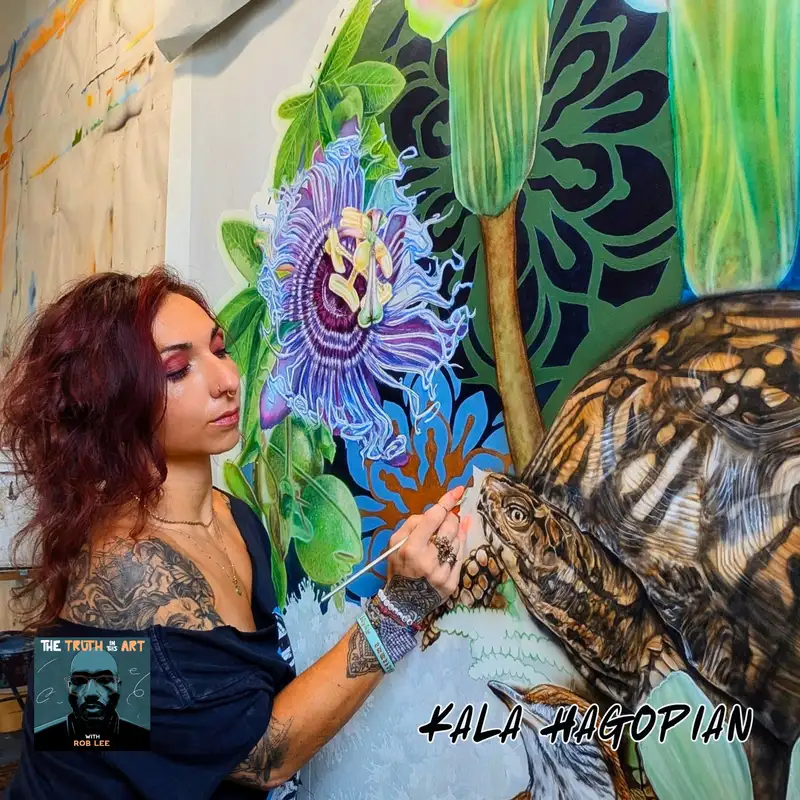
Download MP3Rob Lee: Welcome to the Truth in its Art, your source for conversations connecting arts, culture, and community. These are stories that matter, and I am your host, Rob Lee, accept no substitutes. Today I'm excited to take you guys back to a conversation I had with the founder and lead artist of Hagopian Arts, a woman-owned public art studio in the Philadelphia region. Her work transforms public spaces through large-scale murals, blending botanical and wildlife realism with geometric design, exploring ecology, culture, and our connection to the natural world. Joining me today is Cala Hagopian. Welcome to the Truth in His Art.
Kala Hagopian: So my name is Kala Hagopian. I'm the founder and lead artist of Hagopian Art, which is my mural practice. I got into art just naturally, organically. My dad is an amazing painter and I grew up with him in Vermont, just immersed in nature and painting.
We didn't have a lot of money, but we were rich in connection and love and art was everywhere. Exploring fields and forests and learning about natural ecology, I weirdly... Well, it seems strange to me now, but I had a public school that I went to where there was something called the Renaissance Program where you could develop your own independent studies And work with like ecologists in the field, well, in my case, ecologists, but basically like professionals in the field doing the things, going to the source and working with them as you develop these independent studies. So I learned art and like basically the foundation of my creative practice and my enthusiasm for that deep dives into and exploring ecology, culture, history. Um, you know, growing up in Vermont essentially, and then went to the Pennsylvania Academy of Fine Arts in 2005. And after that, I um so that's my formal fine art training.
Sure. After that, I started painting murals and that was my intro into public art. Um started my first collaborative initiative, myself and a partner in 2012, and then started Hagopian Arts independently in 2016. And I I also had my son I I gave birth to my son in 2016 as well. Um and then in 2018 I started the Ecomural Project. So that's kind of a summary of my history.
Speaker 3: You you took us through the history in an abbreviated way, and we'll be um and thank you. And we'll be going back through a few of those touch points really to add some more uh depth because you gave us the overview and I and I dig
Rob Lee: that and you know, so going back a little bit, you know, beyond artists, you've you've learned from ecologists, writers, historians, other specialists. Who are some of the people you've encountered?
You know, you've your your father could be in there as well, obviously. But some of the other people you've encountered who fundamentally changed the way that you see the world around you. Um And this question comes up because uh I I think exposure, whether it be to arts, whether it be to the world around us, kind of helps shape or reshape or maybe confirm things for us. So what was that like from you with so many pr potentially different influences throughout your your life and your creative life?
Kala Hagopian: I mean, well, it does all go back to my dad essentially, Philip Hagopian. Um he raised me understanding that authenticity and living in a a genuine way, um, is a priority. So we lived authentically. I was encouraged to be myself and explore based on my interests. Um and then obviously everything else that I mentioned with developing my skills and learning based on those interests, um, which created the foundation for what I do now. Um and then along the way, it was just understanding that I what drives me is a multi pronged, multifaceted approach to learning about things. So if I can go to the source for that, it's that's really compelling to me. And building in research and going to the source. Um even now, like within my EcoMural project, working with different organizations as partners, um, so that I'm getting I am going to the source for information. I'm learning constantly.
That that never stops. So, you know, for example, some of those partners have included like John Hines Wildlife Refuge, Philly Orchard Project, North American Land Trust, Sarse Society, Pollinator Partnership on Joint Venture, and they have all worked with me collaboratively to give educational content for community engagement, basically activation for mural projects and and educational resources. Sure. And then just feeding my own knowledge as I'm researching subject matter and you know diving headlong into a project.
Rob Lee: Yeah. And definitely that's a thing that that that came up sort of this what I'm grasping this desire and this thirst for knowledge and reading and research and then applying that to sort of the creative practice and the creative process. Um you know like I'm I'm a bit of a nerd myself. So if it's like something I can learn and if it's through conversation, which oftentimes is through conversation or the conversation leads to me looking something up, reading a book or an audio book. I'm always plugged in through the day and looking to learn something and apply it to what I do day to day. Absolutely.
Kala Hagopian: Yeah. I feel like and that's endless. Like there's it's it's an endless journey. I feel like I wake up as long as I have energy, I wake up inspired like every day 'cause there's so much to take in and so many facets and little rabbit holes to go down. Um but you know back to the original question like even with my dad I was painting and exploring and like then just working with ecologists in the field like going to vernal pools and seeing like amphibians in the field like at night like and tiny spring peepers that are like tiny little gems and learning about how like basically their their place in the larger ecosystem. Um so it's been a consistent process of learning wanting to learn more from people who are who are already doing that work with depth um and even having crossover with other artists.
Rob Lee: So there's always it's always this and and I'm grasping perhaps this is early on for you but it's always some early creative thing that we do. Um you know I've heard from uh different people who are like hey you know I'm a chef now but at a point I was in a band and I thought music was the direction or for myself I do a podcast and it has a creative thing meets journalism thing meets archival thing but once upon a time I wanted to be a comic book artist. So how do you define sort of creative talent? You know we have all types of creative talent when we're young and perhaps it gets maybe polished and refined as we're older but how do you define it and when did you realize that you were talented creatively?
Kala Hagopian: Um that's a good question. I mean I think it all starts with knowing yourself and being comfortable with who you are and being able to embrace your authenticity and your genuine self and then it's the combination of how you perceive things, how you feel, curiosity at least this is for me curiosity, um you know the knowledge behind something, the skill behind it and you know the self-trust that you would have to have to to basically harness all those things together. So all those parts connecting and you know sort of tapping into like a flow state where you're embodying you know whatever that interest is to the fullest extent with skill to back it up.
Rob Lee: Yeah that's um that that that's right so like you know I and I think that's why there's these different points. Like when you're young I don't know like when you're when I remember when I was a kid I it wasn't one of these things of well I hope someone likes this drawing that I did. It's like I'm just drawing and I think at a point someone told me that oh you you have some talent in this area and maybe that was a thing but I was just being me. I was being the person who liked to drew to draw rather what was was it something in that vein well of some of the earlier uh creative stuff that you were doing like what were you doing early as a career? Was it always painting or
Kala Hagopian: well kind of like what my work embodies now is a lot more than just painting. So it it's you know the thirst for knowledge and doing tons of research. I was always researching. I was always wanting to learn writing I loved writing I was I would just sit there and like write stories or write about something I had researched for hours um you know being outside being in nature exploring um and then painting wise, I just grew up with it. Like
salon style paintings on every wall surface, weird antiques and strange things that my dad would like collect and like musical instruments. Um it was it was really just living and breathing that and it just it just kinda happened. And then you know obviously as you start to do something and then you ha you build the skill behind it, you know, you can have aptitude but then you're like, oh I'm I'm really feeling this. Like I I'm able to I I have enough skill that I can really take off of this and harness all these other things and include them in it. So for me, I'm painting murals but I'm still building in the writing, the exploration the learning and in my mind like problem solving and curiosity too.
Rob Lee: For sure. That that's like I can go back and look at early instances where maybe doing an interview or having a conversation or recording a chat kind of maybe had some roots to what I do now. But I think you're right that it is these other interests that you have these other not not compulsions I would call for myself I suppose but sort of these other areas where it's just like hey I like I like looking up things. I like you know researching like different things from for myself. Um so like what is this work about? Like sometimes I'll interview an artist and then I'll go down one of those aforementioned rabbit holes that you said going down rabbit holes earlier and I'm like I'm learning a lot about this one topic and I'm feeling really satisfied and sometimes when I'll interview a guest it's just like all right I feel like I know their work a r a lot now because I've done so much research and I've dove so so deep into it and um it's a good feeling and it connects to something that's kinda normal for me as well and I would imagine sort of normal for you where all of these different interests the writing sort of these aspects of nature s and and painting and all of these different facets kind of come together and it's just like this is natural. This is just naturally what I'm doing and what I'm being
Kala Hagopian: yeah and I think that the layers and connecting things and the intersection of multiple things and like trusting yourself to find that sweet spot of bringing them all together. Like that's what really like drives me and it does all go back to the that origin story for sure.
Rob Lee: Certainly so you build Hotopian art. Also raising your your son as a as a single mom so talk a bit about like what that building was like building it out and perhaps what did it teach you um like while being a a parent teach you about sort of business and and starting out that perhaps if you were just an artist or not a parent as well as an artist like talk a bit about what that would look like of sort of maybe the stakes or maybe the thinking that went into it while having having a child you know like it's it's not a it's not an easy path I guess
Kala Hagopian: yeah I mean I was already like creating a lot of structure to support you know my my creative drive and doing the thing that I love every day making you know it's survival. Um so for me like to meet art creative work that's self-driven is is one of the most open ended things that you can do. So having structure in place to support like the free flow and the creative process is like essentially doing it intentionally so that it's not just kinda like meandering or free falling. So being structured and intentional obviously with survival at hand and a and a child was obviously it became you know this is what I love and I already have a pretty you know rigorous structured mindset but like this is survival and there's another life depending on me. You
know so but I I definitely did not let that stress me out. I was just like this is what we're doing um it's gonna happen it just has to be what I connect with otherwise it's it's gonna be disingenuous and it's it's not gonna go anywhere. So but um also like as a parent growing up in a home where my my father was doing his art and living authentically like I keep saying authenticity but that living in a genuine way um where I was able to harness who you know really understand who I am um and wanting my son to experience that life as well so that whatever his interests are he understands it that he can he can create the life that he wants and that it's gonna be a lot of hard work and it's gonna take a lot of drive and you're gonna fail sometimes but that you just keep going and you may approach things from different vantage points and there's a lot of mental flexibility involved. So I think like giving him the awareness that that's really important. It's
like we have this one life like to me living it to the fullest of being able to explore and create and you know never stop learning and driving that from a place of like self-awareness.
Rob Lee: That's that's a gym right there really and passing it ahead um you know there are conversations I have with people of all ages even when I have a nephew who's like you know 17 I'm gonna see him play football a little bit later a little senior year uh football season and he's thinking more about like hey what is the path for me because it's sort of a set of things of what you can do and what you should do or what have you and these different weird pressures um and in some ways I'm very free of those things. So he's asked me so what should I do? And I'm like I what do you what are you interested in? And it y you can see it kind of open up a little bit his sort of mind of like oh there's so many different you know options and pretty much you know using the the word of the day authentic right I you know just tell him just be genuine, be authentic and kind of find what you're interested in because you're the one that's gonna have to to do it and there'll be people there to help you. But I think sort of the point is when you're getting that message early you know especially from the household and it's thing that's sort of tried and true you can really believe in it. Where a lot of people I think they're you know as I said people who are older than I'm I'm I'm interviewing who are my age if not older who get that lesson a little later of hey I was kind of faking it for a while and I didn't know that there were more options out there or different things that I could do.
Kala Hagopian: Yeah yeah and I think it's it's hard to develop that self-trust that's necessary to know what you really want to do if you know you're not supported in in your who you are genuinely as a person if your natural inclinations are not supported. Um and I do think that like one thing that I've tried to communicate to my son for example is like it's not always going to look like what you pictured. So
having the mental flexibility to you know like develop yourself and explore different things but then see that when you put different seeds out there what really aligns is going to be a parent and like that's the path to follow. But it might not be what you thought. And a lot of people get discouraged when they see that something isn't exactly what they pictured and they're just like oh yeah guess this isn't working. Um and also yeah it's like believing in something I think that half second of hesitation and self-doubt is the difference of things really happening or developing an idea or you know you name it.
Rob Lee: Yeah and I think that that point around it may not be exactly what it is I think that's a reminder that's that's always needed. Um I I think at times I get maybe like nervous for an interview or nervous for something that's a little outside of the norm and as a way to kind of bring myself in I try to visualize it and I think naturally the negative of this is going to go terribly but it's like how do you know that your pre my preset is this is going to go terribly everything is going to be bad and I suck or whatever, right? But I think having some semblance of an awareness that there's a lot of different directions this could go. Maybe
it could go this direction it may not turn out how your mind is perceiving it, whether that's good or bad. It's gonna be something it could be really good it could be not as good but the way that you're you're seeing it it may not turn out it likely won't turn out that way but also having that support is is super important like anything that I'm doing. I I don't have any kids um but anything that I'm doing I've always you know to a degree it may not be like I know what you're doing I get it I know the whole podcast or recording thing but there is the support there from the people closest to me and it feels really good I think getting that from from a parent is just so so important.
Kala Hagopian: Yeah definitely and then also knowing that like you might have that from family or friends, but that unwavering belief is necessary because you're not gonna have that always and like all the time, you know, and it's almost like a little bit of crazy that allows you to put the blinders on to you know, leaning into the obvious reasons why you shouldn't do something or negative feedback or something like that. Um but yeah, and also just understanding, and it might sound corny, but like I feel like when things don't line up the way that I want them to, when I look back, every time there was like something I was upset about or a big challenge or something, I needed to go through that. You know, like I had to turn a corner before I'd be ready for something that might have looked different, but ended up being better. And
that's like it it might sound basic, but like that's really true. And I do think it goes back to the self-trusting, like, you know, maybe it wasn't supposed to happen because there needed to be this experience to I think if people reflect on their you know the things that don't go well for them or their challenges, that's how they learn from them. And then that's you know, I think the the most challenging things are what actually push us to be better. So a lot of people avoid that though. They don't want to look at what might be painful or challenging. Sure.
Rob Lee: And and you're you the impression I get from you, you're not a person that shies away from a little pain, a little bit of a challenge. I've seen you hitting the gym, you know, working on the legs, working on the core and all of that good stuff. So tell me a bit about the challenges that were there early on starting out. Um you know, you have a woman owned public art studio. So what was that like starting out? I have some follow-ups in that realm, but what was some of the early challenges and what was it like sort of like starting out sort of in this territory we're at right now?
Kala Hagopian: I mean, I already had a pretty strong foundation of of self-driven work. Um but beyond that, it was just like keep doing it every day. You know, it's not just painting, it's like having an analytical mind and understanding the business sides of things. Um, you know, really just be like doing it all the time, living and breathing it, embodying it, breaking things down to their smaller parts. Um And honestly, I think before and earlier on end now, it's always about like creating balance because I'm pretty good at understanding bigger pieces and breaking them down to their smaller parts and approaching them in a methodical way, and then also being able to tap into creativity and take the push things and explore, um, like that's always what I'm aiming to do. But having balance, like for example, like working out and being strong and eating healthy and like having time to be present with my son, um, or whatever it was at that phase of my life where one thing isn't taking away from another. So like that's you know, kind of like the concept of like symbiosis and and instead of you know, an ecosystem essentially, like one thing is giving to the next, not taking away from or in spite of, because you know, it could just take one thing and then everything feels like a lot, you know. Um so in something self-driven, I think you do have to be living and breathing and embodying it, and it's it's like really understanding like what can I have in my world right now so that I'm staying balanced enough to have all the energy I need to do this, especially when this is literally like an expression of your creative energy and hitting it on multiple notes, you know, like running a business, doing the creative work, interacting with clients, like being a parent, like that all takes like real energy and you can't fake it. Yeah. So that challenge of creating balance, I think always is about you know, recreating structure and recreating balance because it can be thrown off kilter easily.
Rob Lee: For sure, for sure. And and I think it's a good distinction where you know, uh I I have some similar things where I'm doing this, I have a day job, I have a training regimen, I have all of these these sort of different things, and I find that when I'm inserting something else in there, it's that creative adjustment, but more often than not, and I really look at it from a time standpoint, like if I have to do an interview somewhere that's outside of the norm, I I try to find ways to 'cause I'm I I'm aware we have limited time and say, how can I maximize it? How can I stack that time so that I'm getting everything done, especially when the stakes are high, you know, where things are expensive, you can easily in some instances translate to this time. I can't
afford to lose it. I I'll give you an example. Um I I had a an interview not too long ago scheduled, and I put a couple of hours of research in to do do these do these questions and do the research and all of that stuff for each guest, and you know, just the guest just no showed it and just didn't show up. And um I waited on like the the Zoom or the the meet or whatever I was recording through for like 15 minutes, and I try to add that disclaimer in there because that the time piece is important, but also sort of the time that's already invested as already, you know, sort of a a two hour deficit. And I
don't want to think too deeply into it in that way of I put this time and I'll never get it back. Maybe I I learned something from it to kind of go with that that that thirst for knowledge, you know, maybe that sparks some other questions, or maybe I learned something about my process that I can improve. But you know, I really need to think and I really spent more time thinking as I've done more of these interviews and more of these episodes of you know, make sure that the booking went well, double check, make sure that this time because the stakes are so important are as used in a way that it's not it's not wasteful because you could be doing something else. So if
I have to implement something else, like let's say I'm not recording in my home studio, I gotta account for uh traffic, commute time, all of these different things that are just taking away and at time commitment is that much higher, let alone any fiscal resources. So just sort of thinking about things in perhaps a different way, um, more maybe systems, I suppose, of what's going in and what the output is.
Kala Hagopian: Yes, absolutely, and that's like the mental flexibility part, and I've that's definitely something that I've encountered, like challenge wise, it's like even just figuring out um, you know, I sometimes I would get overwhelmed, like I have to do everything right now. And then I realize like, no, these two things can be, you know, this week, like in two weeks, and these are the priorities right now, these are the urgent things, and just learning how to maximize, like you said, and prioritize and not allowing it to flood and overwhelm um. So absolutely.
And I feel like even like interacting with folks, whether it's like someone I work with or a client or a community engagement event, um, you know, learning from things that might be more challenging or or don't go well, like maybe now I have to approach this differently. So absolutely, I think like that goes back to like instead of letting it take away, like at least trying to see where you can, you know, not self-correct, but improve or approach something differently for sure. That's that's been the case for me. Is like understanding people, understanding that everyone communicates differently. Um what do I have to do? Just keep this balance where it needs to be with all the variables and structured things, like you said, systems.
Rob Lee: Yeah, it's like you know the balance is off. And one one thing that I found, uh, and before I move into this next question, um, one thing that I found early on, I used to be super super involved in the booking every step of the way. And I found like I didn't like that as much. I don't I don't need to I don't need to, nor do I want to chase someone down to do an interview. If you want to do it, cool, if you don't want to do it, that's also cool. Um I
don't need to babysit someone. So like, hey, make sure you, you know, are you ready for tomorrow and all of that stuff? I send over sort of like if you want to do it, here's the link. Um, and
I'll send a maybe a follow-up if I haven't gotten the materials I need to do some research. But I'm trying to think of my side of it, and it's just like limiting that, and I don't one want to be a nuisance, you know, because I don't like that myself, but also it's just like, hey, you know, and if there is some need to cancel or postpone it, like that, you know, scenario I was describing, I have like pretty much a standard operation that I I do just to keep it and it works. And for like 95% of the people, it works very well, and there's a few that may just forget it or may just kind of ghost it, and I just accept that and and keep it rolling. And one or one of the things that I've realized that's been helpful is something as simple as a scheduled email, Schedule send. Because um, I think you were touching on it a second ago of I gotta handle all of these things right now, and I'll send send an email to someone like I just did the uh I think the art fair and armory show, and it was in uh Spring Break Art Fair like a couple weeks ago, and that following Monday, I was like, let me put together some draft emails. Who do
I want to reach out to, who do I want to talk to? And I would schedule them to go out at just really weird times, just so it's not like inundating their their inbox, and then when I would get responses back, I would schedule you know, those responses at a time that's convenient. So if I know I got a bunch of travel coming up, I'm not gonna follow up right now. Probably follow up a week later, but at least I wrote that email and attended to it, but it's not something I'm actively working on.
Kala Hagopian: Yeah, and and that goes back to learning from your experiences and and developing those systems, and I think that does make a big difference. Like I definitely noticed that in your approach. And I think that's the way to go, like, especially when it comes to people showing up for things or participating uh with the engagement that you would want if they're not taking the initiative, you know, and it's probably not the guests that you would want to have on, or that might not show up or whatever. So yeah, I think it is it's also learning how to manage yourself and have systems, but learning how to recognize how you need to interact with other people. Yeah.
Rob Lee: People be peopling sometimes. You know, people will be on some stuff.
Kala Hagopian: Yes. You know, you you you work with clients, you work with partners, they're like, all right, man, I responded to the email already. What are we doing? Yes. Yeah. I would
actually back to like challenges. Yeah, like I feel like it's for me, it's it's navigating people and understanding you know, how different people are gonna communicate, like I said, but also different levels of investment, and some people are just responding based on like their insecurities or you know, outliving like some you know, personality disorder or something. And then other people are really open and want to genuinely connect and are excited about the work and I'm speaking across like all aspects of life essentially, but especially you know, from a work mindset, like you never know where people are coming from, and a lot of times people are unconsciously moving and they're coming from a place that is not even related to what they're you know, responding to, you know, essentially.
Rob Lee: Right, right. It's you know, there are there are times where I have folks come on and it's like, yeah, this is like um some influencer thing, right? You know, I could just come on and promote my thing. I was like, maybe, but I don't do the influencer thing like or when folks ask how do you go about the whole curation, like how do you select your guests, or and I think you pointed one of the things out a second ago of how do you know who's gonna be a good guest? The early on engagement is sort of a sign of are you are you responding? Are you
responsive? Because that's a shorthand of are you gonna be a good guest on the as far as a conversation goes? It doesn't need to doesn't mean that the person needs to have the greatest best art or the greatest best story, but it has to be something that as a minimum is just interesting and the conversation is just interesting. And yeah, you know, and the def definitely I relate to that being a challenge early on of like just the different communication styles and and how people go about stuff, and it's like I haven't even got to the stage of making anything yet or recording anything. Um but once that was shorn up and you know, always checking in with that as the foundation, then I can kind of play with that balance that we've been been talking about a little bit, and just knowing that whenever something new is added, you know, um during the summer, I teach a class. Um it's a six-week class, I make it a point not to record during those classes anymore, during the uh the time that I have those classes because they're they take so much out of me. They're they're
so draining. And I had to learn it by making a really big error. I fell asleep during a podcast um the first year I was doing it, and I was like so mortified.
Kala Hagopian: Yeah, yeah. I mean, and I've learned I've learned to even like read an email and know how I have to communicate with someone. Like I can tell if I should be giving someone all the information, or if they might just scan the last sentence, so then I'm gonna parse things out, or maybe this person isn't paying attention at all, or you know, and and someone's accountability says a lot about their work too. You know. So Yes.
Rob Lee: That was a that was a thing I saw earlier, and I'm definitely gonna move to the next question now because now I'm just in the wheeze. So we're both doing a rabbit hole thing. This is
all your fault. I'm gonna blame you for um I I say that facetiously, but that was one thing is some podcast I was listening to and they were talking about um what is it Motley Crew or or something, but they had the uh brown MM clause in their contracts. So they would put some little and I think it was them, but it was some little line in the different contracts, the writers to see if the the people they were working with, whether the venue or the book or what have you actually read it. So they would go on air to their uh backstage room and they would see MMs and it had the brown ones in there, which they used they have in there as a closet, no brown MMs, then they would know that they didn't read the contract. So they would check all of their stuff just to make sure. And I was like, I'm gonna try that. I gotta figure out how to try that.
Kala Hagopian: Yeah, and those little things, like I have found that the small things I will get like because of all the years I've been doing this and interacting with all different kinds of people, like I find that those early little things, I'll notice everything. And those are the things that matter. Those little things where I'm just like eh no I'll just it's cool. Like we'll
see what happens. And it I'll keep it in the back of my head and those things become amplified and they show up, you know. So I feel like people are usually how they like how they are all along is who they end up being the entire time. Or sorry,
how they are in the beginning, even with the littlest tells is who they really are the whole time and how it's gonna present is probably the smallest indicators in the beginning.
Rob Lee: Yeah it's it's uh similar to the sports thing. It's like you're going to play the way that you practice. If you practice half ass in it you're gonna play half what it matters it's not gonna be what it should be. Yeah it's like muscle memory. Hi, weight lifter. Don't are
we talking about muscles now we are here. Um so you're you're in the Philadelphia region, you're you know, just outside and you've you know have extensive work in and around the area. So Philly is known for its murals. What is it like contributing to that tradition while also making work that is distinctly yours. It's not like I wanna do something that this person is doing because that's getting engagement and that's getting awareness and attention but just doing something that is if if one would say contributing to the canon that is Philadelphia murals. What what is that like for you well
Kala Hagopian: early on I r I decided like even if it costs me that to do this and to be po pouring all of myself into this. Like I work seven days a week. Um it has to be driven by how I want to paint and and what I love and that's ultimately going to be how your authentic there we go again style comes through and your aesthetics and all of that. So you know I wasn't willing to compromise how I really wanted to paint and I think that's defined me. Like it wasn't economically the best choice in the beginning. Like I'd be working on something it might take me six months and someone else like two weeks like literally um and making the same amount and that obviously evolved and it had to but retaining that stuff my style, my you know the drive to paint the way that I do um literally painting with tiny brushes and it doesn't matter what the project is if I see something and I feel like it's not its best or I could push it further or you know accentuate the colors or push the atmosphere the depth you know I'm gonna do that. And it
might take way longer than it should. But I think holding that standard and you know wanting to to grow through the process that has really defined the style that I have and and set it apart. I mean even with the subject matter it was like no one's gonna want murals that I haven't they haven't seen me do this kind of work. So I you know essentially donated thousands of dollars worth of eco murals to West Philly community and other areas on street level and I was just like this is going to be the work I'm doing. Like I'm pouring all of myself into painting murals like this is going to be my focus. And you know relatively quickly it you know it started to evolve and eventually it did become you know the majority of my commission work. But I think it's just been like not compromising what I know resonates as far as like my authentic style, my you know my even if something is not you know paid for even, which now it is, it has to be, but really never compromising the way that I would want to create or paint or express myself or the research that I would want to do or the relationships that I would want to build, um, because that's what's gonna set it apart. It's like your real creative voice coming through.
Rob Lee: Absolutely. That's that's that's great to hear that. And you know, again, authenticity, right? It's it's the word of the day. I know I think it's it's that's what perhaps why folks come on here and why folks gravitate towards this and why anybody really if they're doing something that's them it it hits the people that are supposed to hit. Perhaps it
is a part of what a particular scene or what an environment has, but it's like what is that unique trait that makes it it. And sort of your approach and the way that you go about it and your subject matter and what you want to include in reading over 20 murals. Is that the number? Like, you know talk a bit about that, like sort of you know the the eco mural project more about that and sort of it's 20, right? Like I want to make sure I got that number big number.
Kala Hagopian: I've done tons of public art projects. Way way, way, way, way, way more than twenty six. It's twenty six eco murals now. Yeah. Um and each one I think I mentioned is like usually between six and eight months to create the smaller pieces might be like three months. Um but lots of different public art projects and even the ones that have not been eco murals, they still have history, culture and ecological nature inspired elements and patterning throughout them. Um and they're painted with the juxtaposition of patterning and even patterns you would find in nature and you know repeating geometry um juxtaposes realism. Um but yeah I I essentially developed that the way that I mentioned and it it grew from wanting to spend every day if I was going to pour myself into something doing what I genuinely love, what you know as corny as it might sound like tapping into flow state, embodying like what I'm excited to do and explore through. Um and it started with one street level mural and at that like in the beginning in 2018 it was like getting permission from wall owners and doing it in between other public art projects, other mural projects. So working around the clock on other projects and then even more like with my baby on my back to create these eco murals in between and then that evolved through partnerships and ecological partnerships and organizations that were aligned and then just folks that saw you know these striking naturalistic pieces and and wanted to you know contribute to that and you know the educational aspect of them is that they're all QR linked um to heavily researched information educational information and a lot of it it evolved so that a lot of it is coming from a source like you know informed by an ecological partner or you know research that was done by experientially um and interactively and they grew to become really layered and multifaceted. So usually there's a community engagement component there's a component of engagement that is directly connected to the the educational aspect, the environmental aspect, the whatever ecosystem is being depicted and I find that you know it's more than just you know cool looking highly detailed artwork on a wall. Yeah. What
excites me is when I can create layers and something is multifaceted and a connection point might be you know the environmental aspect or the ecology of it for one person and for someone else it is seeing the nuances of you know how things are rendered and captured in a piece. It could be you know a mural painting event where folks are painting into the mural and I'm taking it back to the studio and refining it. Um you know I've worked on projects where we created like a wild medicine journal where like the public art pieces themselves depicted the local ecology and there was an ethnobotany element. So um you know I had all different folks contributing to that Lenape Nation of Pennsylvania chief Adam Waterbear he was like, I I essentially my goal was to connect people and connect them to again, I keep saying it to the source, so it's not just me like Googling information and spitting it out. Um and then one part of it is I'm doing I'm doing what I love. I'm tapping into something that I'm driven to do that excites me, it makes it possible for me to continue to grow and learn and explore. And I
don't fake it when I'm like talking to a client or talking to people. I'm getting excited about it, and that goes back to challenges because it requires energy to constantly have that output. But I think that's what excites people is like the real excitement and knowledge and skill behind it. And then I think people really like to feel that and then it kind of awakens something in them where they might tap into it from a certain vantage point or connect with it or realize, oh, I really like this feeling. I like the energy that I'm getting from this person who's so into this self-driven thing, and then it encourages them to explore whether it's in a project or on their own in that way. And I think those little moments where people can connect and have that overlap and it might trigger something in someone where they want to where they're inspired to be rooted in who they are and express that, like that's amazing to me. Like connection, crossover, you know, people connecting with the art, but then also sparking their own interest, like that's that's what does it for me.
Rob Lee: I love that. It makes sense. So I got like three more real questions. And then I got some rapid fire questions for you, because I've been adding as we've been talking, I've I've added to these. There was only one, and now it became three. So you've
earned new ones. So shout out to you. Um, And let's see. um I got I want to hear a bit about your. discernment around collaboration. Um, yeah, I had this exercise a couple years ago, sort of end of year stuff and thinking about like what do I value in partners, whether it be community, whether it be potential guests, because really it's collaborative in that way, whether it be funders or things of the sort, and just like what do I value amongst them? Who do
I consider sort of ongoing sustainers, things of that nature? And um, how do you sort of look at that like with the expansive list of of partners and collaborators that you've had, how do you like apply discernment? Like, how do you know what's gonna be, you know, something reciprocal, something that's gonna be this might be a little bit of a challenge, but it's gonna work. Talk about how you approach collaboration and and partners at this stage.
Kala Hagopian: Well, I can I I think again, it it does come down to to self-trust. Um and I can I can feel people pretty accurately and pick up on different tells and I can discern pretty early on um how someone is approaching a project, whether it's from the standpoint of a client, a participant, or someone working with me, or collaborating with me, like working for me or collaborating with me. And I can tell when someone is coming from a place of you know, excitement, that's my favorite, is like if I get to collaborate with someone, and maybe it's another muralist, or maybe it's a different kind of artist, like a musician or something like that, and they're or it could be a client or someone just participating in a painting event, but they're genuinely inspired, and they want to give to that moment that experience and build. And then there's people where it's a mutual exchange, and that's fine too. And then there's people that like it it kind of goes back to like are they coming from a place of deficit as a whole, or is this exciting? Is this
like expansive for them? And you know, learning to understand where people are coming from as far as that goes. Um are they coming to take something or get what they can? Unfortunately, there's a lot of people in this world that their mindset is just how can I get mine and get the most for the least. And I don't think like that at all. Um but I've had to learn learn it, like learn how people think like that. Um because I think like that is the biggest challenge is like different people and and how they're approaching things and when people are approaching things from that vantage point of like, get mine, essentially. Um, and whether it's personal relationship or you know, directly involved in a project, it can be incredibly draining if and detrimental if you're not aware of it. And like, you know, take uh I think honestly, I try not to engage at all in those situations where I've where I'm encountering that, like if at all possible, I'm just I don't want to have anything to do with that. But sometimes there's situations where you're just gonna have deal with the people that are involved. And yeah, I mean that's that's something to definitely navigate, especially if you don't think like that. It's learning to understand those tells and what the impact could be and you know, whether if you can't, you know, separate from that completely, where to place people essentially, learning where to place people because not everyone needs to be on the outside, but not everyone needs to be right here on the inside either.
Rob Lee: So one of the things in in doing the research, um wild medicine, uh and it looked like it was an event, a combination of a few different things. Uh definitely collaboration was at the forefront there. So could you tell us about that experience? Like what was that like because it's so robust. I saw like a music component, I saw your work. It was a lot of different things going on there.
Kala Hagopian: Yeah, so that stems out of the wild medicine ecomural series. So there's the Ecomural Project, which is like the umbrella, and it's the environmental series that I've been developing since 2018. And the wild medicine series is a focus on local medicinal plants, so local to wherever a project is and plants that have been used indigenously and you know, into present time. Um and
their pollinator species and um learning about the history and culture of an area through that lens. Um and the wild medicine events, so experiences essentially have been basically the coming together of the public art component, um with other creative elements, um sort of intermingling and intertwining to create the whole piece where people are coming into an event and having like an entire experience of wild medicine. So the public art is accentuated and expanded on by 3D art installations and then live um like fine art body painted mile models and then like there's been performers, so aerialists, electric callus, vocalists, and it's essentially each artist being able to tap into their flow state, like connecting with the environment, with the themes, with the art, with each other, but really embodying their own creative outpouring. Um and truly being able to, you know, riff off each other, but then you know, be a layered expression of you know, within the whole, essentially. And it kind of goes back to like what we were talking about, like collaborating when there can be different collaborators contributing to one part, but they're all working in it together and creating this like immersive experience essentially.
Rob Lee: That's that's amazing. Like hearing about it, I'm I'm mad that I was I mean, I didn't get my invite, um, but um it I I it's it just looks amazing where it's a combination of just folks really getting their thing off and showing and you you touched on that riffing and that working collaboratively is just like a a showcase in some regards, and it's going to a almost a culmination of a period of time um with the sort of series of of work that was there and just you know, the so the series of work that was leading up to the experiential facet of it and just folks collaborating, working together. I I've said this a lot that I just think that we're better together than sort of that discernment, that sort of layered and a multi interest thing that you have going that makes up how you approach your work, it just seems like it's on display there.
Kala Hagopian: Yeah, and it is like the culmination of the of a journey. So every project, because it's you know, might be six months, eight months, a year long, um, you know, so man there's been so many overlapping facets to it from research, tons and tons of research, tons of design work, um, community engagement, painting for months and hours on in the studio, and you know, different approaches within engagement too, whether it's public painting, like mindfulness and yoga, you know, was it integrated into the last event was for wild medicine ecomural twenty three. And so
we had all different components, um, from the public painting to the mindfulness and yoga and wellness being incorporated with the painting to you know, some of the ecological partners coming in and teaching at the painting events, um and working with like a range of community members and people. And then, you know, once the artwork is is done being painted in studio, it's installed and the installation process is very intense. Um no matter what the scale is, it's like physically intense. So it's like working for months and months and months, and then this like laborious process of like accuracy and just being like physically on for hours and hours and hours to install the pieces. And in this case, it culminated with this multidimensional, immersive wild medicine experience and the artwork that community members had a hand in, um, that you know, was worked on for all those months, that's on display, but it's really amplified by you know, the intersection of all those collaborators coming together. And for me, i again it might sound corny, but it's like connection and interdependence and creating more when we come together and we're like all able to tap in to that authentic, you know, coming from an authentic, genuine place and people that work their lives to do what they're doing and they're working at the highest level. Um and so all of that is coming together and for me it's like that's like such a cool gratifying experience because it goes beyond, you know, just painting something and it's layered and that really is what inspires me, like when things are layered when there's always more to expand on. Um I
feel like I'm sort of a productive junkie, but um where I where that can go even further than being productive and other people can come into it with their drive and their skill set too.
Rob Lee: Yeah, I mean that was just so so corny of you. I can't believe you were so corny there describing this amazing experience
Kala Hagopian: and well the corny part is like I'm like, Oh, connection and coming together and we all need to put be part of one whole. But I really believe that. Like I think the more disconnected people are the more capable they are of being the like we were talking about earlier, that I'm gonna get mine to the expense of others. And when people have a reason to to know themselves enough to to recognize that they are connected to everyone and everything, then that does produce something pretty amazing.
Rob Lee: It's an investment there. Um, you know, whether it be time, energy and so on. And I I just find that's when the the best things happen, you know, and I and I don't think it's corny at all. I think it is truly just something we need more of. I I think I think you and I are very similar in age and there's a term that gets floated out there a lot. Oh, that's cringe. It's so cringe, we're linear with cringe. And it it's something about it where I think it's a campaign, right? Where it's cringe or it's corny or whatever the thing is, and it's like is it human? Is it
a thing that people actually are doing and want to do? Maybe it's not cringe or even to be more nerdy about it. I'm gonna reference the Superman movie, uh, you know, that came out last year of like or maybe earlier this year, you know, maybe that is the punk rock of it all, you know, to paraphrase, you know, maybe kindness is punk rock, maybe connection is punk rock. It's cool, yeah, yeah.
Kala Hagopian: It is, and I think the people that are haters about it are really it's because they're not cool with themselves and maybe they don't feel like they can connect from a place of being grounded in who they are. So yeah, I mean I think sometimes the most the simplest things are are the foundational elements to to all of us and what's most important. But yeah, I mean I feel like that's essentially like with my work, I'm that is the basis of it is connection, um, expansion and how everything affects everything else. Yeah.
Rob Lee: Ecology. Uh so here's the last real question. Um it's it's related, but I'm gonna make a reference to a different creator, um, different artist, if you will. Um lastly film director Sam Mendez uh has a quote that there's no such thing as right or wrong that's interesting and less interesting. So with that in mind, and I'm also considering sort of that wild medicine experience, that's why I kinda ordered it in this way. With that
in mind. How do you determine what's interesting creatively? Maybe it builds on the collaboration, maybe it builds on sort of that full experience, but from your perspective, what is how do you determine like what is interesting creatively? I think I have a sense on it, but I'll at least want to to tote that over to you.
Kala Hagopian: Yeah, I mean it definitely connects to what you last asked. It's it's basically for me, like how can I expand on something? How can I push it further? Or where is their crossover? Connecting the dots between things. Like that's that's what excites me. Um, you
know, whether I'm painting and you know, I have all the energy I need and I'm pushing myself to take something further, or literally seeing the intersection of the seemingly unrelated parts and expanding and growing that.
Rob Lee: It's good. It's the it's a thing I saw recently, it's not a matter of what's original, it's a matter of at times, it's a matter of how you're taking these different references and finding that intersection or finding how they're arranged. I think the what I was reading was uh the way that folks are taking their references in and maybe remixing them if you will, and being influenced by them is an act of curation in some ways, and it's something about that, like the things that I find to be interesting, I see the connection there. That's that's what kind of matters. Like I gotta trust in I suppose why am I interested in it, and I have to trust in what that interest is.
Kala Hagopian: Yeah, and and also like for me that interest is usually what is genuine. So is this genuinely resonating? Is this a genuine expression? Am I I could be talking to someone that does a completely different thing, maybe they're an athlete, but I see them that I see their genuine expression. I see how hard they've worked their entire life towards something and everything they poured into it. And then
you can also see where people live that in the rest of their life. And that's super interesting. And you can have someone that again that does something completely different and understand them and connect with them through that because you know, like this anything self-driven, um, is it's a unique task, but it's you know, it to me like that's that's super interesting. And just even watching like performers and you know, even within that event, but just even going to a performance and watching people who have believed in a thing enough to embody it and hone that skill, and you can see them like they're really doing the thing that they love that they've honed their entire life. And that's
beautiful. And you can again, you could see them tap into that flow state because they have the skill to back it up. I don't think you can really tap into that. I mean,
you can accidentally, but like to sustain it and do it on command almost, you really have to have done it all the time and and devoted yourself to it, I think. Yeah. So that's super interesting to me.
Rob Lee: And it's a it's maybe a hollowness there as well when you can see that there's no connection to what they're what a person is doing. It's just like I'm good at this, I don't my heart's not in it. I don't it's I'm not doing it genuine, it's a pathway for something else. Um I I see it in podcasting all the time, and you know, I and and and I don't consider that even in that class of like high art or fine art or it's something that's perhaps art adjacent, but when I see people comparing sort of what I do and how I approach it to maybe something that is this is a marketing pathway to promote my business, sure, but it's not the same thing. This really is a entree or entry point to get to the next thing. And I find a lot of times folks are trying to use art in that way of hey, come for the art, but really there's a whole other grift running in the background and art which feels more pure and it feels more perhaps genuine, you know, that it's it it's it's sort of that, and you're like, hmm, let me let me observe this. Let me keep my eye on this. And as you were talking about earlier, you have that keen discernment of like, I know what's happening. I'm I'm gonna let y'all do it. I got it.
Kala Hagopian: Yeah, yeah, I can't I can't participate in that language, to be honest with you. I'm not good at it either. Like I'm not good at putting on or faking it, and that's why it requires a lot of energy to like do something from a genuinely energized place. Like you you have to have energy to embody something for real and put in the work. And you can see it when it's performative. But I think that goes across all areas of life when people are just doing something for the sake of doing it or performing or doing a physical act and there's nothing there. There's no
connection point. And you know, I think like a lot of it is like clearing out the noise too. People are a lot of like clutter and they don't know what they want, um, then they you know, they don't know themselves and they do put on and it's just to get to the next thing, like you said.
Rob Lee: Yeah, it's like there's no soul connected to that skeleton, but topic for a different later conversation. I feel like there's that's a potential future part two here going into like these are the people that suck. Never mind.
Kala Hagopian: Um But I got I got a couple rapid fire questions I want to run by your way and then I'll go back into some sage advice and the rapid fire question, here's the first one. You touched
on this very, very early on, maybe before we can put the mics on. So I gotta ask you, um, what is your daily ritual? What is one thing that you have to do? You you mentioned that as an area of interest of what artists do daily, but what is one thing that you have to do daily?
Kala Hagopian: I would say the my priority that I have to do just it's it's so important to me is like knowing that I was able to balance things enough that I'm able to be present with my son. So and that's that's so important. Um and when there's a little when there isn't enough balance, you know, it's so easy to just be moving and doing and going through day-to-day life and slowing down and having that presentness is like it's so important. Like there's
moments that happen that they could they could be there for years in your mind and your memory bank and and those could be the smallest moments, but that to me that is living life to the fullest is like being able to have that present interaction and for me it's really important with my son. Um I also really need to work out and move my body. I've been lifting since I was sixteen. Oh wow training, you know, not just you know, not just lifting heavy things, but agility and flexibility and for me it's like it's an embodiment of you know, optimization and who I am at my core and being able to, you know, move however I need to or want to and have the strength to back up what I'm doing every day and the agility to like I don't ever want to feel like oh I I just can't do that, or you know, like health spin. People talk
about life spin is health spin and being able to have the energy to produce and create and enjoy life. So that's really important to me. I'm not always able to do it every day for sure, but it's the thing that balances me for sure, like mentally, um and physically. But um I mean, I this is what I do, like this the creative work running my business, like I don't think there's a single day that I'm not doing it. And it's not you know, it's not of course it is for survival, but also like I'm compelled to do it. Like I even when I'm tired, like I'm compelled to do it, it gives me energy.
Rob Lee: That that tracks, that tracks. Um similar, I you know, uh I gotta have the the activity, I gotta be able to do my my stuff. But we're talking about you, we're not talking about me. And so the second one, the second question I got is um so you know, energy levels is a thing. And you know, life can get overwhelming, or it can be all assuming, all consuming. Um what's one thing that you have to do to protect that creative energy, like one thing that you always have to do.
Kala Hagopian: I mean I think it goes back to what we were talking about of like it's knowing where to place things in people and tasks creating systems, protecting protecting your energy is like so important for anything self-driven. Um to me it's about I'm I'm very sensitive to the people around me. So not
sensitive like it can push me over, but like I feel like I take in a lot. So making sure that they're like cutting out the bullshit and the noise, like there's not um draining people in my life and around me. Um, you know, because for me that can be the most energy draining thing is, you know, kind of like we were talking about before, like the people that may not be there to collaborate, um more so to take, and maybe they don't even realize it, but I think I think creating balance every single day, recreating it, um prioritizing what actually matters and not what like you think in the moment matters. Um and and prioritizing like what's fulfilling. Like I I will admit, 'cause that gives me energy. Um I will
admit, like I'm still working on creating balance. It's an everyday thing. Like, you know, some days I may not eat until late. And that's not good, you know. Some days I'm not moving my body and I'm you know, stagnant and that's not good. But I'm always looking to to recreate that balance and grab onto it because it is a thing that's that's fueling the whole. Yeah.
Rob Lee: So here's the last one. Uh last sort of rapid fire question. And it's funny you you mentioned it a second ago. What have you eaten today? What what's the meal have you eaten today?
Kala Hagopian: Oh man.
Rob Lee: I put you on the spot right there. I've eaten nothing.
Kala Hagopian: So I actually I like to eat real food. Okay. But I had a protein shake because I was just like I don't have time right now but I should eat and that was me like just you know trying to get it in. And I had energy drinks 'cause I didn't sleep last night. But normally I'm keto. I've been keto for a decade. Oh wow so normally it's like um veggies and fat and meat essentially. Okay.
Rob Lee: Uh you know I was I was I I was looking through it, I was like, all right, put me on to something 'cause whenever I see a a specific name I feel like Armenian, maybe I'm wrong. Mm-hmm. Yeah. Okay, I try yeah yeah I I try to I like I said I did the research a little bit.
Kala Hagopian: I and yeah. I was always like, yeah here's this dish that I like. I was like, oh put me on to some Armenian food. I was waiting for that.
Rob Lee: So keto. Keto for decade plus what is one of your favorite dishes to have
Kala Hagopian: honestly I w I wanna make the most of everything. So it's not necessarily about a dish but like if I'm not eating a bunch of meals, it has to be good. Um and for me it's
healthy but it's not just fuel. Like I can't I can't tell you a favorite dish 'cause like it's gonna be different all the time. But it is like whole food. It's like you know, grass fed
beef, like well seasoned like veggies. I mean last night my son and I went to our old block on Marco Street in Philly in West Philly and we had an Indian restaurant. We had an Indian restaurant 'cause we moved in June um right down the block from us. Yeah. And um we went there after he had ice hockey and we got our favorite dishes and it was amazing. Oh yeah.
Rob Lee: I I like how you said well seasoned 'cause there's some people out here again a different topic for different conversations. There's some people out here ain't seasoning in their food. It's like I got this chicken and it's like why is it bland? Why's the right bland? Everything needs to be seasoned.
Kala Hagopian: Like what are we doing? Are you supposed to enjoy maximize it Everything counts.
Kala Hagopian: Yes, in large amounts. Um that's a reference from an eighties song I just aged myself right there. Um so here's a stage advice question. Um and thank you for for enduring the
rapid fire. Um so I value independence in what I make. That's been coming up so much. I begin to offers to be the face and the voice of a thing but they don't want my unique perspective just perhaps what I represent and creative freedom is top for me. Flexibility is in there as well. What are the advantages of independence and from your perspective and what advice would you share with an artist around maintaining their um independence?
Kala Hagopian: I mean zooming out it's creating the life that you want to live and not letting life just happen to you. Um and yeah I mean like I think I I cannot let life just happen to me. I want to be creating it. If there's challenges, you know, oh well like I'm gonna grow from them it's worth it. Like I wanna be creating producing and to me that's that's living life to the fullest but then also like not being um not deadening it and just doing the thing to do it and make money doing it. Um so retaining creative voice. So but you know obviously there's all the the risks with doing a self driven thing or being creatively independent but to me it's like hands down worth it. You know like every day um it there may be a struggle but I'm so happy that there I'm creating something that that to build on and I don't see an end to it. That's great.
Rob Lee: And that's um that's what we got. That's what we got for the day. So um thank you for that. I think that's just something that carries over and folks can really apply to what they're doing in their respective craft, art, pursuits. And with that in mind, there's two things I want to do as we close out here. One, I want to thank you for coming on. Glad we were able to make this happen. Um truly been um a treat to chat with you today and learn more about your story. And secondly, I want to invite and encourage you to share with the listeners where they can follow you on social, check out your website, any of those final thoughts. The floor is yours.
Kala Hagopian: Thank you. It's been awesome talking with you. Great conversation. Amazing questions. Um I can be found on Instagram at Hagopian Arts, and my website is HagopianArts.com.
Speaker 3: And there you have it, folks. I want to again thank Kala Hagopian from Hugopian Arts for coming on to the truth in this art and spending some time with me and sharing some insights and her story.
Rob Lee: And for Kala, I am Rob Lee, and that there's art, culture, and community in and around your neck of the woods. You just have to look for it.
Creators and Guests