Nicole Clark
Download MP3Rob Lee: Welcome to The Truth in This Art, your source for conversations connecting arts, culture, and community. These are stories that matter, and I am your host, Rob Lee, except no substitutes.
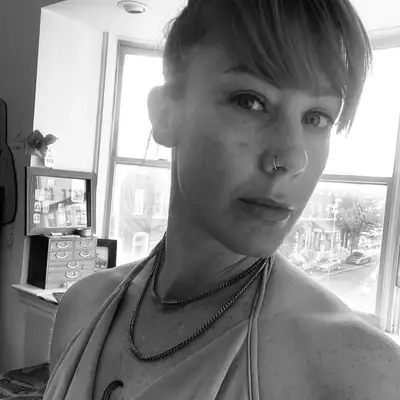
Today, I'm excited to welcome my next guest on to the program. She is an American artist and writer originally from Chicago, Illinois, and currently living and working in Baltimore, Maryland. Her works uses art and prose, featuring abstract and figure paintings that highlight the feminine form alongside collages that use paper artifacts from her past to create poignant satirical designs about the female experience. Please welcome to the program Nicole Clark. Welcome to the podcast.
Nicole Clark: Thank you. Happy to be here.
Rob Lee: Happy to have you on. Happy to start off with this first question. It really, I think, sets the stage for the conversations. One of the things about this podcast, I say it in the intro, I really do believe it, stories matter and sharing stories that matter. And typically, the story starts with the subject of the story, introducing themselves with this type of storytelling. So I'd love it for you to introduce yourself in your own words.
Nicole Clark: Sure. The protagonist. My name is Nicole, though, depending on the day or who you ask, I go by Nikki. I really don't get offended if you call me one or the other. But aside from my name, I am a Baltimore based artist. I paint. I write. I am also an accidental though now intentional entrepreneur. I have my own consulting business called Valkyrie.
And I work with leaders to make complex change doable in my consulting business, which I know is a really broad statement, but you can check out my website. Yeah, please. Yeah, I see. I self critique a lot. Like I'm already thinking that perhaps my introduction is very American and focusing on what I do. I, uh, outside of what I do, I am, I'm a perennial optimist. I suffer from a sort of chronic hope, I think sometimes. And I, uh, I also, I tend to, um, yeah, I tend to analyze right in like the midst of what I'm often thinking and saying. So I do hope that by the, this podcast is stream of conscious because I kind of send a talk like water sometimes.
Rob Lee: No, I think, I think that's good. And, you know, one of the things in these conversations that I, I really like it. I think it helps show who the person is that's making the art or who's doing the business who has these, these really like strong ideas. And it's a lot of times it's something that's missed. It's like, Oh, you did this.
You must be this type of person. And sometimes they're vastly different people. And, um, going back to, you said, Valkyrie, right? That, the, the, the brief description is just complex to kind of simplify that. It sounds like problem solving. Sounds like problem solving for me. And, uh, it, uh, connects with, uh, the art artist background. It does for me.
Nicole Clark: And I've actually been spending probably the last two years actually trying to merge my identities of what I do at Valkyrie, which is change management work. Uh, so it is problem solving, but working with leaders to essentially bring about some form of change in their organization. So it does lean heavily on creative thinking and thinking outside of the box.
So, so the artist identity, um, has been able to make herself more known. And my, my client engagements, which is felt really good. Um, but yeah, it is, it's essentially problem solving.
Rob Lee: It's, it's a big thing. Like for, you know, I do this and often folks just think this is the one thing that I do. And we were talking a little bit about my, you know, sort of, uh, my Bruce Wayne background versus the, I don't know if this is, I don't know the podcast about that.
But, uh, I wear a black at it a lot. So maybe, but you know, I would get early on when I would share with folks that I'm a data analyst and sort of identifying problems and figuring out solutions is a big part of what I do. And I'm like, so how does the creatives and the storytelling and I was like, they both serve each other. It's, you know, I won the, the podcasting piece is a storytelling piece. And that storytelling background helps me when delivering those details from how to solve a problem and then being able to do the analytical side of things through the day job, if you will, when folks come to me about, Hey, you know, what's the return on this? How, you know, what's the engagement look like? I can actually tell a story that's backed up with data. So both of them, they kind of like work with each other, had it in. Yeah.
Nicole Clark: And I, I don't know if you found this. I think I've, as I've like, finally accepted that I am an artist when I'm showing up on a zoom call, you know, to go over a project plan. And I am the same person when I'm behind, you know, stepping in front of my canvas. I, I'm realizing that the people I work with, my clients, a lot of times they're bringing me on because I am an artist.
And I think that's been a really helpful realization to kind of accept, you know, the two in one. So imagine for you, especially the storytelling and data analyzed, analyzing data, telling stories with data. Yeah.
Rob Lee: I, I find that I lean a lot on the production side, especially when engaging with those instances where, you know, like when we got started, I gave you essentially a run of show, but it's also like me kind of serving a purpose. Like I know folks get, they're like, man, I got to talk, I got to talk about my work and it's some nerves and so on. So it's like, I'm processing multiple things at one time.
All right. Get the cuff, get comfortable. Here's the, uh, here's the verbal equivalent of here's a warm tea before we get started, you know what I mean? They're sort of here's what to expect and sort of the rod, checking the levels and all of these different things. And I find when I'm working outside of this capacity, the one to one in sort of a other instances where I'm working with perhaps an organization, they have an expectation that I don't know how to run my own show despite running my own show. So it's sort of that thing and being able to take that sort of, because I'm a data management, right? So take that sort of management background and have the confidence to share like this is why we're doing this in this fashion. And that's just something that I've had to get, you know, comfortable with in doing this podcast over the last six, nearly seven years.
Um, because, you know, I've been a podcaster for nearly 17. So the first 10, I was just kind of isolated individual contributor, if you will, to use the business parlance. And I didn't really have to bring in other people.
I had the same solid team of people that I was working with. And now being able to be a bit more outward. That's again, where that sort of business degree that I, that I have in that background comes in to combine those efforts together. Mm hmm.
Nicole Clark: The blessings of being in our 40s. Sorry to call you out. Following myself out. Look, I'm hanging on. Coming into our identities.
Rob Lee: Yes.
Nicole Clark: So, take me back a little bit. Um, what was it like growing up in Chicago's? I thought I'd in your background, Chicago, you know, and could you share an experience that perhaps shaped you as a person or shaped you as a person interested in art or something that nudged you towards art and in creative pursuits?
Nicole Clark: Absolutely. And I, yeah, I would be remiss not to include in my introduction that I am a Chicago native and to make sure there's no confusion when I say Chicago, I do mean Chicago proper, not the suburbs. I love it. Like the real Chicago.
No, sorry. No offense to anybody from Schomburg. Um, but yeah, I guess the, to take you back. So I grew up in Chicago in the 80s and 90s. Um, my family moved there in 87. And essentially they did the opposite of what was happening at that time in a lot of major American cities, which was the great white flight. Um, the failed housing experiment from the 50s and 60s. Um, the education systems that were being gutted from, you know, kind of poor efforts at desegregation basically created this mass exodus. Um, and my father was a minister and was moving to the city to start a church.
Um, so I guess I, I share that in the context of coming into the city. I was four at the time and, uh, my, my parents were kind of fish out of water, but the, uh, the enrolled us essentially in public schools, which were magnet schools and the fine arts. Um, and I've tried to do a little bit of my, my own, um, back reading of history to understand the uniqueness of my upbringing in Chicago.
And this just gets into the arts here in a moment. But around that time, Chicago was doing a really bad job at desegregation. Uh, after Brown Beach board, essentially the federal government had to issue this desegregation consent degree. And what that meant was a lot of the public schools in Chicago adopted this magnet school structure where kids were busted from all over the city. Every background, uh, to these magnet schools.
So happened to be the neighborhoods where my parents landed. We were next to magnet school. That was a magnet school in the fine arts. So I grew up going to the schools all the way through high school. There's also a magnet school in the arts where I would go to English class and then I would go to dance.
I would go to history and then I would go to art class theater. Um, so, and then, you know, by a certain age, you're encouraged to pick a track. And I actually chose dance, but was always hanging out with the visual artists. Um, so it was, you know, I think it was also, aside from a lot of the brokenness in cities like Chicago around that time, there was this really beautiful forced diversity that, you know, I found myself growing up in, in the midst of the arts as well. Uh, and you, you layer on top of that, like in the nineties, you had, of course, the Chicago bulls, memories of, you know, sweating over a box TV, watching Pippin and Rodman and Jordan, you know, repeat the three Pete, writing, I mean, celebrating in the streets. Uh, so it was, it was, it was, you know, magical sounds kind of, you know, saccharine and maybe a little cliched, but it was Chicago was magic for me in the eighties and nineties. And because of the, the diversity in the arts that I grew up with, it became an intrinsic part of my identity. Wow.
Rob Lee: No, thank you. Thank you for that. That's, um, thank you for taking us back. That's really, really cool. And you forgot Lou Longley. You forgot about Tony.
Nicole Clark: No, I know Steve Kerr.
Rob Lee: What about Tony Kukos? Tony Kukos. That is going to come back up later. I'm just letting you know, just letting you know that that bit's going to come back up later. Um, so moving into, and I know that there's sort of time between Chicago and here, so we'll skip ahead a touch. You're, so you're living and working in Baltimore. What brought you here and how's the experience being an artist in Baltimore?
Nicole Clark: I moved to Baltimore and fun fact today is actually my Baltimore anniversary. I've, I've been in Baltimore for 16 years, but moved here. Thank you. Thank you. Uh, moved here initially on the heels of the, believe we called it the great recession started around 07. Uh, as much as I had a, you know, a network, my family in Chicago, the job mobility was near, you know, non-existent. I was married at the time and my now ex-husband, uh, was approaching layoff, uh, with no kind of opportunities that could be had in sight. So started to cast our net wider, looked out here.
And I think DC tends to the DMV region has a little more insulated protection with the federal government. So after a year of trying for job opportunities in Chicago, applied out here and almost immediately, uh, he landed a job initially and then moved out. And a couple of months later, I landed a job. Um, so the recession is kind of what, what brought me out here. What, what kept me here was the people in the art. Love that.
Rob Lee: And so in the experience of being an artist here and like, wow, that's like, you know, saying 16 years or something. You know, it's a little bit just under how long I've been podcasting.
But, um, really setting that stage there. But, um, you know, what is, what's the experience been like for you being an artist, um, here, you know, in Baltimore, because like in covering it and doing these interviews and as I keep marching closer and closer to a thousand interviews for this, this podcast, you know, thank you. It's, um, it's one of those things where, you know, you'll have folks who, who move here, who, who are really like crushing it. And I talk about how accessible it is being an artist and just being a round artist and it's listed as at times one of those hubs though, I think externally and outside of Baltimore, it doesn't get that due sometimes. So I've wanted to hear sort of your perspective. What has it been like being an artist for you in the city?
Nicole Clark: I'm pausing because I, it's, it's a question that's very important to me. Cause I think you're right. Baltimore hasn't, I feel like gotten it's dues and it's kind of swinging to this other direction now of, you know, assertions, I think from that French publication or, you know, that it's having a renaissance.
Um, though I think everyone's waiting to see if it has staying power. Uh, I, I think for, for me, Baltimore felt like I could, I could return, you know, it was kind of this return back to my, my artists and creative life, um, around 2012 when I, I started painting. And for, for me, like I started with salvaging pieces of wood and painting on them to decorate my apartment. And soon, you know, kept doing that and showing up through art events. And it always felt like there wasn't this layer of pretentiousness. Um, that perhaps I assumed was always there in the art world. Uh, in Baltimore, it felt like if you came and you had an idea, people would ask you questions, you know, how do you, how do you plan to do that?
What do you need? And, you know, I think there's, there's been, I think a propensity to say Baltimore has a very DIY culture, but there's also been critique around that where I think it's, it's not exactly do it yourself. It will do it. We do it with you.
Um, so for, for me, at least I, I've, I've found that I want to show up with an idea when I show up with a work ethic behind that idea, um, often been matched with support. Um, it doesn't feel like it's pretentious here. It doesn't feel like there's, there's competition. There's friendly competition, but it doesn't, it doesn't feel like a, an us versus them, uh, when it comes to trying to do your thing in the art scene.
Rob Lee: That's, that's legit. I think that there are definitely scenes. There are definitely groups that are collaborating and I love seeing just when those names are together. I, I like even, you know, sort of what my intent is at times and talking to people. I'm like, yeah, how can I, how can I be a service?
How can I help? And even doing this, I joke about this all the time. I call it two different things. It's, it's blind dates with artists or it's just a collaborative art project. You know, I just call it that because literally, you know, I, uh, when I have someone on my, you know, hope is I have this goal to, to cover this as an end date or anything along the lines with it. But, you know, for the folks that are coming on, it's just like, I'm doing my side of it, making sure that person is prepared, given them everything that they need, and they're coming into it, I think, with any intent to collaborate and help me accomplish this. And I think that speaks to what you're, you're describing like this is what you want to do. How can I help you get there? Let's be in conversation together.
Nicole Clark: Yeah. Yeah. The, I will say the, the, the last, the last year and a half, I feel like has been maybe not a tipping point, but one more evolution. I feel like in my, my foot in the art world here in Baltimore, um, been working as co-founder of a space in Canton, um, with the founders, Jeffrey Kent, and called Delisted Art Studios, but it's been a front row seat to the body politic and kind of the key stakeholders to throw in some of those lovely consulting terms, um, that, uh, that I guess have it have a certain thing, say in, in kind of, you know, where the spotlight shine. So I guess I, but part of me is that pretty low optimist, you know, where my experience has told me that I've, I've showed up in all kinds of different spaces at this point in, in Baltimore and been met with collaboration.
And I think as I've matured, my time in the Baltimore art scene, I think I'm, you know, also now witnessing some of the underbelly of it where there are key stakeholders, uh, that you tend to have to know and shake their hands and, you know, I'm not surprised by it, uh, but just adding an element of, I guess, adulthood to, you know, what has been kind of a, the first chapter of my time in the art scene here. Yes.
Rob Lee: That's, that's good. And I, I like your, uh, your thoughtfulness and answering that. I, I relate to that a lot, uh, kind of based on a little bit we were sharing before we got started and, um, just even in doing this, you know, for majority of my time doing something creative, doing something journalistic, you know, I find that when I'm ambitious or when I'm doing something, I'm met with perhaps one of those key stakeholders that there is a clash, perhaps because I have my S together as it were. And maybe, um, the R S's don't align because, you know, we got to align the S's.
That sounds really wild, but it has to be alignment there. And in seeing those folks, you know, like, how can I put it? Um, like I try to come into anything that I'm doing with a certain degree of curiosity, and I find that in doing this and having certain interviews and certain types of folks that I'm interviewing, coming from that curiosity standpoint of, was this job entailed?
What, how does this person make that piece of work and so on? I find that it's much, it's either much more simpler than I thought, or wow, that's really complicated, but just sort of now with having so many interviews and being involved in so many parts of this, I kind of understand a little bit of the underbelly a bit, or even I'm able to maybe address how I'm going to engage in that conversation before even getting to that conversation of whether they're engaged. There are folks that I'll write my questions for sake of argument and I'll send that out, you know, probably a week and change before the interview and sometimes a little short, but usually there's enough lead time and some of the more buttoned up suit people, as they call it that, they haven't spent any time with the questions, they don't care, and they're looking at it as, oh, this is a thing that people are on that seem to be popular. I need to attach myself to that because I need to show that I'm part of the Renaissance or the story here and being able to- Or a pecking a box. Exactly, and being able to weed that out a bit more because I don't go for who has the name, like, you know, Jeffrey's been on this podcast and I was just like, oh, let's just make this actually was that the lifted like early, way early, like, I think we're the first.
Nicole Clark: Yeah, I know, I missed you that day.
Rob Lee: And so it's in alignment. There is connective tissue between the folks that are on and it makes sense for some of the folks that I'm talking to and some of the other ones, maybe there's a referral, but just not going for who's the biggest name for maybe cloud because because being aware of that sort of underbelly and how these things work sometimes.
Nicole Clark: All right, I respect it. It makes for good storytelling.
Rob Lee: Yeah, it makes a real storytelling too. Because there's a few times where I'm like, ooh, how am I going to answer this? How did I not pull out of this one? So I'd be remiss if I didn't ask, you know, I want to go into sort of your current work. So, you know, for the folks who are undepth unaware of you, you know, that's far, could you describe your current work and sort of some of the influences that have shaped it or currently shaping it? Sure.
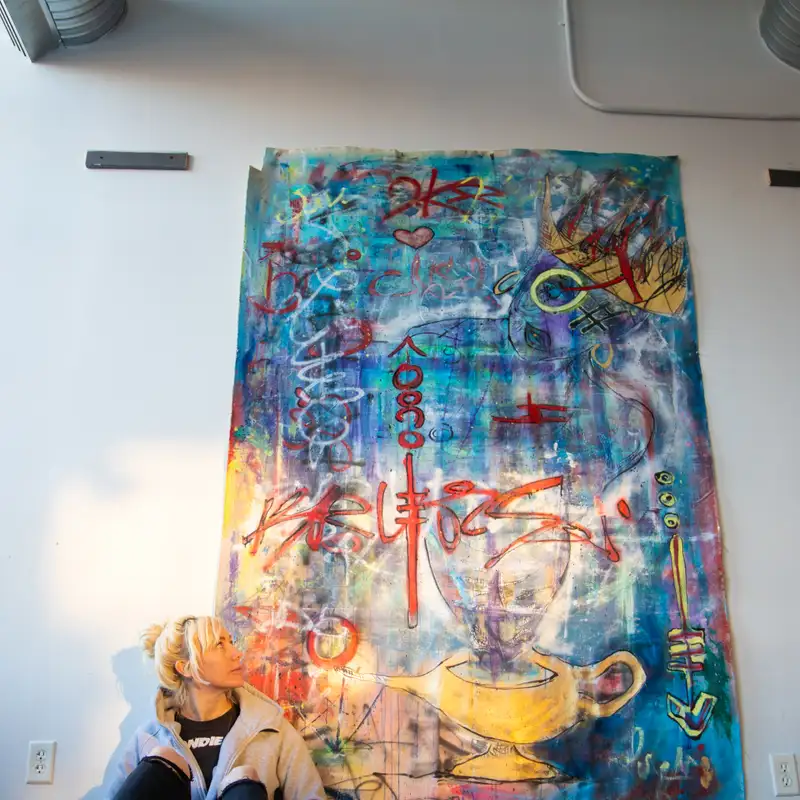
Nicole Clark: So my current work, I'll focus on my my painting. I I describe myself as an abstract, expressionist, graffiti-esque artist. And it my work is it tends to focus predominantly on feminist themes, even though the compositions often times, you know, end up abstract. But the the my current work, I feel like is an extension of my old work, if you will. And I think I mentioned I started painting in a very scrappy way by collecting scraps of wood from alleys, painting on them. And it was really out of a sense of self preservation, where I had become a little bit dead inside in a marriage that had become very isolating.
And I didn't have really any community, any family out here. And when I got out of said marriage, painting was a way to find my way back to my myself, back to that creative self. And part of the process of the process that I would take was always very visceral, very physical in form, where I would often time start with paint growing, scribbling, you know, painting words, mark making, if you will, to set down initial layers that would be predominantly subconscious at first, but would evolve into a more conscious creation and composition.
So my I added spray paint and elements of tagging into the mix years into, you know, returning to the canvas. So the the layered process really ends up adding these textured elements that I hope tell kind of the story of the physical work that it took to produce that and some of the emotional state that went into creating it. A lot of times where the feminists things come in, again, it's a subconscious process to begin with, but most times the composition takes on some feminine form. And typically it relates to something I'm reading, something that I'm listening to, an internal experience that I'm working through from, you know, the lived female experience. And the the figure often becomes a protagonist, the source on the canvas. And, you know, sometimes I can cough the story behind who and who that is and, you know, what the what the meaning is behind it.
Sometimes it remains fairly abstract. But for for my influences, I think. If I had to, if I had to kind of give it a try, I feel like influence would be my experience of growing up in Chicago, being immersed in these often kind of paradoxical styles and themes and ideas from grunge to hip hop, fatalism to hope, you know, and kind of this clash of ideas that ends up becoming kind of this clash of colors on the canvas. I've been called a color theory criminal. Which maybe maybe speaks to the fact that, you know, my formal visual art education extended only through high school.
I am self taught beyond that. But I guess going back to the trifecta, I would say the upbringing in Chicago, my experience of divorcing religions, I grew up Christian, dad was a pastor, but I've been able to make kind of a healing journey away from my religious upbringing and back to a form of spirituality that really centers on kind of matriarchal concepts that again are often worked through subconsciously in the paintings I have. And the third piece of that trifecta, I would say is hip hop. I think I try to remain intentional in how I named hip hop as an influence and borrow from it, you know, knowing it's roots.
I think it's important to be careful as a white woman and how I talk to that influence. I think for me, it feels like again, part of my upbringing, it was very prevalent just in the styles and the art that I made when I was younger. The graffiti that I saw around the city occasionally added to myself. So there are elements of that. I guess you could do slash punk, you know, with it.
Rob Lee: I get a piece of punk off of that. I definitely, I was waiting for that to come in and, you know, like, I think one, thank you, thank you for giving me that context and giving the conversation that context and, you know, it's journey. It's one of the things I heard in there, sort of finding where you're at through different stages in your life and your different relationships, whether it be, you know, personal, whether it be spiritual, what have you and really kind of exercising, I guess, that's maybe that's the word I want to use exercising a piece of that. And, you know, I'm sitting in my studio space currently and probably 10 years, you know, ago, I'm looking at three, I have seven paintings in here. I did, you know, I had this aspiration of doing a painting a month and I too have not touched, you know, I don't have any like train, like, you know, training outside of like great, great school, have you. And I'm looking at just three of them that are in here, actually four that are in here and each one has a significant, like, emotional component to what I was experiencing at that time.
And I suppose the painting was the means of sort of exercising that. Like, I was doing podcasts at the time, but I didn't say, Hey, let me talk about my brother being sick and how I'm emotionally feeling about this at this time. But there is a painting that I did that is almost a silhouette of he and I with like a discreet backdrop. And I remember one day he came by, he's like, is that me and you? And I was like, yeah, yeah, he's like, you're a lot bigger than that.
Like I am in real life as well. Or even this, um, it's one that's about a relationship that that failed. And for some reason, this is going to, this is going to be particularly interesting. I'm seeing it now.
It has sort of the, the image, I guess it's me, the, the figure that's in it is sitting in a chair and the color scheme and the sort of, um, the theme around this protagonist is the cover from the low in theory from tribes. And I was like, yeah, I was a bugger not at that time. I'm like, wow, what are we doing?
Rah, what are we doing? And, you know, just seeing those things and just never, I haven't since gone back to painting or anything along those lines. Like that was an area that I explored when I was very young and kind of went back to when I was in my early thirties and haven't touched that since, but it's a reason that they're in my creative space, this room, this, this studio space is, it has an altar in it, but it's walls and all of this stuff in here serves as an altar.
Nicole Clark: I don't know. I just felt like sharing that at that point. Yeah. Well, I mean, I think the, I feel like what you've described resonates with sometimes the. The process that starts subconscious for me that ends up having a conscious connection to something I'm living through or experiencing, which it sounds like for you too, especially with the painting of the silhouette of your brother. Yeah, my brother now.
Yeah. Now that's beautiful. I have a piece that feels like it was a collaboration with my brother, though accidentally. It's a, the piece has a very long name called I took apart the sky for you and left it there for you to see. And the line, it's a line from a song that my brother wrote. And I was working on this piece that was one of the largest kind of statement pieces of a show I did a couple of years ago called XOXO. And the show was all about love and love loss. Yeah.
And in that shell. And this piece was about just the nature of COVID's impact on my friendship and my family, like kind of just the different new dynamics that it was creating for my family, not being able to see them back in Chicago, especially during the pandemic. And struggling to finish this piece for the show. And my brother sends me this song and the line in it mirrors essentially the composition which is this like celestial moon kind of sky being torn apart.
And the night before the show goes up and I like roll it out. It's actually here in my space, but it's roughly like four feet by eight feet. And I end up just spray painting and kind of scribbling over the entire thing. The lyrics, I took apart the sky for you and left it there for you to see. There's this one of those synergistic moments with my sibling where kind of helped bring that piece into form.
Rob Lee: That's fantastic. That's fantastic. That's fantastic. That is, it's cool being able to have some sort of connection point with, especially creatively with a family member with a sibling. And I've always joked about my brother's like my biggest fan in podcasting. And when I was doing this, this other sort of comedy podcast years ago, I'm like, hey, man, I don't know if that episode was that good. And he would just give me bullet points like notes. And he was like, I listened to these. That is what you'd have known. I was like, what is it?
Nicole Clark: Unsolicited.
Rob Lee: Literally. He was almost a historian in some ways. He's like, so an episode 300 because I do high volume episode 300. You said this at minute 15. I'm like, why do you remember that? Like what? Should I hire you? You know, and and I find that for me creatively, and I definitely want to get your take on this since, you know, there's a piece and I want to talk a bit more about XOXO because I did have a question about this. You're going ahead.
I like this. I've had instances over the time that I've been making this that I've had friends and co-hosts and so on. But, you know, I've had instances where my dad has been on not this podcast, but this other movie review podcast that I did. And, you know, I would always look at my dad. It's like, all right, you know, you're a Vietnam veteran. You're this dude.
You have this background and putting a mic in front of this man. He's like, nah, I got much to say. I was like, you're nervous.
You're nervous. And but it was when we were talking about something goofy, like a Van Damme movie, like, you know, John Claude Van Damme movie from, I think it was Double Impact. And I'm like, yeah, you remember when we watched this? You got this from Blockbusters back in the day. And you would think we were talking in front of an audience.
The mic definitely intimidated them. But I just felt really cool being able to show my dad this thing that I've been doing for a long time and being able to share, hey, you know, you're, you're, you're getting movies back in the day is one of the reasons why I love movies. So let's talk about a movie that we share this experience with. And same thing with my brother for things and same thing with partners and all of these different things. And it's something about being able to share your work or if your work is influenced by someone very close to you and they have some, some dealings and it's just a really interesting feeling.
Nicole Clark: Yeah, I can, I can relate.
Rob Lee: So, so XOXO was your debut solo show, right? It was. And I see that the features works from 2019 to 2023. Yes. So what was it like in sharing, you know, like a solo debut? So what was it like sharing some of those strong emotions through your work and how do you decide sort of maybe what's, what's all right to share? What's it like? I'm going to sit on this one for a little bit. Talk to me a bit about that. So to those considerations.
Nicole Clark: I think my default setting is an open book, especially, especially with, with my art, I feel like it's perhaps because it's abstract enough that there's some safety behind people maybe not, you know, having a concrete portrayal of, you know, this breakup that I went through or the loss of this friend community. But for that particular show, it was borrowing from the Alfred Tennyson, I got this name right, quote, it's better to have loved and lost than never to have loved at all. So the paintings were essentially a pondering of that question. And there were moments in those years in the paintings that I was creating as these visual journals of love loss, where some paintings were positive. Hell, yeah, it was worth it. And some paintings, you know, in that series, you could look at and see that not, not so sure the heartbreak was worth it, you know, but just deciding, deciding what went up on the actual wall. And this was at the, the night owl gallery. Shout out to Beth Ann Wilson for giving me my first solo show. Think the decision of what went up was kind of dictated by just the realities of the pieces that I had available to dress the walls and the fact that they were all very personal.
Yeah. So there was a bit of a forcing mechanism, I think for my first solo show, where the opportunity was given to me and it was like, well, this is the body of work that I have, that I felt most proud of, especially that I didn't, I didn't shy away, I guess, from the personal side of it. And I actually instead leaned into it and focus, you know, an artist talk that was about the whole concept of love lost and had kind of an interactive portion where invited people to, you know, have post-it notes about how they would answer that question. It's good. It's really good.
Rob Lee: And shout out to Beth Ann as well. I got, I got two more, well, three more, one of the two part question. Real, real questions left. And then I have a few rapid fire ones for you. So, you know, writing is also in there with the visual components I must ask. I've noticed that prose, the prose of the written piece in the web scene and descriptions for some of the collections and some of the work, it's, to me, it feels like a connective tissue adding more depth and story to the overall theme.
So why is that important? Like, because I'll say this, I have a friend who'd asked me for a piece of advice on an upcoming show. I'm like, I don't know anything, brother. And he's like, that's the point. And I said, cool. And I gave them sort of the, the business thing going back to what we were discussing earlier.
I was like, I think the words are going to matter. You're articulating this to me and I understand it. But I think you and I are very similar.
We're like our birthdays are like a month apart, well, week apart. So I kind of know them and so on. But it's like these influences that are there, I think having some good prose and storytelling around it is only going to elevate the work that they are adding that connective tissue. So why is that important for you having this background as a writer and as a visual artist?
Nicole Clark: First off, I got to say, I'm going to borrow your phrasing of that, the connective tissue, something in my updated artist statement. I think, I think at the base level, it's, it's important for me to feel understood. You know, I, I'm trying to think if there's a sexier way to dress that up. But the knowing, knowing that my artwork has an abstract element to it. I mean, there's, there's a lot of figurative components and I have collages that are more literal, if you will. But the, the conceptual thinking that goes into it, I feel like is a labor of love that I want people to be able to experience in some semblance. The, the writing also serves as a way for me to understand myself.
So I think understanding is, I guess, kind of the root answer here. Sometimes when I finish a piece, I step away and am able to see what I've been working out on the canvas or a piece of wood, you know, or collage. Sometimes I have to write about it. And I think some of the, the pros that you see on my website or on my, I have a medium blog site, silk, clean them come where I've, I've drafted short essays, creative essays that go along with some of the pieces. So it's, it's kind of a means, I think of, of archiving the experience for me to understand myself, but then, you know, I, I realized that like art feels unapproachable for a lot of people. And there, you know, I think the pretentiousness that I talked about that wasn't there in the Baltimore art scene.
I think I even went in ready for it. So sometimes the pros serves as a way to offer a literal life vest to coming into the art and kind of understanding in a way if it's not your first language. Yeah.
Rob Lee: That's, that's good. I see the stream of consciousness, right? Helps because you answered the second part already. So now we have one question left. So that's, that's pretty tight. Um, but yeah, I, I definitely relate. I felt, I felt seen or heard, um, the, the being understood part. Um, cause I find like often I'll do this as a, as a courtesy, I suppose, but the intention is not to be misunderstood. It's looking for certainty. If I'm being completely honest and it's I'll put in those extra words to really get across something. I, I can have a way with words. I can say something that's slick that sounds real cool.
And you know, let's speak in slang sometimes, but also it's about. Can you articulate a message? And I find that some folks kind of go a little bit too short with it because of the last, what, nearly 20 years we've been writing in 140 characters or less. So now the sort of how language is used, especially when articulating something that isn't in language, that's maybe a visual component or, you know, maybe something that's a creative endeavor.
We're assuming that people know a certain thing. So some, but sometimes words are required to help add that extra texture to it. Um, you know, recently I kind of did this sort of deep dive into, you know, an album and I didn't know the language, you know, I wasn't really privy to the language and set album and I appreciated musicality of it. I appreciated the story of it. And I appreciated all of the other artistic contributions attached to this album.
There's a short film. There's all of these other, other different elements there. And I was like, Oh, this feels like a full profile, a dossier creatively. And I thought I was in that world. It's immersive in that way.
And I find at a minimum folks are kind of falling short at times. It's like, well, you should just get the art. And it's like, maybe, but also you could add a little bit more to it because I think a lot of times it's this, um, they use a term in podcasting a lot now, the per social and I struggle with it, the per social relationship. I struggle with it. Like I did the, you know, podcast while I'm being interviewed, but I tend to shy away from that because it's like, who cares about me? But, you know, giving a little bit more, if something could be misunderstood, I think that that can be helpful. And folks are sometimes just reluctant to do so. So I think you having the, the sort of storytelling component, the, the text real component with the, the visual component, it just adds to it. It makes it much more robust, giving a person almost a, an entry point into perhaps your thinking and perhaps like where you were at in the making. And in the process of making.
Nicole Clark: No, thank, thank you. I appreciate that. It is, there is a sense of vulnerability of trying to make the abstract concrete as well. So that's, I appreciate that. Thank you.
Rob Lee: And it seems over explaining. That's what I do. That's what I do best. Uh, so here's, here's the last, um, question. Um, so let's talk, talk a bit about like, you know, you're, you're abstracting your, your figure painting focus on the feminine form.
Wow. Your collages offer poignant and satirical insights into the female experience. How do these artistic choices connect to your own experience? And I know you touched on it a bit, but if you had like, maybe an example, you'd like to share on that or speak on that a bit further, I'd welcome that.
Nicole Clark: Absolutely. The, the theme here is personal. My, my work is deeply personal. I think especially as a lot of my artwork is this externalizing of some of my experiences that have been very shaped, uh, by walking through the world as a female. I, some of the, the collage series that I did in particular were all very focused on kind of different archetypes of, of women.
And for me, that series was part of thinking through how those archetypes showed up or would show up under the guise of an experience that I was going through. I experienced sexual harassment in the workplace and a very un, well, it's always unfortunate, but, um, in that sense, the collages were a means for me to think through not necessarily how things might have been different, but to, to, to build a certain resilience and kind of mental experience of how I might show up. If for some reason it happens again, um, again, not trying to dwell on the experience itself, but it was a way for me to visualize, you know, if I was the warrior archetype, if I was the maternal archetype, um, how, how that might look, how that might sound, uh, usually the collages I make incorporate prose once again. So kind of a means to reconfigure parts of my experience and transmute them in a way that I could reflect on and kind of absorb for maybe future situations. That's, that's good.
Rob Lee: I think taking, taking from something that's not a positive or a wanted experience and being able to take sort of the feelings and the emotion every, every member being in therapy years ago and talking with my therapist. And he was just like, he was saying to me that anger is a fuel for change. And so like, you shouldn't get angry.
You shouldn't have emotions, you know, Aquarius, right? And, uh, and I was just like, all right, how can I leverage that? And one of the things, and we'll close on so that this is the last real question. One of the things, and I was sharing this with you before we got started, the creative mornings talk, um, you know, pretty much I'm talking about and providing examples of instances of when me sharing the truth kind of got me in trouble. You know, I was in a meeting with a diversity meeting and I was the only black male in the meeting and I'm speaking about my experience here. And I had two white women next to me telling me my experience didn't happen in a diverse diversity meeting. And it was just kind of like one of those things that you just roll your eyes and you just giggle about it.
I'm, I'm a six foot four, 250 pound man. So it was just like, I guess it didn't happen. Back to this coffee cake I'm eating and, you know, but being able to, but being able to, to take that and get something out of it versus just sitting on it and keeping it internal. And I find that even going back to the paintings I was describing earlier, those were real feelings that are expressed in a way that have some, you know, abstract elements and so on that are there. The, the paintings that I chose to make abstract and some, some degree of figurative.
I'm not, I'm not copying your style by the way. Um, but really being able to take sort of these emotions that perhaps are in experiences that are fragmented, you know, that I'm trying to tell a story with it and using what I do now and sharing verbally these stories and trying to make it entertaining, but also trying to keep it as close to real of what the experience was because at the end of the day with time, you know, time removed from an experience, it feels a little bit more silly. But also it still has the feelings that it had attached to it. It's like, this sucked. This was unfair. And, you know, the result was what the result was, um, with it and being able to perhaps recontextualize it and make that a chapter of my story, but not my defining, you know, story. Yeah. All right.
Nicole Clark: It's, it's, I have, I have so much gratitude for the ability to have an outlet. I, some of some of the consulting work I've done has had me in the mental health space and learned a lot about the connections, you know, between the mind-body connection and the things that we internalize that can lead to cancer, can lead to higher risks of heart disease. And, you know, I think there's a very tactical, physical healing element of, you know, whether it's through storytelling on a podcast like this, through art of being able to find that healthy outlet to, to make sense sometimes of those really shitty experiences.
Rob Lee: Yeah. Um, you know, one of the things that I've gotten advice from my, my partner on the slide here, you got to stay neutral. You got to stay neutral for too much. I was like, nah, I got a feeling on this one. And, um, I remember I did an interview with, um, a, uh, actor playwright and, you know, we were talking about sort of just loss, right? That was the thing. One of the things that came up, she was pretty, um, she had a lot of attention around her work because of this talk that she did around like loss and grief. And as I remember you're sticking out that, you know, when someone is like, it has an emotional response to on the podcast, I'm like, Hey, hey, let's go back to fun questions because I'm like, oh, neutral feelings. And I think, and as I listen back at that podcast and I teach podcasting as well, and I referenced that episode and a conversation and it was just sort of the power of being vulnerable and sharing. And, you know, I gave the, the subject, the guests in that conversation, sort of the space we could have posted, we could have did whatever that was needed. And we just didn't. We just kind of kept rolling and as if it was a real conversation. And I just looked back at that moment as, oh, right.
This is can be what this is at times. And it was not, Hey, my goal is to have a person have an emotional response. I want to make you cry this episode, but it was more so asking sort of a real question and having a real thing that, you know, that's in the forties, uh, kind of, kind of encounter and it just was one of those moments that really stick out, fix out to me in doing this, um, because it felt really real where it could have been completely scripted, cleaned up and all of that stuff. That was, that was actually a lot of real and I was hoping it for it to be. Wow. That was a little bit much. Let's move into the rapid fire question. Okay.
Nicole Clark: I'm ready. I'm ready.
Rob Lee: Oh, all right. So I have three rapid fire questions for you. And, um, I'd like to say to you, to everyone that does this, this round of podcasts and everyone does this round of podcasts is, you don't want to overthink it, whatever is the, the first thing that comes to mind short sentences, you know, one word answer, whatever that is, we're looking for the shorter answer. It's making me think of
Nicole Clark: when I was little, my dad would have us do book reports at the dinner table, which were essentially tell us about the book you're eating and I would be like 10 minutes in and I'm like, and then in chapter two. So I have, I have my dad's refrain of summary, Nikki summary.
Rob Lee: So here's the first one. What is the first thing that you do when you enter the studio? Stayer at my paintings. So I say, I say smudge, smudge and shade. It's just like, I get all of the bad energy from previous conference. Not all of these go well. Some of these, I'm like, all right, I gotta edit that one down. This person was mid or I was mid. Somebody was mid. So I got to get the bad creative juju out of here.
Nicole Clark: No, I have my palo Santos and lavender spritz. Yeah. I think the first, yeah, thinking again, productivity, what you do. Do I stare, stare at my paintings and decide where to dive in?
Rob Lee: I sometimes if I'm doing it on site, because I do on occasion, just go to do studio visits, do interviews. The first thing I do in that studio setting is forget all of my questions and be a buffoon like, oh man, who am I interviewing today?
Nicole Clark: What's your favorite color?
Rob Lee: It's gray. That's what mine is. But yeah, that's literally where I start. I'll share this with you before I go into the next one. I had an interview on site with a guest at his restaurant. And I'm ready. I'm going there, doing all of the stuff. And I prepped and how are my questions sort of like good to go and everything was ready to go. And, you know, while it was ready to go, I get there and I'm just kind of doing a little bit of what I did with you earlier, sort of like, let's just shoot, you know, shoot it up a little.
So that's just, you know, shoot around as it were. And I asked him something. I said, yeah, so when you were writing back in the day, because the research that I did said that he had a background in writing as well as being a chef.
And in the conversation, he was like, I've never written anything. And I was like, all of my questions are wack. I got to, I had to improv the entire thing.
And I did well, but it was just like, I was just like, okay, I know how to do this, but I feel grossly as a preparer now. Cause I want to ask him so cooking. How do you turn on an oven? I don't want to ask him that.
Nicole Clark: Does he watch pot never going.
Rob Lee: So here's the, here's the, here's the second one. Second rapid fire question. What is the question that you commonly ask yourself? Cause I think we all have these questions like, why am I doing this? Who's this for is the question that I always have when I see something that I'm confused by, I'm like, who is this for? So what is the question that, that you find yourself asking just in life? It could be art related. It could be socially would have you, but a question that you commonly come to. Hmm. Where is this going? I've been asked that a few times. I tell you actually.
Nicole Clark: Well, I guess as well.
Rob Lee: If it was a while back, the question might be, what are we? That might be the question. I was like, I don't know. All right. That's, that's a good one. That's a good one. Now here's, here's the one that I've worked on that I'm really happy about. So some lead up for this.
So I'm going back to maybe 2020, 2021. I think of the Michael Jordan taken it personal me. Hence the pedi-aquarius thing I mentioned. I think it's an effective meme, the notion of taking something personal, even if it's the most miniscule or even self created in practice. What emotion drives you when you're getting something done?
Nicole Clark: Boom. Anxiety. It's a good driver. Um, it's rapid fire, right? Don't ever think it. Yeah. It's like the red, red dose of anxiety. Okay. Yeah.
Rob Lee: I take it. I take it personal. I take things personal. That's that's what I'm being honest. It's like, he didn't have to say one other thing. Just said, man, you wasn't good on the mic this time. What? And I got put 40 on you.
Um, and the podcast equivalent of 40 is just a 40 minute podcast. Like, if I don't know, um, so, so here's the sage advice. Here's the last question you completed the rapid fire portion. So thank you for indulging me. And, uh, here's the sage advice. And so in your opinion, and really just sort of peeling the curtain back, however you want to do, or peeling the onion back and pulling the curtain back.
Um, what is the best way to cope with the feeling of being ignored or overlooked as an artist? Hmm. Rapid fire. No, no, this is not rapid fire. However you want to answer this one. Oh, okay. Page advice. Yeah.
Nicole Clark: I'll take a few more awkward silence pauses. Um, it's making me think of a conversation I had with someone who I think would call herself an artist, a craft woman, let him more founder of knit soy metal. And I remember talking to her when I was starting to take my, my work as an artist seriously and also trying to venture out as an entrepreneur and start my own business, she had successfully done the same. And I remember her telling me, you got to put blinders up at a certain point. And, but especially at the beginning, because you could get paralyzed looking left and right at what others are doing, the recognition that they're getting, that you're not getting the comparison of yourself to others. And so this like really great visual of blinders is I think something I would, I would, I would pass some stage advice that was given to me on.
So I wish I could take credit for that stage advice. Uh, but blinders. Yeah. I think it's an important to also know sometimes when it's a season for blinders and, and there's seasons for looking at what others are doing that, you know, if they're getting recognition, asking yourself, are you putting in the same discipline of work? Like you might think that their work isn't as good as yours, but are they showing up to the studio on a consistent basis? Are they, you know, doing something that perhaps you need to introduce into your own rhythm?
Rob Lee: That's good. And I think it's super real, you know, um, and, and something like this and seeing everyone with a gambling of, with a gambling finance or is doing podcast now and, you know, being able to distinguish those things. And I get calls and offers that I would imagine the same way as any artist. They're, you know, we need art. We need somebody to do this. And, you know, it's just like, does it fit?
Doesn't match. And it's like, why is that person getting that? And I like what you said there. It's like, well, maybe what they're doing, you could apply to what you're doing. Maybe they're putting in more hours.
You don't know. And it's last season, I got one really cool piece of advice or that was, or an insight that was shared in the pod. It was from D Watkins and it was running your own race. And it's such a real, real thing. And I think it relates to that blinders piece. You got to have it on. Sometimes you should be aware, should be aware of the universe around you.
But, um, sometimes it's a season as you said, to have those blinders on. So, um, so thank you for that. And I think that's something that, uh, that folks would take something out of. And I think that's where we'll wrap for today. Um, so there are two things I would like to do as we close out today. Um, number one, thank you for coming on. Spending some time with me. This has been a pleasure.
Nicole Clark: Thank you for having me. Uh, the pleasure is all mine. They say I appreciate the chance to tell my story. Absolutely.
Rob Lee: And, um, number two, I want to invite and encourage you. This is the shameless plug portion. Invite and encourage you to share with listeners where they can follow you. Check out the medium. I was on there earlier, uh, website, social, anything you want to share in these final moments, the floor is yours. Yes.
Nicole Clark: So I, I go by tillqueen.com is my art alias. You can find me on the gram tillqueen.com, uh, or tillqueen.com .com.
Rob Lee: And there you have it folks. I want to again thank Nicole Clark for coming on to the truth and this art and sharing a bit of her story with us. And for Nicole Clark, I am Rob Lee saying that there's art, culture and community in and around your neck of the woods. You just have to look for it.