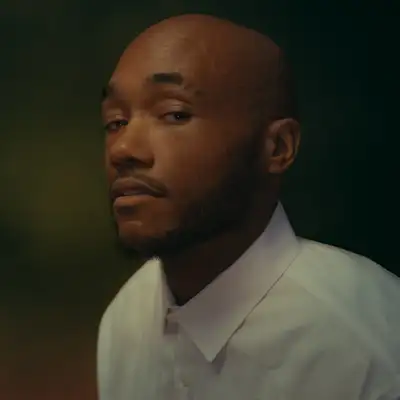
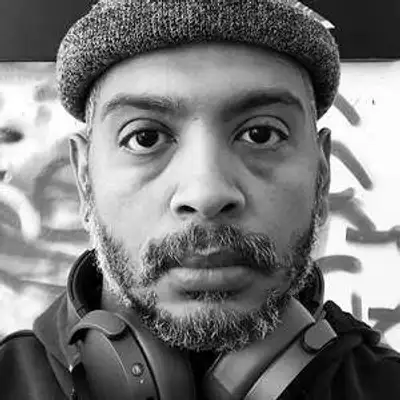
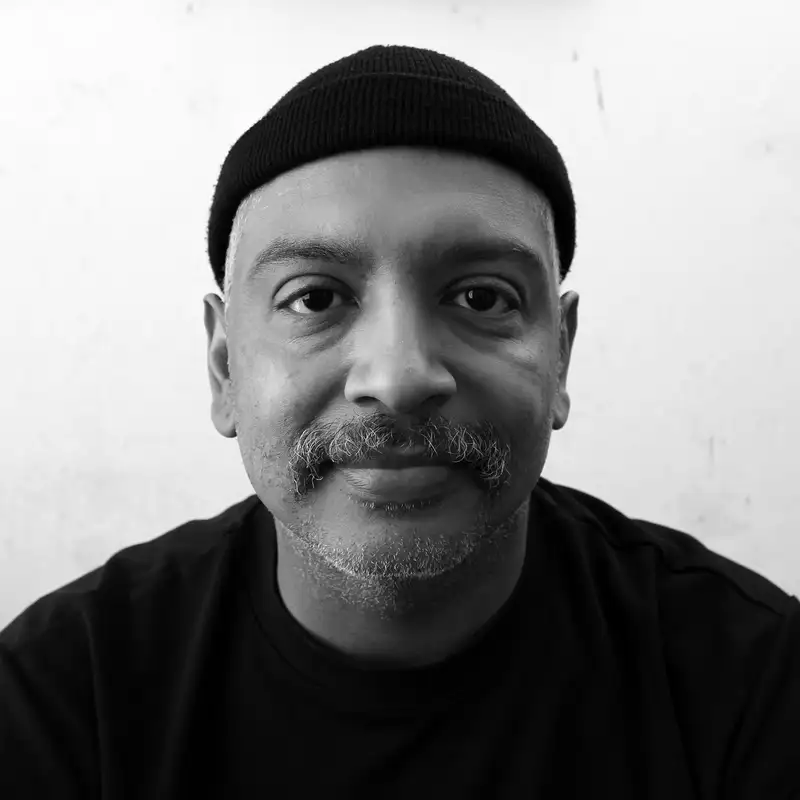
Santos Shelton
Download MP3Rob Lee: Welcome to The Truth In This Art, your source for conversations connecting arts, culture, and community. These are stories that matter and I am your host Rob Lee. Today I'm excited to welcome my next guest onto the podcast. My returning guest is an artist from the Bay Area who intertwines storytelling, science fiction, and fantasy through vibrant colors and dynamic textures, exploring themes of vulnerability and healing in his work.
Please welcome back to the program, Santos Shelton. So since a brief bio often focuses on the career, it doesn't fully capture the subject, the person. And I want to remedy that by giving you the time and the space to introduce yourself in your own words. And if you will, please introduce yourself in your own words.
Santos Shelton: Yeah, I'm Santos Shelton. I'm an artist, storyteller from the Bay Area. I infuse my trauma, trauma I've seen from society and things going on that affect me. And I try to infuse that with my love of sci-fi and storytelling into a type of mixture of just expression and vulnerability. And I derive a lot of inspiration from my own life, but also from my culture background, being biracial, being black, being Mexican, and that kind of like pulls into and affects how I speak about my work. But also it's a kind of a cornerstone, I think, for a lot of connection I've seen in my work with sci-fi and other work of other artists. Yeah.
Rob Lee: Thank you. See, what we do is when we have returning guests, we do a test. We line them up, we compare them. Word for word, ball for ball. I was like, nah, Santos, you said it the right way, Les. It was different.
Santos Shelton: Yeah, I mean, I think that it always changes, man. I think the way we identify ourselves and we create always changes. And I made sure not to listen to my old interviews so that I wouldn't feel like I needed to connect or I'll have the same things because that was me then and this is me now.
Rob Lee: And I think that's one of the ways and always play with it and always kind of struggle with a little bit of having that as the first question line of requesting someone introduce themselves because I think I can do an introduction.
It'll be one in post-production. But I think having a person describe who they are in their own words, it really gets to the root of what they find important about their work or their background and so on. And a lot of times when we get these really splashy, well-written, sometimes chat APT written bios, they miss the essence of who the person is.
I want to add a little humanity there in that initial question. So in moving to the second question, to the follow-up to that, so writing your bio that art has always been a necessity for you. So helping you make sense of the world around you and just, and I think that's a good thing there. How do you, how do your personal experiences and emotions like evoke, you know, influence in the stories you want to express like in your work? Like where do the emotions play? Like how, I guess that's the first half of the question, I suppose. Like how do emotions like really show up in your work? Is it like generally happy about this? Let me, let me make a painting about this or man, that was a really tough time right there.
Santos Shelton: I would say I'm classically a pessimist. I'm not a, I wouldn't, I guess if you would meet me on the offset and meet me up front, you'd think, oh, he's not a positive person and he's not really like, oh, he's just kind of a Debbie Downer or whatever. So my work tends to focus a lot on trauma and that's because, you know, when I was a young and trying to paint, it was just really hard. I think, you know, especially being a person of color, there's just not a lot of leeway to express yourself or feel like you can, especially if you grew up, you know, as a, I think like my dad was super macho. My dad was, you know, a hustler. So my dad kind of instilled into me this kind of like cold facade that you need to have and you need to keep yourself together.
So when you go outside and make sure you don't. So a lot of stuff I had was just really pent up and art was really the only way that I found a way to like voice stuff that I was feeling without articulating it. And so, you know, I found as I got older, I was trying to kind of like mask that and be happy and like, well, I want to paint a painting that's happy and I might see someone that like, you know, a colleague or a friend and they have paintings and maybe they're about being happy and stuff.
And I might see like them sell a painting and I'm like, oh, well, no one's going to buy my work. It's about trauma. And so I think I started to realize that like to sway from that was not being myself to sway from not painting and talking about subjects such as, you know, racism, classism, abuse, systematic oppression, things that I like have affected me to the point that like it feels like I have to speak about them.
But also like I've learned that I need to speak about them in a way that is respectful to myself, but also not overbearing for other people because emotions and trauma is a very hard, you know, thing to tackle, you know, and it wasn't until, you know, I've read, I went through a time in a period in my career, I really like I said, I tried to change and be like, I need to paint happy stuff and maybe that, you know, but I really I read this this article about how important it is to have movies that are like that are showing trauma. And I think we forget about, you know, there's some really great funny movies out there. There's some really great sci-fi movies out there, but there's some really great movies that have opened up me personally. And I think other people to trauma that we live with on a daily basis. And I think the reason those movies, if you think about it, if it was such a bad thing, why do these movies that have trauma and I'm getting Academy Award here and notification is because I think in general, human beings in this society don't always have a release or a narrative to what they're feeling. And so when we see a movie and it connects to us and it speaks to us about something maybe that we're not talking about or we're not vocalizing, it is very powerful. And I think very uplifting, although it may seem like, you know, it's not at, you know, you know, at first class. So, yeah.
Rob Lee: Is there a topic or a theme that because I think you have a really good point there where we build out, I think I play with this a lot. This notion of we have certain feelings that we feel and we express and so on. But I think sometimes there's depth that's missed because we look for the sort of primary feelings, but not those other ones. And I think, you know, there's a feeling, let's say around loneliness, for sake of argument, that a lot of people are engaged in now, but we're afraid to sort of explore it and go deeper into maybe the causes and actually the feelings really get into it because it's uncomfortable. So, you know, are there any topics that you have been exploring or maybe kind of stop short of exploring in your work because it's a bit too sensitive, because it's particularly challenging to kind of tease out visually? I've definitely had some fears.
Santos Shelton: The last show I did was probably like, I have a kind of a change of always my personal life in my work, whether it's, you know, very visible or not. But the last series I did, which was the solo show I did in SF last year in 2025, that work was very personal and it was about my own experiences with abuse in the home, it's abuse in general and how that affects not just like the visceral like what we see and like someone gets like beat by a parent or with how that affects the way they think about themselves, how that kind of tinges upon the way they see themselves and how they grow into things. And it was really hard.
It took me a second to like kind of like talk myself into it because I kind of didn't want to do it because to paint and to talk about these things was not only going to be an illuminating factor to my own path, but like my mom, my dad has passed, but my mom is still alive, my family is there. They're going to see these things. They're going to see what I'm talking about.
They're going to see a side of things that maybe they didn't see. And so I think part of me is maybe that's just my own need, but it's been very difficult, I think sometimes to wrap around the high emotion of that with like containing it in like work and stuff I have to do. I think by saying that, I mean like it's one thing I think for anyone who's creative to acknowledge trauma they have, but when you put that into a show or you put that into a piece of work or music, it's not only there and you expressed it, now it's there for people to digest themselves. And once it's out there, you kind of have to realize that whatever comes from it, family members not understanding, people not understanding the situation, maybe you feeling a little like weird being that vulnerable and allowing people to see it as part of the process, as part of, you know, what allows, you know, the work to be impactful. But I think one of the things that I still have, you know, kind of some residence and I'm still negotiating, it's stuff that has to deal with more politics and that's not because I'm scared of, I think the way people view it, I'm just like my point of view isn't always to express, it's always to like kind of create a narrative. And I think sometimes, especially when there are things that are political, we have to really be understanding of what narrative we're putting out there, because that is, you know, it creates a kind of a flow on its own once it gets out there, you know, you can make a statement, but you also have to be willing to kind of back up that statement, but also accept that you are not controlled of how that statement affects other people and how that's going to kind of, and that's, I think the hardest part about being vulnerable or talking about really powerful things like Palestine, like immigration, any of those things, because there is going to be some misunderstanding, whether it seems like it's, you know, we can all agree that killing someone is wrong or, you know, police brutality is wrong, there are always going to be some type of perspective that doesn't understand the full nuances of that. And that's something I think, if anyone's trying to be more expressive about their stories or create that into their work, it's partly something you kind of accept, and accept is that the goal of it is not necessarily like what are you trying to get out of your expression of what you're going through?
Is it something, you know, for people, or is it something for you, or is it both or whatever? And mostly for me, when I'm expressing any type of trauma, whether you're talking about race, or it's for me, because I don't, I don't, I've just already understood that like people aren't always going to, to necessarily respond well, because they haven't had my experiences. And that's part of the elimination of different experiences, you know, not everybody knows what it's like to go to war, or I have two brother-in-law that have served and I don't know what that's like. And I would need them to eliminate the nuances of that to me, just like maybe someone has never grown up being black or grown up, you know, impoverished or grown up and having that along with having, you know, maybe some abuse or stuff in their life.
And so someone has an experience that they're not necessarily going to understand that doesn't mean I don't think people can fully understand it, but they're not going to get the nuances of what you're talking about all the time, which kind of folds back into what we're seeing earlier about reverberation and going back through the stories and really looking at the smaller points.
Rob Lee: So that's a good point. It's very, I think, well thought out, well, you know, considered because, you know, we're in this era where it's who, what message and what narrative is out there the most, which one is easily, easily cleftable, which one it doesn't get to monetize, all of the things.
And it's just like, well, where's the sort of truth sitting in there? Like, you know, when it comes to any of the things that are the things that we're, I don't do this podcast to try to get across a certain store. My thing is to document my thing is to try to cover conversations with folks moment in time, things. And if somebody comes on, they want to talk about this, I've never told anyone, let's not talk about that. It's never been sort of a thing for me. Sometimes there are certain issues that I'm like, all right, let me let me pull back the curtain a little bit. Here's the here's the real topic on it. And then there are others that I'm like, I'm not qualified to speak on that.
I can share my opinion if the person is so into whatever my opinion on a particular thing is, hey, let's have a conversation. But I think it sort of takes away from it, because I think it's it's nuance. There is like going back to making a painting, making a work, you know, or even like doing a podcast or something, right? Where it is, it's the sort of period where you've had an opportunity to create, consider, edit, and then put it out there, where sometimes the conversation is much more instantaneous, you might have some some things lined up, but it's much more instantaneous. So I think it requires a little bit more consideration and more time with it. So as you were touching on, and I definitely have an interview I want to share with you regarding this, if you want to touch on like things that comes from like a family standpoint, and you're like, these people are so around.
How are they going to feel about this? I still want that relationship or whatever the thing may be, but I still also want to share what my experience was. Those are those are challenging. Those are very weighty. Yeah.
Santos Shelton: Yeah, I think it's, you know, it's all personal. I think it's, it's, you know, you decide what's comfortable for you and when you want to do that. I don't think, I actually don't think every time is the right time to bring up traumatic things or political things and you have to kind of read the room.
And like you said, put out a feeler and if someone brings up, then okay, I'm not going to, you know, be announced it or I'm not going to, but I'm also not going to make that the subject of everything, you know, and I don't, I don't like to have my work be the total like summation of my work is just all political and about trauma. It's just like, that's what I express and what I like to make. But I think in general, to be a creative person is you really have to have in touch with like what you really want to say all the time. And that changes a lot. That changes from, you know, as you know, if you're, I've been painting since I was 20 and my brain and my emotions have changed and evolved through that time up to 45.
And some of the things that, you know, there are things that I still want to paint about that like I wanted to talk about before, but now like I think some of my, I don't know, I'm finding that as I get into like my 40s, I'm in midlife, as I'm getting older, I'm finding that a lot of my brain is settling down into like this, kind of like balance of realizing that like their life is about opportune times to engage people and not you trying to always force upon your, the way you think or feel unless it's being accepted or the rest, the energy is there for it. You know what I mean? Yeah. Yeah.
Rob Lee: So in that, I think it'd be like timely to shift into, but not too far away because it's kind of a stage of where you're at. Let's talk about your upcoming mini solo show. Can you describe what the show is about?
Share a bit of the creative process and developing it? I have a follow-up question for it that definitely aligns to what we're talking about, but I want to give you the space for that.
Santos Shelton: Yeah. So the show I got coming up is at Gally, Ergo and Seattle and it's a mini solo show and it's a show I'm doing along with another artist who's going to have kind of like a full solo show. And her name is Brynne Perot and she does these really great wood carvings and stuff like that, but my show is mainly centered around death at this point and that is due to the fact that I've had just a lot of loss in my family over the past four years. Since 2017, I've lost about seven or eight family members due to illness, COVID, stuff like that. And I think I didn't have the time before because I was working on a previous show about my views to really tackle these issues and what death means.
And for Mexican-Americans, death for us is winged into a way of like thinking in life with the Adelaus Marcos and thinking about life and connecting with people. But also, it's something I think that impacts us as we get older. Many of my friends who are now in their 40s and stuff are having their parents are having issues with health and they're having health.
I'm starting to like getting the stuff, hey, you're 45, you need to get this stuff checked out now and you can't. So I think a lot of that hit me in a way that I really wanted to focus on talking about just what death means. And so the show is titled Afterlife. And so it's really about the character that I continue to use as a tool and the character's deep space traveler. And he left this volcanic planet and now he's out back in space. And when he's out in space, if anyone's a space nerd, there are these huge nebulas that exist out in space filled with gas and all types of elements that create the powerful stars and stuff we see. So this, the deep space traveler kind of gets caught in this nebula.
And within this nebula, they see remnants of past people from their life. And I wanted to use this as kind of a tool, but like an homage to my family, but also like it became a little bit more like an homage to Mexican culture just because of what's been going on. And I was really thinking about like, do I want to make, what type of work do I want to make in correlation to that? Because a lot of the work came from sketches that I often, if there's something bad going on or something I'm reading on the news, a lot of my go to meditation is sitting in the studio and sketching a character from that or sketching something about that because it allows me to kind of just like debunk these feelings I'm having inside and try to get back to myself and get focused on what I'm doing. But I think for this show specifically, I usually try to like, I know it's a bad habit, but I try to come up with even more extra work to like new creative work. And this time I kind of went back and looked at all my sketches and what they were saying to me. And some of the characters really stood out to me that kind of embody this, this idea I have, which is a mixture of just the culture of, of, of, Del Dela Smarthilson, my community, but also like showing the many kinds of facets of people in the history of, of my people in relation to, you know, what's been going on. And to me, the, the, the, the sense I get from anything is, is that any type of, of, um, um, subjugation or, or mistreatment of people, it's always, we're, we're, we're meant to not love ourselves.
We're not meant to be proud of where we come from. And that to me was always so illuminating. So I wanted to focus on people I've lost, but also just the culture itself and that being the power behind the work that we come from, you know, a powerful culture, powerful people and, and, and celebrating that is just as much a fight against things that are going on as it is to, you know, say stop eyes or whatever is we have to be, have this type of, um, idea of ourselves that we, we, we, we should have respect. We are living beings. We're black, we're Mexican, we're Asian, we're other.
We need to be seen and heard and seen as human beings and why this is our history. We don't, you know, showing just kind of sticking on that tip on a positive element also kind of enveloped in the trauma that I usually kind of about. Yeah.
Rob Lee: I think, I think it's, um, it, it, it keys in on this area that, and it sounds very, very interesting. One, I want to say that, but, um, also, you know, this, this thing where death is not a topic that most people want to talk about. It's also the thing that all cultures share, all people share.
And I think we've become desensitized to it with some of the, the new stuff and when it gets even more personal, it's just like, you know, once I got to 40, I'm like, oh, oh, how many, how many years I have left? Word? Right. For, you know, people that you know, you care about their, you know, like what is, it's just, it's, it's changed. And when I started thinking of sort of death and just the closest period where the notion of death and someone being ill was around me was probably 10, maybe 11 years ago, um, where my brother was not in good shape. He was ill and for whatever reason, he's good now.
He's, he's in, you know, he's, he's helping out, back in, back to where he needs to be. But science fiction was, was there as a means to try to cope right. Philip K. Dick, a lot of Philip K. Dick, you know, just trying to understand, um, sort of what reality was and just trying to cope with it in that way. And there's always this sort of somewhat, somewhat morbid, I guess, but fascination with death, like all of these different cultures and you think of like voodoo, you think of voodoo, you think of New Orleans and the, the jazz funeral, you think of, as you've, you mentioned, you know, um, with Mexican culture, it's all of these different ways or even like in Japan, sort of like they revere, you know, death in a certain way and they treat death a certain way. It's a thing that we all experience life and death. We do have a point that begins and a point that ends while we refuse to talk about it. Right. Yeah, I think it's, it's
Santos Shelton: like I said, like I try to focus on stuff that people don't like to talk about. Like what I feel like an essence I'm here to do, but that's, it's something that I had to come to terms with, with like several, you know, my dad passing and then, you know, well, before that, my uncle passed and then my dad passed and then I had some cousins that passed and then my grandfather passed. And so it was like kind of a domino effect and that had to do with, you know, a lot of external factors, of course, with health and stuff, but, you know, of course, marginalized communities and their access and stuff. But I think it is something that, like I said, my work is also like always a way of to kind of, it helps me as well as like, how do I deal with all this? How do I, and I know I'm not the only person that has gone, you know, my dad is, his death was, you know, due to COVID, which, you know, in many ways, it's still been hard for me to fully accept to deal with, you know, the political ramifications about how that was handled and stuff. So, you know, how, how do people in situations, to me, I'm always thinking like Palestine and, and, you know, not even Palestine, America, just being in America, how many people we see on a daily basis that not necessarily gets, you know, the raw end of the system and, and, and, you know, how, how do people, I'm always questioning how do people go through such, you know, extenuating circumstances and still wake up the next day and smile and still wake up the next day. And, and, and it's been, I think that viewpoint of me trying to understand that has been, I think more of me accepting to my own mortality, but also accepting while I'm alive, you know, how great I can, you know, use my legs, you know, I got my, I have a cat and a dog and my cat's 18, my dog's 13, they're also old. And so like you kind of get more, I think, of appreciation for those nuances, right, of, of, of, like, you know, taking a walk or, or laughing at something or, and I think I just wanted, you know, I see death to me as a reminder of what we need to focus on, what we care about, you know, and we need to think about what time maybe we're wasting, worrying about things that we don't need to worry about or convoluting situations that are difficult. And I can't say that life isn't difficult, but I do think that sometimes we do fight of the fact that life is finite. And one day, we're not going to be worried about those things, we're going to be gone. And in that time span, you know, what, who do you care about, what do you look forward to, or how do you want to spend your time?
And that's ultimately what I've been trying to focus on, I think, with this show and death is not like a negative look at it, but like an acceptance of it, and more of like a, in essence, like Harry Potter, like the wizard who accepted death and became his friend, like, I hope that I get to a point in my life where I don't like fear death and more like, I feel like it's my time to go out to post like, ah, give me two more weeks. Oh, maybe I should have, what do you do that roller coaster? Yeah, those doughnuts, I should have ate less doughnuts or something.
So I think more doughnuts. Yeah, I think just, you know, like just in the, you know, I think this whole past year of things that have been going on worldwide, which to me, there's always been things going on, but the illumination of the horrors of what we've been going on is we also have to be, you know, I think conscious of how like easily, you know, you can slip and hit your head or you can either there's a car accident, like my wife, when she leaves, always make sure to give her a kiss and tell her goodbye, because I want to make sure maybe it's some kind of cryptic thinking that like, if something were to happen, I got to say goodbye to her, you know what I mean? And I think that's those little things that I think we forget about those things and we get too caught up with, you know, whatever's bothering us. So that was like really the main focus.
Rob Lee: One thing that I'm going to add in there before I move to this, this next question is the numbers piece when And this podcast started, it was 2019, so maybe six months or so before 2020.
And we all know what started in 2020. And so I would take a walk every, pretty much every day. You know, you're inside, you get, you know, I like biscuits.
I'm not trying to gain any too much weight. So I was like, let me walk around, right? And I would walk by and there's a lot of like medical people and they would just have their sort of information out there, their beliefs, their politics, all of that stuff. But it was one house I would always go by and they would have a ticker of how many people had passed due to COVID, how many cases and the ticker will go up each day. Yeah. And I print out a new sheet each day and the scale and the scope of these things.
Then I kind of think about it in this way. I'm based in Baltimore. Baltimore had had this has this and have had this reputation of crime and murder and so on. And we have these, these numbers that's like 300 murders, 400 murders a year, what have you? And I was like, you know, and it's like, we're bringing it down or what have you?
And then I look at other cities that are bigger, but the numbers crazier and the numbers astronomical. And I'm like, these are still people, you know, and I was just like, so we turned these people and their lives to numbers that using the COVID one, there was a dashboard that you now cannot find. It's archived. It's a way.
So that sort of commemoration of those folks is just left to the people who are left behind. And it's just like a full, robust life. And I just think it just kind of echoes what you're touching on of just being more aware of that and just trying to have things set up in a way like checking on the people you care about being there for those people, recognizing your own mortality, because I think we've all seen it. And we've seen how the folks that are quote unquote in charge of things treated things.
Santos Shelton: Yeah, I think it's, you know, one thing I like about camping is you're really, really aware of how fragile you are right away. You know, you're in the city, you're in your nice warm condo apartment, you know, you got fire at your fingertips, you got water at your fingertips, you forget how much is needed to keep you sustained and how like fragile you are.
When you get out there and you're in the elements, and I've been in a few situations where I've been, you know, to my own ignorance, like in a bad situation, but because, you know, the nature doesn't care. But like, we are such like fragile creatures and we need not just like, like we need each other. And unlike a lot of, I mean, even animals, we, they need reverence off other animals and stuff, but we need communication, we need touch, we need all those things. And I think like that's the nuances I'm talking about in terms of like, you know, how we forget, you know, how death is kind of like the spiritual thing that we don't talk about, that we forget how many people died here, how many people died there, you know, we're aware of things like, you know, like the Holocaust and how many people died there, but we're not aware of like how many people have died in the Congo, we're not aware of like how many people died in the pan-Tranoclave trade, how many people.
So there's a lot of, I think, I feel like a, like a lot of it has to deal with, like, like you said, those numbers get put in, right? Oh, it's only 100,000, but you know, the population is 7 million. And if you look at your town or your city or your block where you're in, that's less than 100,000 people. So if you look at that context of like, okay, let me just imagine if I woke up today and then the next three blocks that I live on, no one is alive there.
They're all gone one day. And that, I think, puts more practical context into these things. And that, in essence, like, you know, what I think, you know, when we talk about death, when we talk about these things, we're not being negative, we're illuminating things so that we can, you know, learn off that history so we can learn about like how easily and fragile like life is and how it can be taken really easily and just over disagreement or just over, you know, things escalating and things not being, you know, properly talked about or seen or heard. So for sure. Yeah.
Rob Lee: So I want to shift gears a little bit to sort of the living as an artist. Talk to me about living as an artist. Like, what are the ups and downs you experience? And I think we were kind of touching the periphery of some of those, but what are some of the ups and downs that you experienced some of those triumphant wins? Like, okay, that was pretty dope. That turned out well. Or some of those moments of loneliness, doubt or even bravado. Talk a bit about that.
Santos Shelton: Um, I've been, I mean, for me, like, I've been doing art for about 25 years now. So, you know, I'd say a lot of the struggle for me always was, um, you know, I think one aspect of being an artist that I always find very interesting is that a lot of artists I know aren't the most sociable with people. They're not the most like, Hey, I can sell you something or Hey, I'm this cool person.
Yet a lot of our job is about meeting and talking with people. And I think a lot of struggle I had was just finding my right kind of like, tune with that. You know, like, how do I talk to people?
How do I engage or how do I like, you know, is this person like me or this person not like me? And I think for me personally, um, also being a person of color also growing up in a system that was like, you know, uh, the way you speak isn't right. So it's like, I had to like, it felt like sometimes like I had to look at the way I spoke or like the way I conducted myself to that maybe wasn't as natural to the way I am.
And I had to kind of, you know, and I think there's also there's, there's, you know, issues around like for me, trouble is like finding a good flow with how you work and finding a good place to, to, to work and create. And, you know, for a long time, um, I painted in my bedroom and, and, and that was what I, what I did. Now I have a separate bedroom.
I don't have a big studio, but, you know, it's allowed me to, you know, have a separate area to work from home and a separate area to focus. And so, um, that was always a struggle. And I think also like for me in general, I think one of the biggest struggles I think in general for me as an artist was finding my voice, was finding, okay, you're an artist. What do you paint? Why do you paint?
You know, what's this all about? And really like not trying to, I would say, I wouldn't say when I was younger, I wasn't, I would say that I was figuring out who I was and trying to project that. But the older I've gotten, I've realized who I really am and realized that I don't need to project anything. I'm just, I just need to be, you know, who I am. So I think a lot of those things were always difficulties for me working. And of course, trying to, you know, figure out ways to, you know, get paid, doing art.
How does that work? What is a good rate? When should I be aggressive? When should I be understanding?
When should I, should I have parameters for that? What type of artist do I want to be? Am I my mirrorless? Am I an illustrator? Or am I doing all those things to pay the bills? So I think it's a lot of just been a lot of trial and error of figuring out which way those things feel.
And I think that's, I think across the board, a lot of artists have those same struggles of their voice. How do I make money from this? What type of artists I want to be? And also like, you know, what do I want to say? Or how do I stick out? Or does that matter to me? Or like, what entity?
What is this? Is me being an artist a separate thing? Or is it me?
You know what I mean? Some artists do go with a separate thing. They have a separate name.
They have an identity. And some artists, you know, I think go more of like myself, like this is my name, what I'm about. So I think everyone has a different way that they go about trying to, you know, present themselves and navigate, you know, the creative world.
Rob Lee: It's good that you're, you're touching on sort of, and there's a, there's a lot there to, to consider, like who you are, how do you go about your stuff? And then sort of how do you make money from?
How do you make a living from it? Some of those, those elements. Um, so I want to key in a little bit on, um, sort of value. Let's talk about that a little bit. Like, I think there's, there's two sides of it. There are, and I've been seeing a lot of it from sort of my lens as a podcaster. There are times in the past, if you, if there's some device to look at, all right, I can hear this dude's voice.
I know it's Rob, but I did not put my name on that episode. I've done some ghost podcast on the low for some folks, um, in the past. And, but I've, you know, done this and I'm, I'm proud of this, but I think there are some spots where when scarcity is, is baked in. Folks will do things that feel like maybe selling out. Folks will do things that aren't really alive or what their values are.
I don't really want to put their, their name on it. And they're just after the bag. And you see these things that are not quite aligned. You see these things that like I've seen folks that say, Oh, I'm just doing this commercial work right now.
I'm like, get your thing. I'm not judging. But you can tell by listening to them and perhaps subsequent work that they're not proud of that period in which they sold out. So what is your relationship and how do you like look at money as an artist? And how do you equate sort of that to your value as an artist?
Santos Shelton: Um, I don't think there is really any selling out because it's, it's, I think people all have to do different things to, to pay their bills. And if it's something that you decide that you are not necessarily proud of and, and not necessarily like, um, I think you shouldn't be ashamed of that. I don't think anyone should be because, you know, unless you have someone who's willing to offer you, you know, a house and everything you need, you got to do what you got to do.
And, and this, this, I'm sorry, capitalist country finding the way you need to get ahead is, is, is, is on your, on, on your, you know, watch and not anyone else's, and you shouldn't be really worried about that. But also I think in terms of, as you grow as an artist, you need to think about what kind of artists you're going into. And by that, I mean, for instance, um, uh, if you like to do, if you don't like to do mural work, right? You find yourself getting mural jobs. Yes, that could pay your bills for a while, but also you have to remind yourself that you putting that energy towards doing more mural work is going to get you more mural jobs and not necessarily the work you want to go towards. So you kind of have to find a way to still hold that and then bridge kind of like where you want your career to go. Because I think a lot of creative people can get very caught up in whatever's making them money is the direction they need to go. And that's not necessarily true. I think you can be very good at certain things and that can help us creatively to make more money.
But I think there are still things that you know that are like, this is my shit. I want to do this. Not like, well, I'm doing this kind of like to supplement that. And that's perfectly fine.
I think if you're an artist or a creator and you work at the post office or you work at whatever, I think you're just as much value as any other artist. And as long as you are willing to, to look at yourself and then remind yourself that like, it's not about what I'm doing during the day. That's, that's my work. That's how I live, but this is my value.
This is my work. And I think we have such a correlation to think that everyone's value is based off of this, I don't know, this like trope of like, well, you know, I get up and I'm this perfect artist and I make so much money from it. And so if I work from home in a bedroom or more, it's like, I have a side job and you know, artists, my side, I'm not a professional artist. And I think a professional artist is someone who's devoting their time every week to their craft.
Not all professional artists make a huge amount of money. And I think that is something that like has helped me in very like, you know, like, long some moments, you know, bad moments where, you know, maybe something didn't sell or maybe I had expectations of things and it didn't go the right way. Is looking at like, is my value this project or is my value what I'm doing? And I think you have to look beyond the project, the job to like, why you're doing it. And sometimes that's actually what can get you through the job, because if you're doing something, you know, I used to work when I was way young, right? So working in a warehouse and it was like the only job I ever really quit. And it was because I was sitting on a forklift at six in the morning and sketching on my sketchbook. And I was like, what am I doing here?
And it wasn't like, it wasn't about like that. I felt like I wasn't, you know, good enough. I just felt like I needed to do more things that like, and that's when I started to do teaching after school with art. Like I needed to do something that connected with what I want to do or it's going to be too far away for me to, I get a slash on to. So I think, yeah, I think, in essence, I think a lot of people today shame themselves too much for not fitting this box of what a successful creative looks like. And, you know, it's the more you talk to people, the more I've met people who I used to think like, oh, when I get to that point, career-wise, they're set and I'm like, oh, they're not that it's what we project on Instagram. It's what we project in sales or whatever. So it all depends too, because even if you see an artist or, you know, someone doing a podcast and they're like, you know, raking in the viewership and raking in partnerships and raking in the money, we have no idea of what their costs are either.
We have no idea of what they put in. And maybe they're not, you may see all this, they're getting, but maybe they're barely getting what they're, you know, what they put in back or not even getting it all the way back. So I think another part of, you know, success lies in with you not looking at others too, because that is, to me, what I've learned is like the enemy of your own success is you're like looking over at the next person, well, they just, you know, sold all their work or they just did this and it's not about that because to me, that's their pathway and they're going to have their own dips. Now, it's not going to be, I don't know, if any person in history, whether they're, you know, even if it's someone like Michael Jordan, for instance, had a lot of problems before he became like Michael Jordan, a lot of, you know, people don't know about that. But even after he stopped being Michael Jordan, we don't know about costs and stuff that he has to deal with upon retirement.
Rob Lee: We only see the very periphery of things. We see what's presented, what's orchestrated. I think there are two things that you can't handle. And in comparison, it's the thief of joy that I was saying, right? And the other piece is we get these carefully crafted sort of the social media story. And to me, it's just a lot of external factors. You know, someone that's super successful, we don't know if they had to visit an island and some papers that just got released. We don't know if they had to do that for that success. Who knows?
Right? It's a thing of are you doing something that you care about, that you enjoy? And I think one of the things I took off what you were describing is regardless of however you're getting there, does the story or the things leading to you getting there make sense?
So it may be something that, Hey, I had to do a ghost podcast that I really want to put my name on. Did it give you experience? Did you get something out of it?
And did it pay? If it hit some of those things, then it's fine. And then you move to sort of the next thing. And I think you're right as well, where we're very hard on ourselves. And I think we put too much favor into people who let's call it what it is. People really don't have taste. They just have money. You know, saying, Oh, well, this is what's selling right now.
And people are impressionable because people are starving. So it's like, yeah, I'm going to make that thing that's selling. And it's like, you don't even make that work. And then as you were touching on, you just become the mural guy. If you're not making murals, you don't really like to make murals, but murals are what's selling the murals was getting you that grant. Is that a thing that you want to do? Maybe you want to do it, but do you want to do that in the next stage or further down the line in your art story?
Santos Shelton: Yeah, I think I think you, you know, success is it is it is what you which your perspective is on it. But I also think there's there's a practical, like I don't I don't like like, Oh, like, well, success is what you make of it. And just think successfully.
No, it's a practical thing you have to do every day. Just like you get up and it's like, well, I want to think positively. It's like, okay, like you have to keep thinking and reminding yourself that you are a success.
And maybe it doesn't look like a success to other people. But those are the type of things where we see, you know, for instance, like someone like, I really love Samuel Jackson, because that dude, people know has been acting forever. Do was in coming to America. He was a dude in the shotgun scene. And he did an interview where he was just talking about how he saw Denzel come up and he saw like all these other, you know, black actors come up and he was just sitting there and sitting there and sitting there.
And now he works his ass off because he's just happy to work. But I think there is a level of also impatience that we have as creative that impatience. I cannot say anything about it because that impatience is impacted by the deciding living where we need to pay our rent, where we need to pay our bills and we need to keep going forward. But there is a level of success that as you get older for me, that you realize it compounds over time to with little things like I saw the painting here or like, you know, sometimes I, you know, I don't know, I say this, but like, I get a message on Instagram here.
I really liked your painting and that makes me smile for the day. That is a success, you know, and that those little things compound. And so success looks different sometimes too. Very like at first and success also looks differently, like compounded over a long period of time. And so a lot of times we're not looking at where we've come up.
We're looking at right now, maybe at the plateau, you know, we're not looking at, well, like I was way down there. I was the first painting, you know, I sold with $40 and like, you know, I bought a, you know, a McRib and some fries, but hey, I remember that moment. And that is a success because to, to like, I had a moment when I was really 20 something and I did a show and, you know, I woke up really early that morning and did a quick painting for some reason. That painting sold and they gave me enough money to go to New York.
And I was so ecstatic that I could buy my ticket to New York with something I made. Oh yeah. And those little things are what carry you over when you're like, you know, having these, these moments where you're like, you know, questioning yourself, those moments, you have to really remember those because those are the ones that carry you through those times when you're like, well, people aren't responding to my work or people are responding to what I'm saying and having the patience to keep pushing forward. So yeah, I think you need to practically put in your mindset of where successes are and remind yourself and kind of like, patch yourself on the back here and there. So you can keep that motivation going. You know what I mean? That's what helps me the most.
Rob Lee: That makes sense. And there, there's two things that I'll say before I move into the final portion of the pod, the, the wrap of fire questions. Yeah, you know, sort of that success, just the notion like I have a buddy who had been working for the last two years to try to get a solo show and he continually works. He's continually putting out stuff, but just desperately trying to get that solo show. He's gotten it. He's gonna, he's gonna have it later in this year. But you know, that's a success of being able to have that breakthrough of I'm able to do this show to have work to put out for this show. And I think, right, defining that. And the other thing I'll say is Santos, I like your work behind your mind.
Santos Shelton: Oh, yeah, there's some like old paintings. I just want to put up stab like in the background, some stuff that like I'm always like messing around with. Yeah, I appreciate it.
Rob Lee: Yeah, you're gonna tell people these things. You're gonna get some juice. It's one of those payoffs, man. Oh, I got some rapid fire questions for you. And then I have this one last one is a new idea I'm playing with called Sage advice, but I'll hit you with the rapid fire questions first. And as I tell everybody, you don't want to overthink these.
That's the first thing that comes to your mind. Try to answer in a sentence or less. All right, here's the first one. If you could have dinner with any three people living or otherwise, who would they be?
Santos Shelton: Malcolm X. I can't remember his name right now, but the creator of the alien creatures, the artist. HR Geiger, and then off the head would be probably Denzel Washington.
Rob Lee: Okay, so you're just you're just hanging out in the movies and just like black leaders like before we got. Yeah. What's a fantasy world or universe you'd love to live in?
Santos Shelton: Oh, fantasy world universe I probably love to live in would be at this point, cyberpunk. 277 the game universe is, you know, that's my shit since Blade Runner.
Rob Lee: So Okay, see, we're in definitely the same age, Griblin going cyberpunk cyberpunk and I'm a Roy Batty this thing. All right, here's the last one I got for you the rap of fire. What is your oldest art related item?
Santos Shelton: Old art related item would probably be my palette. I've had my my my paint palette since I was in college. So that is probably like it's got a crack on it and tape on the bottom but it still works.
Rob Lee: That's all that matters. I have I have one of my first devices recording devices, the interface that my ex co host, he wrote on their universal fart machine and I was like, you suck. But I still have it. And I've had it for 17 years.
Santos Shelton: Oh, man, you have to keep it longer. So like someday in the future, someone finds the universal fart machine and like some kind of like cyberpunk, like this topian like, you know, where we're only podcasters later.
Rob Lee: That's what I want. I mean, back in the day, I was talking to a curator yesterday and she was like, what the hell are the the time capsules? She's like, I'm 50. Where are the time capsules?
Santos Shelton: I know there should be time capsules hover cars. There's a lot of stuff that should be going on right now. Exactly.
Rob Lee: So those are the rapper fire questions. And here's the last question. This is the sage advice question. In essence, this is sort of the peek behind the curtain. This is an observation.
And this is I'm going to get your insight on this. So my observation is that basketball players aren't as athletic as they used to be. Rappers can quickly fall out of touch.
And then suddenly they're politicians or podcasters now. And you can see these declines almost in real time. I call it a fall off. How do you define falling off and how do you prevent falling off yourself?
Santos Shelton: I define falling off as like, you're just out of touch with why you're pursuing what you're pursuing, whether it be creatively or work wise. And I think for me, how I don't fall off is I mind yourself a to like take a break, be reflect, but also like the big P patients and having the patients to see things fall out. So if you're not taking a break and looking at what you're doing, I think it makes it harder to keep going forward.
And that's how you can get kind of caught up and stuck in like the what you expected the outcomes to be as opposed to what happened and then sitting with it. And I think that's what can lead to falling off or I might as I would say like burning out and not feeling like you don't have that same connection or sync with what you're doing. So I think you have to make space to take a break and I think you have to make space to reflect and I think you have to make space to like just like sit with it and allow it to like do what it's doing. And I think a lot of people don't always give themselves that break or reflection, but then that patients factor of like, no one necessarily is going to be A plus at everything all the time. And when you fall, that's the time definitely for reflection. But also it's also when you're doing good as a time for reflection so that you can keep kind of let energy going and not like, you know, take it for granted that you're always going to be able to pull creatively what you need to do or you're always going to have the most inspiration behind it. That's something you feed. I feel it's not something you just go, okay, now I'm like, you know, Kendrick Lamar and I'm on autopilot.
I don't need to like worry about or I'm LeBron and I'm like good. So like, because yeah, you do get older and you can get out of touch or in sync with things. And I think one of the, you know, some of it like Andre 3000, his like newest album that was like really different and abstract. I was like, that's how I want to be as I get older because I want to not feel like I get stuck and stuff. But also I don't want to be scared to change.
I don't want to be scared to like, well, you know, screw it, I'm gonna try this new thing. And I think in order to keep things fresh like that, you have to do those components. Yeah.
Rob Lee: So at the end of 2026, we're gonna hear you on a flute. That's what's happening.
Santos Shelton: Maybe a flute or a kazoo or a harmonica. Who knows?
Rob Lee: Look, man, I just want to see you giant sombrero with the flute, just something really out of pocket and slight. He's getting it. This is the new show. It's like, I'm gonna perform as well as make all of the work. That's 2026.
So that's kind of it for the the pod. So there's two things I want to do as we close out here. One, I want to thank you just so much for coming on and spending some time with me. This has been a truly insightful, fun, interesting conversation. So I'm glad we were to reconnect. And secondly, I want to invite and encourage you to share with the listeners where they can check you out, stay up to date and get that information regarding the upcoming show. The floor is yours.
Santos Shelton: You can mainly check me out at my Instagram, Stanto's Art. You can also check out galleyergo on Instagram to look at like some images of I've been working on at the show and to keep up with the show that's coming in March 13th. So stay tuned.
Rob Lee: And there you have it, folks. I want to again thank Stanto Shelton for coming back onto the podcast and giving us some insight on the artist life, his upcoming show and much, much more. For Stanto's, I'm Rob Lee saying that there's art, culture and community in and around your neck of the woods. You just have to look for it.
Creators and Guests