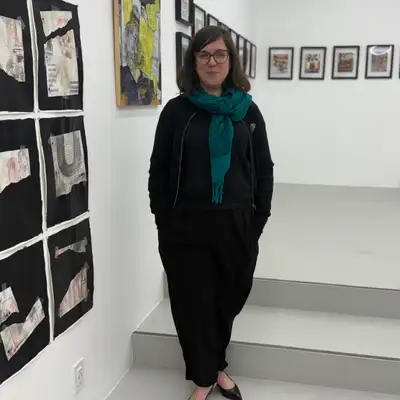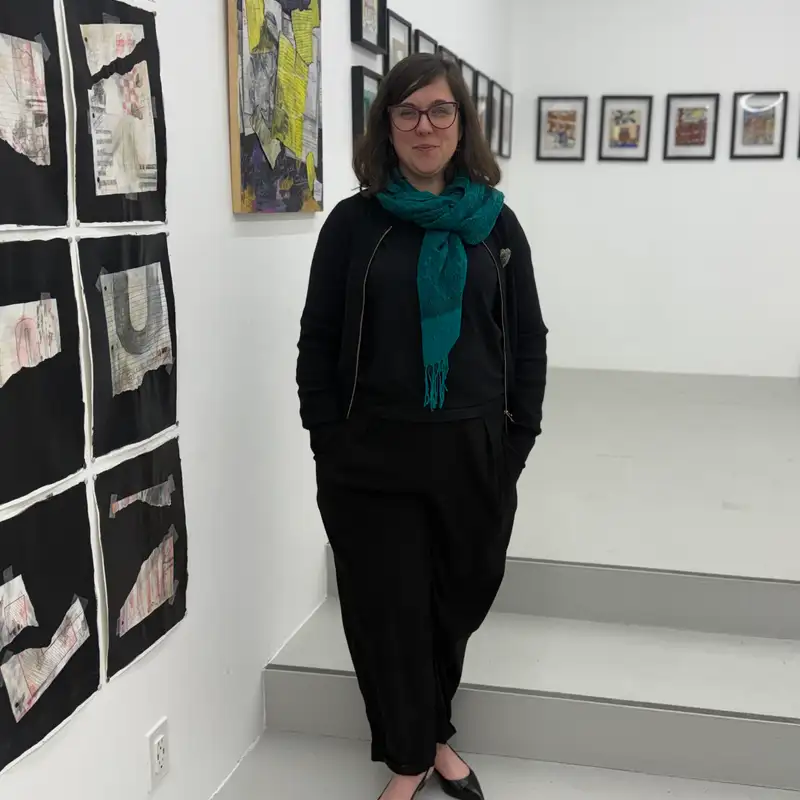
Sarah B. McCann
Download MP3Music
Rob Lee: Welcome to The Truth in Art, your source for conversations connecting arts, culture and community. These are stories that matter and I am your host, Rob Lee, except no substitutes. Today I am thrilled to welcome my next guest on to the program, a Baltimore based curator, community artist and consultant, as well as the founder of the SBM Gallery, a space supporting living artists working across disciplines. Please welcome to the program, Sarah B. McCann.
Welcome to The Truth in Art. Thank you for having me. Oh, you're welcome. And, you know, as I was saying before we got into the actual nitty gritty of putting the record button on, I feel like this is an interview that we should have done years ago, a conversation we should have had years ago, but now is the right time, so I'm glad that you are here. And to start off as is the custom, I think this podcast is interview storytelling archives and I think the storytelling piece is the part that I'm most interested in. And with the good story, we like to start off with the cast of characters and you're the character here, the subject. So if you will, could you introduce yourself, let's say that foundation, that groundwork, could you introduce yourself in your own words?
Sarah McCann: Yes, I'm Sarah McCann. I'm an artist and curator and writer and consultant and work with the arts community and non-professional here in Baltimore. So you're very succinct.
Rob Lee: If you've done that before, I like it. I like it. So going back, what would be, because we all, to some degree, are doing something creative when we're kids, whether it be drawing, I still have old drawings from now 40, not almost that would age, years ago. And I think a formative experience for me was maybe trying to do my own comic book, trying to do it on my own. And that was the thing that worked out and I was like, middle school. So for you, what was a formative moment that shapes your relationship with art, creativity, community here in Baltimore? Tell me about that.
Sarah McCann: Okay, well, I didn't grow up here. So it's a much later story than a drawing, comic book.
Rob Lee: Maybe it's two, then. Maybe it's two stories. The one, the initial one and the Baltimore one. Yeah. Yeah, I'll tell the Baltimore one first because I went to, you know, I grew up on Lang Island and I went to underbend studio arts in New York and had that moment of like, I'm in New York, where do I go? Because you can't leave New York. And I thought it would be the West Coast. And I went out there a couple of times and was like, oh, no, what's happening here?
This is not the right pace for my life. And I ended up getting into an MFA program in San Francisco and deferring. And somehow they had a link to Micah on their website. And so I found the community arts program here. And a funny set of coincidences brought me down.
And I think I drove a station wagon like full of all my things. And Kenny Kraftjack and Paula Phillips were the directors of the program at the time. And they were really like what brought me and introduced me and pulled me deeply into Baltimore and community. So that the community sort of, oh, is it the coastal thing? I'll leave in New York. You know, station wagon sort of.
Sarah McCann: Well, I had that moment too, where I was like, now all my friends from New York are going to come to Baltimore and live with me here. And they took them like years to visit even.
Rob Lee: Well, you were ahead of the curve, you know what I mean?
Sarah McCann: I know it's happening now. I did somebody did just tell me that. And I was like, OK, I was like 19 years early.
Rob Lee: So. So was there a like an earlier like in terms of prior to that, like you were into maybe like maybe a painting or an exhibit or a piece of music or something that you saw as a very young person that left sort of a mark that gave you this inclination that, hey, I want to make art a part of my life, whether it be in the making of it, the appreciating of it or the supporting of it.
Sarah McCann: Yeah, well, the time I grew up in on Long Island Huntington has its own museum. So we spent a lot of time at the park in the museum. I think that was a piece of it. And then I tell people like what you wanted to do in third grade, I think is actually like a very big piece of who you are. Because and I did not want to be an artist. I wanted to be a writer. But I think that's how I end up then making a lot of visual arts that's tech-based because that piece of me still exists somewhere. But I think in about fourth or fifth grade, I started to get a lot of positive reinforcement for being good at drawing.
I like this. And so I think that steered me into the path of arts. And then I've had a couple of lane shifts in my life and doing administrative work and other things. And I always end up returning to art as a piece. And my first year in the community arts program, actually, I ended up working in the south in Southwest Baltimore and in charge of a community garden. Because I also thought I wanted to be a farmer at that point. And I very quickly realized I was not going to be a farmer.
It's not it. And I'd be out there with a shovel and people would walk around the space. Like they'd walk all the way around the space so they could avoid me. And then I took out the paints and started painting signs and everybody was like, what are you doing? Can we help? Like I want to and kids would be walking to get something from the corner store and be like, I'm going to run home and tell my mom that I'm coming back here to paint a sign with you. And I'll say, OK, bring your mom to. But yeah, but it really like Baltimore. My first year in Baltimore really solidified that art is the thing that brings people together and is a tool for community building and change work.
Rob Lee: That's that's good. And that's definitely some foreshadowing for the later portion of our conversation, my later questions, I guess. And talk a little bit further into the text piece because, you know, you were touching on it there. But what is it that perhaps, you know, doing something, making work that has a text heavy component? You know, what does that do? Maybe that other art for you doesn't quite kind of kind of do. Like, for instance, I always have this push and pull of I do an audio podcast.
I don't do video yet. And one of the reasons is, you know, cost, but also that's just the real answer. But also is sort of I want engagement in that real engagement, not the artificial online engagement. You know, we're making content visually that people can ignore, but still listen to. Let me cut out the middleman.
Sarah McCann: Yeah. Wait, tell me your question.
Rob Lee: Yeah, I always like to have this context in it. But yeah, what does it, you know, language?
Sarah McCann: Yeah. Well, I think a lot of my work is about communication and how we connect and the things that get in the way of understanding each other. And I think language does both of those things, right? Like it's often a way we try to express what we're thinking or feeling and understand each other. And it's often also a way that we can totally misunderstand each other and not speak the same language.
So I've always understood it as a piece like that. And then also I worked in a lot of libraries in my life. And when I was finishing my undergrad thesis, I worked at the New York Historical Society Library and sat looking at the manuscripts department and went down this rabbit hole a little bit of like, why is it, why can you appropriate things in visual arts, but in literary arts, it's plagiarism. And so I, I got this idea. I'd write the perfect manuscript and that I do that by copying a already published piece of text.
And so I hand wrote, I started with JD Salinger's Seymour. And then I showed up to install my thesis show and my advisor was like, you need to go photocopy those now. And I was like, no, they are copies. And she was like, but didn't you hand write them? And I was like, yes, but they're handwritten copies. And we had this hysterical moment of like no one knew what was what.
Yeah. But I think that if that piece is that moment of like, what is this actually? And, you know, even if it's true, it may not be understood. You know, I love it.
Rob Lee: Like it's almost a little, it's a little trollish right there. I like that.
Sarah McCann: Well, no, the best part of it, though, I later went on to hand write Paul Oster's New York trilogy. And in this book, the main character gets hired as a detective and ends up sitting in an apartment across the street from the man he's watching. And they're both writing in notebooks. So he starts like contemplating, what could he be writing? Is he also just watching me? And right, he's like, or is he copying the row? And there is an artist who hand wrote the row.
So I'm also part of this tradition then. Artists copying books for some reason. But yeah, it was they were beautiful and meditative like ways of making for me that I really enjoyed for quite a number of years in my life.
Rob Lee: So in doing that and the work that you're you're doing now, like, how would you describe sort of the work that you're doing now, like purely as the sort of art aside, because there's an art to curation and all the other things that you do, you do a lot of different things. But as far as the art specifically, what are you doing now and how does sort of that background and that foundation play into the current work?
Sarah McCann: Yeah, so I returned to painting after many years of a hiatus. I've recently returned to clay after many years of hiatus. So there's something I think, you know, as I age also, I'm looking back towards like, what have I done and what needs to move forward.
And then there's this whole piece of like how we survive as people. So I was also working some pretty intense nine to five jobs in that time. And I had somebody I worked with say to me, like, why don't you paint?
Like, what you're feeling? I was really cranky about it. And I was like, I don't want to do that. And then I was sitting there one day. I was, I don't remember what I was doing. There's something that had happened that I was like, I need to process it somehow. So I made this little abstract painting and I really enjoyed the process. And it like, it helped me process some other things and heal a little bit probably.
And so I did a series of those. And I think that's kind of where I'm not now in the like, what is, what is my truth? And my like the things in my life that I'm really trying to figure out how to put out in the world.
And I think COVID, the COVID lockdown was also another place where I started to experiment with other materials and really think through some of these things of like, what do we create in this world? How do those things now be sometimes become destructive? And because I had started just picking up rusty pieces of metal off the floor while I was walking in my neighborhood. And those all became mixed, you know, resin pieces.
And I like most of them were tools, right? Like it sounds like a whole hammer and a like saw one day. So it's like, what is happening? That people are just like throwing tools to this street while we are all stuck in our houses. But like these things are tools and now they're dangerous. Because I don't know about you as a kid, like my mom, the fear of stepping on rusty things and needing a tetanus shot was like drilled into me. So like they become they become something dangerous.
And like there's beauty and decay and like as we think through life and start to age, like start to think about some of those things also. You know, if I answered your question.
Rob Lee: No, you did. And I'll say like and going back and you mentioned sort of that that covid time and it's when it's at its peak, right? Because it's, you know, there.
Speaker 3: But I think when the isolation with that is highest, right? And sort of folks were inside. It was a period for a lot of people to really investigate what they were doing and what was around them and see things, perhaps with maybe a wider aperture, but also sort of with more time with it. You know, we have this sort of thing. I've been asking this question, are we spending enough time with art and creative stuff now because it's go, go, go.
We didn't make a billion dollars in the first day. So this movie is bad and that's just not how creative expression works. And I look at that during a digital thing during this, right? Where I don't want to make something that feels disposable, you know, folks like you coming on, having a conversation with me and spending your time bearing your soul and many instances. I don't want it to feel like it's audio wallpaper. Yeah. And then there's some really good wallpaper out there, but also it's not like, man, look at that wallpaper, you know.
Sarah McCann: So I mean, every once in a while. Yes.
Rob Lee: It's like that Harlem twall. It's like, I'll look at that. But, you know, I see a lot of gentrification, gray, like wallpaper. And I don't really like that. Yeah.
Sarah McCann: What was interesting is I feel like the lockdown, people started making things like whether it was bread or it was art or it was crafts or it was cooking, you know, like whatever with people were really creative because it was necessary.
It wasn't just necessary at that moment. And I think you're right. Like as we start to move out of that time, we have less and less, less and less space for that. And I think we're not, we're still not okay.
Right. It's like most of us are still not okay. And we're losing the things that help us get back to, you know, some semblance of ourselves as human and whole.
Rob Lee: Yeah. And when you mentioned sort of just finding like just different decaying, like sort of tools or what have you in your neck of the woods, you know, I'm in an area where it was like a sort of flip. And when I moved in, this is where my studio is based.
You know, the area. And it was, I was one of the first people to move in over here in my specific block. And there was obviously tools and all of this stuff levered over because it's a work site for a lot of people.
And I would see that's like, that's a whole two toolbox that would play. I'm not, I thought I just go to my own thing. Well, I was like, let me put this in the basement. You're not going to need this. Right. I'm going to use this.
I'm a homeowner now. Um, so yeah, that's just, just one of those things, but you know, I'll say, and this is definitely going to relate to one of the topics we get into later when we start talking about the gallery. But, um, I want to ask about, um, a little provocative here, but so have you, when you think of your work, have you made work that was more about learning your limitations instead of being concerned whether the work is quote unquote good or not? And if so, what was that like? What did you learn about yourself and making work that was just to see how far you could go with it or stretch the boundaries of your creativity? Yeah.
Sarah McCann: And, uh, so I'm not like a, I'm not a person rooted in technical process. So I feel like much of my work may, may fall somewhere in that spectrum. But I was thinking about this question and ceramics, I think for me was the thing that did that. Like I worked a long time with a ceramics organization. I don't come from a ceramics background. I come from a fine arts background. So I was always like, well, this is what I want to do.
And now let me see if I can make the clay do this. And, uh, you know, some of those things were beautiful and held up and I love them. And some of those things like fell apart in the kiln.
And I remember one, it said, shit always goes wrong. And when it came, when I came out of the kiln, there was like six pieces when I was like, yep, that is what it's meant to go here. But, um, I think, uh, that process for me too. And then the process of firing clay, you end up, you know, it's very human. It's like we get through the fire and we're stronger at the end of it. So that metaphor also, whether you have a success or a failure is a very beautiful thing to think about in life. And I think one of the places where, uh, what you asked about, like pushing boundaries really has, has found its way into my work. Yeah.
Rob Lee: It's, uh, we don't, we can get bored with it. I suppose like I always struggle with being adjacent to it. I talk to a lot of artists, but it's like, not a term that I use for my, myself, I'm, I'm a journalist, I guess, and I'm a podcaster and that's a little pejorative now, but, um, I always try to approach what I do with that sort of sensibility of how can I make this different? How can I keep this interesting?
What are the boundaries that I'm trying to push? Um, part of it is, you know, I can just have the same conversation with people that, you know, it's like, wow, I really know this person. This is going to be great. Let's just do this episode over and over again, or let me reach out and put a few flyers here of, you could be an interesting interview. Let me learn about your work. And one, it keeps me honest and being on point and aware of what's happening around me, but also makes me like come up with good and more insightful and interesting questions. Cause. You know, last year, last season was the first time that I prioritized, um, bringing on previous guests.
So looking at those earlier interviews, I was like, ooh, did I get any better or did I get worse? You know, it's kind of that thing. So really feet to the fire.
And in it, some of the guests were pouring out. It's like, yeah, let's do the first interview, bro. This one is better. Or it's like, yeah, bro, you said that before in a previous interview.
Speaker 3: Oh no.
Sarah McCann: I was like, I didn't feel good about it. I like new media for that reason of the like, can I make something that's thematically the same and like, it's at my voice in a totally different form. Um, sometimes yes. And sometimes I'm like, oh, this should not ever live in my house or studio or should be repurposed into something else.
Rob Lee: There was, there was one, I do a movie review podcast outside of this. And I was really excited for seeing, cause I think we're in the sort of same age group. I was just like, I want to see teenage mutant Ninja Turtles two again. And it was in the theaters like last month.
Sarah McCann: It's the, it's the one you wanted not either.
Rob Lee: Well, because it's the 30th anniversary. Okay. So that's the one with the ice in it. So that's, that's just, you know, and the secret of the news. So I reached out to one of my buddies, um, who's been on this podcast a couple of times, Isaiah Winters. And I was like, yo, do you want to talk about turtles for like an hour? He's like, yes, let's do that. So we did it. It was fun. It was great. And then I looked into our car. I was like, I already did this with my other friends five years ago when it was the 30th anniversary. I was like, I won't compare it to, I won't do it. These are different people.
Sarah McCann: Somebody's going to have like a lot like a listen party where they just play them in the 40, when you get to 40th anniversary, when they play that one too.
Rob Lee: It's like, there's like the bit didn't land then it didn't land this time either.
Sarah McCann: Some days, some future generation is going to be all about it though.
Rob Lee: So with that kind of being a segue, looking at the five year difference between that first, that first review and the second review for you over the last five years, what is one change that you've made in your process as an artist? And I think he's sort of overarching because, you know, folks get really specific, like, well, depends if I'm working in this or that, but I think there's something that unifies these things. So what's one change you made in your process as an artist and maybe one change that you made with that sort of curatorial, your curator eye and that sort of work, what are the changes in those two areas and why?
Sarah McCann: Well, I think it's the return to media. You know, when I stopped painting, I gave my paints away. I was like, I don't need these anymore. Like I didn't give them to a friend of mine to work with. And then, yeah, I think it's the acceptance that I wasn't done with the things I thought earlier in my life I was done with. And with the painting, because there was another artist friend and I started going to paint nights after COVID, that was our like, how are we going to emerge back into the world? So I think it's acknowledging that, you know, through life, you have these moments where actually you do need things you saw at Chuaqura or saw you move beyond. And I think for the gallery, what has changed for me this year is because I nomadically curated for 15 years. And this is my first kind of, I'm calling it a semi-permanent space.
And so that's for me now. This is the second show that opens on Friday that will be in the space. So it's interesting to see how I can build on what has already been here and use like knowledge of what these walls, what the walls hold as I continue to show more exhibitions here.
Rob Lee: I like it, you know, having sort of returning in sort of the artist's way of things. It's something I've referenced before from Austin Cleon with the calls it the whole Phantom Limb thing. It's just like you're rid of something.
Speaker 3: You're like, yeah, you're not done with it.
Sarah McCann: Oh, my God. And you would taunt you or you would like embrace it back into your life.
Rob Lee: And then the other thing with and we definitely were going to go deeper into the gallery in that background, but, you know, kind of putting down those those roots is being in the space. You know, that's that's great. You know, it's like the first time I went to sort of like a it's like a walk through curator. What it was, it was pretty tough. I was like, oh, this is the first. It's like an art person. I was like, where's my beret? I have a beret.
Sarah McCann: And I was like, I got the wine around. Let's see.
Rob Lee: Look, don't get me started. You have other you have other exhibitions coming up. I will stop stop popping up there with a different beret all for each one. Don't give me. Don't threaten me.
Sarah McCann: You're ready if you've got that many berets.
Rob Lee: So I've read that your curatorial method starts with questions to the artist. What are the questions that you're most interested in right now and why through that lens of, you know, you're looking at art, you're curious about are you curious about bringing maybe an artist in? What are the questions? What is, you know, the most interesting question for you right now?
Sarah McCann: So I think right now time based and like what carries through like ourselves, that is, you know, whatever truth we are built on and whatever, you know, in our lives are the threads that keep, you know, that keep showing up. You know, there's things that change and the things that remain the same.
And so the bird, we've just launched a call for entry for a group shown July that I'll co-curry with Tiffany Jones that's artists work with at least a decade span in between. And so I'm really interested to see like what has changed, like maybe your better at your media, maybe you've gained skills or changed things, but maybe there's something that's your voice that continues. And what are those things and making sure we're seeing true of those things? And then I think the questions are also around what is happening in the world right now. The first show I ever curated was What's Your War, which also feels like it could happen right now. And then, yeah, and then I've got another one percolating about.
The working title is All My Errors Are Human, making mistakes in an AI world, because I think there's something still in like how we make things with our hands and all these technologies being tools, but that there's something that needs to be rooted in humanity that carries the work into something that doesn't just become decoration, but it's like true art in a way that has that expresses feelings and individual uniqueness and truth.
Rob Lee: No, that's good. It's, yeah, I've been playing with that and doing sort of digital, you know. And I had a pitch that I put out there about maybe taking sort of, and it didn't get approved, but taking sort of this old media, you know, like these old tools, how many like landfills or like old iPods will have you, right? And just like taking old iPods that still works, loading up really curated, selected episodes from the archive and just have those in almost like those library boxes.
Sarah McCann: It's like a mixtape. It's like you take your mixtape out.
Rob Lee: And then having like the headphone jack have a solar power and people can listen to it and strategically put it in our districts. Oh, I love that. That's so great.
And it was just like, this is me expanding as an art freezer, right? And I think the point around it is you're trying to get caught up on the nose and the yeses, but I was just like, we're not having discourse anymore. We're getting, you talk about AI a little bit, we're getting the online piece of this is how you should feel about this. Like we're not even experiencing it or because I was talking about earlier spending time with it or being around other people in that sort of energy. Um, going back to one of the things you were touching on earlier, sort of being in New York and living there and then, you know, looking at sort of the West coast as an option, those are those hubs that they talk about in death of the artists, like there's art happening here.
People are talking about art. That's just everywhere. And when you're away from it, something feels a bit more hollow. And then we have so much of it happening here. And it's, it's multiple storylines going. And maybe we'll talk about that sort of, sort of later or maybe off-line.
Sarah McCann: Where does it mix into economics and what you need to do to live? And, uh, yeah. Yeah. Healthy community.
Rob Lee: Yes. And look, I have a very interesting vantage point sitting there, much like Batman and it's like, I want to roof just looking down like, Oh no, this is working the way that we're saying it's working. Yeah.
Sarah McCann: Well, yeah, that's a different story telling.
Rob Lee: Yeah. Well, so I want to, I want to hear about, um, building out a show. And again, we're, you know, still talking about just generally, cause having, you know, 15 years of that sort of nomadic experience, that's really huge.
Like, you know, I've only been pongar on 17, so almost concurrently, right? So when you're building a show from concept to installation, what are your non-negotiables? Um, like how do you choose like artists and in the shape of the, you know, the experience for the audience, for the viewers? And I, I think you were touching in a little bit, being a previous answer, but really for that one. Yeah. Yeah.
Sarah McCann: Well, I will say, I just didn't share this, but I ended up talking about the shows to artists before I actually put them into practice and somebody always tells me what they're going to make. And then I was like, well, now I have to do this. So that might, I don't know that that's a non-negotiable, but it's part of the process I think is to have somebody tell me what they're going to make for this idea I have.
And then I'm like, well, now I will make my idea real because I need to see that in the world. Um, I think things need to be ready to install. I mean, this is like a nuts and bolts of like, you've got to be able to put it on the wall or stand on the pedestal.
If it can't hold its own weight up, it's really hard to have an experience with that's positive for everyone. Um, I think for me, the storytelling and how the work communicates with each other is really important. Like on my day, when all the arc gets into the space, I often spend most of that day just like walking back and forth with pieces that then sometimes end up exactly where they started. Um, but they tell me, I always tell people, they tell me where they want to go. And then I, I acknowledge that once I'm ready to hear it. And, um, and then the work goes up. And I think for me that's, and then there's a story creator, right?
Like even if there was a theme, the theme becomes deeper because then the works talk to each other and you know, have this conversation and then people bring in their own experiences that add a layer onto that. So I think that's the piece of it. That's really interesting to me is what happens when all those things start to happen at the same time. Um, and in fact, and then the artists start to play a part in that. So there were two artists who I hung in consecutive shows next to each other. And I was like, they have to meet each other because their work keeps ending up together. And then one of their partners bought the piece of the other artists and like they're hanging in their house. And I was like, okay, now if I've had any doubt, like now you definitely need to meet and talk to each other.
So, and building, uh, Community of the artists I work with, I'll often host the dinner for artists before a group show because I think it's not just about the work in relationship to each other, it's about people and making sure the artists are also together and building that community. Thank you.
Rob Lee: So now we can move into very specific and timely stuff. Let's talk about a SBM gallery. What is it in your own words? What gaps are? Is it filling? I'm just a lowly podcaster. Maybe you don't frame it as it's filling any gaps. But I think everybody does a little something. So talk about the gallery and just give us a rundown on the gallery. Yeah.
Sarah McCann: So I think it's really supporting a community of artists and looking at work rooted in love and justice and artists who are really interested in the way arts can be used to support change in the world and move us toward justice or move us from the world as it is to where it could be and making sure that people are highlighted in that way.
Rob Lee: It's good. It's good. I like it. And with the, so SBM gallery showcases work that addresses community justice and love. How do those values show up into the day to day?
Like what you say yes to, what you say no to and how like you welcome people into the space. And again, as I was touching on, I, so this is, I'll give you this. I'll give you this.
You might like this. So last month is when I was in the space, right? I've only went to two different art related things last month. Your space and MoMA.
That was the two spaces. So there you go. Yeah. Yeah. I was wearing the beret MoMA. I didn't have it for yours. It was a little nippy and I have a bald head. So next time. Yeah. Yeah.
Sarah McCann: So what do I say yes and no to and then how? Well, I think for me, so I, I always try to make sure there's a user community component. So some way everyone's voice can be heard alongside professional artists. And that, that I think makes me not have to say yes or no sometimes because some artists are down for that and some artists are like, that's not for me.
And so that's one, one way. I think also like the way we set up our spaces can either support healthy community or cannot. And you know, I, so I try to make sure the gallery is as welcoming as can be and that people can come in whether or not they have arts experience. Because I think that is, you know, art, everyone can connect with arts if given the opportunity. But I think often people have a negative experience with arts because they don't have the technical skill or they don't have, you know, the contemporary arts understanding. So trying to make sure there's entrance ways for everybody to come in and have whatever experience they want to be having here and participate in a way that I think is not always possible in art spaces. Yeah.
Rob Lee: I mean, you know, the, the, when I went there, it was a believe a one of those first Fridays and in Highlandtown Arts District and, you know, and doing research like immediately, I think I followed up with you about booking this interview right after that. Because sometimes they got to be a little judicious. It's like, ah, you know, I could, but let's see. And, you know, having that sort of firsthand experience, which in doing all of these is rare that I have sort of the precursor to help reinforce how we're going to go about it. And I witnessed all of that.
Like, you know, you have Randall Strolling in and she was like, oh, welcome in. Take a look at the art. And, and I think it's an exposure to art.
I think it's what brings folks in. You know, I had the day job and I remember one time talking with my boss and she's like, so you do an art podcast. I was like, allegedly, because I was like, and she was like, I don't get art. She was like, they can make sense to me. I was like, I don't get art myself.
I was like, you're talking to the wrong person. But then I gave sort of the the answer of like, I think it's the feel something, you know, you know, sort of the exposure to it. And I think being around it. And when I look back at the the work for the inaugural exhibition, we're going to talk about that. I felt different things. I kind of felt like I was tapping into the makers of the work. So could you share a bit about that exhibition and, you know, about the show and, you know, I
Sarah McCann: just want to say one other thing about the arts district, because I think when I think about what I want in a gallery space is mine. And I think about the community I want that to exist in like Highland Town, definitely the Joanna and Amanda who, you know, help organize the art works and all of that, like do a phenomenal job of making sure everybody has anything. You know, even the businesses like the antique shops, it's like, come in, have a beer, like look around, you know, like there's a feel that it's a neighborhood and a community endeavor.
It's not just an art specific thing. You know, all the restaurants are highlighted on the map. Like you come for a night in Highland Town, not just the like, I need to see this artist or that, which for me is really important and like where in space we exist. Yes.
Rob Lee: I relate to that sentiment and going to different iterations of it over the years. Admittedly, that is my favorite set about that. It seems like they get it. And I've shamelessly or maybe purposely been in other sort of arts districts saying you guys should do this, whether it be a dinner and a movie idea, because you have restaurants here, be good neighbors. But when I go to Highland Town, sometimes I just forget or sometimes I'm busy. But for a solid maybe six months, I was going to each of those first Fridays, just like, this is great hanging out at galleries that may have moved or whatever the case is. But definitely it's like, here's a beer, hang out. And I was like, this is amazing. This is great.
Sarah McCann: Yeah. Yeah. And then hang out next door and then go two doors down and, you know, have an empanada.
Rob Lee: Look, I've done that. I've done that. I was like, can I get three of those? Thanks.
Sarah McCann: On my first week in the space, I, and, you know, we were installing. So I ate a lot of empanadas that week.
Rob Lee: Look, I was, I walked through the park. I was like, man, this is what it used to be. I was just walking through the park eating empanadas. I was like, man, this is amazing. Look at every baby like this. So we were talking about the show.
Sarah McCann: Yes, the first show. Yeah. So, so before during now, it started as before during after, because there was supposed to be an after COVID, but there's never, you know, we just now exist with it. So it's now it was one of the longest lead times in a show just because I had some health issues to deal with. And then I was looking for a space and then there was kind of this extended period. But all the artists stayed on board with me because I talked to them, you know, I talked to them two years before the show happened, like, do you want to be part of this? They were like, yeah, they keep us doing it.
You know, every six months, I'd be like, hey, guys, we've got a few more, you know, hills to get over before we can do this. But they all were phenomenal. And so the show is their work before COVID, their work they made during lockdown, some of which, you know, with work that got helped get me through lockdown and then work they're making now. And when I brought all that work in here to unwrap it, I had that moment of like, you know, that folding in of time because a lot of the before work and the now work started to like overlap in a way that like having to process like, you know, the traumatic event of a pandemic that we've been through.
And then on either side of that, also some like real societal problems that have not that we hadn't opening an opportunity to maybe do something in resolution for but drop them all, you know, as the people in the culture. But so that was a moment of like, oh, there's like a lot here. And there's a lot here for all of us and for each of these artists and each of them in their own specific ways and how they dealt with it based on who they are and what they did during the time.
But yeah, people seem to, I think, like you said, be drawn to it, be drawn to specific artists based on again, who they were and what resonated with them in their lives. You know, Sarah Callwasser, who her during lockdown piece, you know, with her family who were healthcare workers. So it was there was a lot, I think, in the show. I'm really sad it's over. Actually, I wasn't ready for it to come down off.
I should have scheduled this longer because I wanted to live live with it a little bit longer. But yeah, we got a good we got good responses for it. And yeah, the artists, all what, you know, the most important thing to me is like, we're the artists happy. They self organize their clothing reception. So I think that's a sign they were happy.
Rob Lee: That's good. And it's good to hear that. And we'll actually going back a little bit. Just going back into that that day, like, you know, I felt super compelled to show up because that's been a thing that I've tried to do, I think, as perhaps you were alluding to with some of the things we may have decidedly dropped the ball on. I think for me, the last, I just put it this way, my birthday is an operation day. So yeah, good times.
Speaker 3: And I thought it's an act of resistance to go to have been down to DC, like at least once a week since,
Rob Lee: you know, last year, but also trying to make efforts to be in person with people as much as possible, whether it be just to be there sullen in the corner, but to be around people and to appreciate the thing that creativity art that's been devalued and replaced with sort of anti intellectualism and like dude bros, you know, that's, you know, I, I tried to be in space with people with, with the community. And I think, you know, that's what it's about really. A lot of times we're speaking on these things, but we're not a part of it.
We're kind of detached from it. So I felt super compelled to come out and one support, you know, what you're doing now with the gallery, but also just being in there and it's like, oh, this lines up, let's make it happen, make it a point to get there. I couldn't say the whole time because I had a prior engagement, but I was like, I'm going to be here for the beginning of it. And it was, um, it was great.
Sarah McCann: Well, and I think that's so important to also not like fall into pits of despair right now is to like, you just show up like that's one of the most important things right now. If you can't do anything else, just like go to the thing and support each other and like continue to like build coalition in that way.
Rob Lee: Yeah, it's super important. And, um, so this is sort of the second, we kind of covered most of this, this question, but I want to at least hit you with the other portion of it.
And this is like the next to last question, 10 ultimate, um, of the real questions. Um, so generally it was been the response like holistically around like the gallery. You have the sort of person response of people showing up, the response from the artist, but there's an online component. There's sort of an external outside of Baltimore component because you got a biggest, you have a long history as a curator, nomadic curator. So talk a bit about that. And like, what has taught you so far? Yeah.
Sarah McCann: So there's definitely like all the arts folks show up. And then, you know, I've had students and Micah from Goucher who were like, Oh, my faculty told me to come by and like, that's been really beautiful. And then there's people in the neighborhood are just like, Oh, what's this now? It's been closed for so long. Like we're so excited.
There's things here. So that's been beautiful too. I actually got invited to speak on a panel at the College Art Association this year, which was in February.
Thank you. But it kind of ended up aligning then with the story of, you know, I got up there. I was like, I'm not an academic. I'm a practitioner. So I'm going to tell you my story.
I'm now like opening this thing because it was a curating during Trump's culture wars panel. And so it's like actually being an independent art space right now is like provides me a lot of freedom to do what I want. And to support artists who maybe can no longer get supported outside of, or, you know, in institutions that rely on different types of funding. So that has been really positive for me too.
And like thinking through like, what is needed in the world right now and how do we continue to support art spaces where artists can do the piece that is needed during times like this? Yeah, it's good. Yeah.
Rob Lee: So here's the last real question. Okay. And this one is this one might get you in a little trouble. This is a provocative one. So in 2026, what is one thing that you want to change about sort of the gallery scene and how are you modeling that at SBM gallery? Yeah.
Sarah McCann: So I think I'm going to start by saying I learned Baltimore Baltimore is a place that I learned that you have to be careful how many people you tell what you want to do because somebody will either then connect you to people doing it or give you the space to do it yourself and then you have to do it. And I think it I've always found it to be a very clever place.
And I think galleries have followed that model. And I think how to how to high point pre COVID, but kind of kind of fell during during lockdown. So I think it's really like continuing to find ways to collaborate and build and build together that I think as we rebuild after kind of what we lost during during the pandemic. I don't know that this is I don't think it was really that provide like it's not, you know, I don't think it's just the things we always need to be doing as human in continuing to find ways to work together to kind of showcase wider or like make wider ripples to have impact beyond beyond just the arts community, beyond just like space here.
I think, yeah, especially looking at, you know, how our country is wrapped up like figuring out how to start to have impact across the nation and really isolated communities that are, you know, not maybe imploding a little bit because of that isolation.
Rob Lee: Yeah, I mean, you know, because it's not super it's not provocative at all. It's sort of a thing that feel like it's a human thing. Like we need to be around people. We need to collaborate with people. We need to take care of each other is however that might sound. Oh, it's so, you know, so triggering, but really, you know, taking care of people. Yeah.
Sarah McCann: I'm really stopped like the stop with the distraction or stop with the consumption and find ways to be creative and to like be generative rather than destructive. I think it's destructive only when necessary, but
Rob Lee: unless that's your practice, like if you're distracting things like boom, let's do it. You make fire art cool. You got it.
Sarah McCann: Yeah, sometimes you gotta take it down, but also like with care and making sure that then you're able to then create something new out of it. You're not just left with like ash on the ground.
Rob Lee: Ash on the ground. I might title this conversation. That's terrible.
Speaker 3: But yeah, that's a good spot for us to kind of close the main portion of the podcast. But I do have a real question at the end of the stage like advice question. But I have three rapid fire questions.
Sarah McCann: It was to you've added a third one.
Rob Lee: It was to, but you said something that I wanted to delve in a little bit more. You did this to yourself. You know, I'm the thing as happens.
Sarah McCann: Okay, I'm going to give you the I'm going to give you the one I think is the most trolley. What is your weirdest curator habit? Have fun. The curators are quirky bunch.
Sarah McCann: That curators have weird habits.
Rob Lee: Sometimes the superstition sometimes is like, I only wear this. I have to have to have the scarf or whatever it is. But what does a quirky thing that you do?
Sarah McCann: A quirky thing I do as a curator,
Rob Lee: or it might just be you happen to be, if you are a curator, you have to do something very quirky.
Sarah McCann: Oh, but you know what? I don't know if this is quirky, but if I am making something during the planning of an exhibition that then ties in thematically with the rest of the exhibition, I will sneak it in. So like my first little clay pots I made in five years since I touched clay needed into this show.
Rob Lee: Oh, that was like, oh, yeah, if you take a look at this, these
Sarah McCann: nice, if you saw, there was one of my COVID pieces with the rusty things in it.
Rob Lee: It's like, yeah, that's just me. It's like a director. It's like, yeah, I'm a past my mom.
Sarah McCann: Most of these artists I've worked with across 10 or 15 years too. So one of them was like, Sarah, what are you including? And I was like, I don't know. And then I was like, well, actually, I just made some.
Rob Lee: Like I just kind of just slid that one in it. Oh, worry about it's fine. That's great. Isn't it? Like, yeah.
Sarah McCann: The artists have always been very supportive of me. So I like it's also I've gotten that positive reinforcement again, like who this works. And some of the most like fabulous things I've ever made as an artist have ended up in my own show. So like, there's a synergy there that's happening for me where I'm inspired by the artists I work with. And my things sometimes end up with their things.
Rob Lee: It's good. It's like a signature trademark. And also going back to one of the things you touched on earlier, if you have it in conversation, you're like, yeah, so I know you're doing this. It's like, yeah, I got to put something in this show now, don't I?
I didn't have anything, but now I do because they said they're making this. So this one is very weird. But I think it is effective. So if SBM Gallery had a signature scent or a signature sound, what would it be?
Sarah McCann: Signature scent or a signature sound. I want to say lavender, like off the top of my head. You know, I say it's a good coming.
Rob Lee: See, let's see how quickly you came with that one. It was like, no, it's like, yeah, of course, it's a lavender. You know, maybe ask an lavender actually to be very specific.
Sarah McCann: He's saying, hey, sir, I hear you. And this Mashing Pumpkin song, what is it today would be just like a loop on the soundtrack as a sound.
Rob Lee: Yeah, it's just a boom, back hip hop instrumental. So that's just all that's happening. Or some trip hop, like maybe some portafilter just playing in the background. Yeah, this is the last one. This is the one I added. So you mentioned hosting dinners for the artists being shown in the gallery. What was the last meal that you made for one of such to these dinners?
Sarah McCann: The last meal, well, you spin them off because COVID did kind of put a damper on my, you know what I you know what my trick is for those meals, though, it's a Trinacria lasagna. Oh, really? Yeah.
Rob Lee: I'm not I'm not hip to that, by the way.
Sarah McCann: Oh, yeah. Well, you know, Trinacria, you go by eating their sandwiches. But yeah, because yeah, I, I, I try to cook when I can. But that is the go to go to for the artists in earth.
Rob Lee: That's good. That's good. I mean, something that's filling something that's good, something that's local. You know, and at least it's better than just like here's some pizza.
Sarah McCann: It might be from a good place. Nice as a pizza. Yeah, it's gonna be nicer than pizza. I mean, and the artists often, but it often ends up more because of the group of artists I work with, it often ends up more public likes than just Sarah has made you this meal, which is always beautiful.
Rob Lee: I mean, just do one for podcasters, right? And I'll bring the cups because I cook, I cook very well, actually. But because knowing and I talk about cooking, you know, enough in this podcast, that it comes up as a theme, like people have heard about the smoked crab cakes or smoked crab balls that I do. And because I brag about that, I'll bring cups. Just like, you know how to cook, but you're actively not bringing me things to this pot.
Sarah McCann: Look, but you know what, I do like to do the one that when I do cook for dinner parties, I do like to make a new thing I've never made before, which usually works out for me every once in a while. There's a moment of like, should have had a, should have had a lasagna in the freezer just
Rob Lee: like, hmm, how can I play this one off?
Sarah McCann: Yeah, I usually just, I do have like a backup side that can become main if needed. I'll say this. At least for the end of the time, they're wonderful.
Rob Lee: I'll say this. I like to experiment as well. And because we're in a sort of like port city, seafood is a thing. And I remember in my old apartment, prior to moving, I said this is more than 10 years ago at this point, I was trying to make beer battered like like fish and chips. And I was like, I got it.
I read it. I used the wrong beer and it didn't give me the wrong beer. Apparently, I think you have to use like a thick, just maybe the batter wasn't thick enough. And I think the beer I use is I use what I drink and it's like, I think I should just close the dude. It's like, hmm, I'm not drinking good beer.
Sarah McCann: But out loud. No, it doesn't sound that way.
Rob Lee: So I fry the thing and I'm not good at frying too. That was two strikes right there.
Sarah McCann: I don't fry things. I know.
Rob Lee: So I took I looked at it, my brother's like, something smells good. He comes in there and I was like, yeah, I'm going to throw this away. He's like, yeah, you kind of didn't do a good job on that one. How did you?
Sarah McCann: When your siblings telling you things a little too straight.
Rob Lee: I was like, I tried. I tried and failed.
Sarah McCann: Yeah, trying to help people want to eat the things that you make that are not good.
Rob Lee: Right. But then everyone asks for the crab balls. That's the laying out stick to it's like, no, what you're good at. So that's kind of about the fire questions, you know, you kind of take very well and you didn't like the bomb out. So good on you.
Good on you. So so here's the last sort of real thing last piece of business, if you will, this is the sage advice. And the way that I frame this is I don't like those typical.
So if you were to give a piece of advice, I don't like that frame in that setup. So the question that I have here in 2026, the year that we're in, when so much of our connection is mediated by screens and algorithms, why is it so important for artists and art lovers to share the same physical space? What can happen in a room together can happen on can happen alone online? So what is some advice you would, you know, share with someone who wants to show up at their local art scene, but they feel unsure about being there about belonging? I will say show up.
Sarah McCann: Well, I mean, just show up somebody else. Somebody will talk to you or they won't you'll have a glass of wine, they can go home. You know, I get what's the worst case worst case you see some are you have a glass of wine go home and I will say the first show I installed the actual art in the space during COVID, which is in 2021, the gallery at Notre Dame, the unwrapping of the first painting I unwrapped and the color and the texture and the smell, like that moment for me was the like, this is why we have to show up in real space. And like, you know, it's like, it's like a good hook from somebody. It's like those things we need, like they are fuel and food and, you know, the things that we we cannot live without. So I'd say, yeah, best case scenario, you get a great hug, you see a great piece of artwork. And then you go home, you know, like worst case you drink the glass of wine, you walk through and, you know, you've at least got some steps in. But yeah, that's good.
Rob Lee: That's good. I think that's literally what it is. It's low risk. It's low cost. And but it's almost priceless in terms of culture and connection, you know, I'll say this for the last piece and then we're going to the close out. You know, I did this event, it's not quite the same. But like I mentioned, last month when I was at your gallery, I was there, MoMA, and then I had another thing like the day after MoMA, it was at BSO, right? And it was something that I booked maybe six months ago.
And I kind of forgot about it and ended up doing it when I got there. Those sort of thoughts are there. It's like, man, why did they even come out? This was, you know, and was it their like gala event?
Sarah McCann: No, it was it was it was the doo-wop project. Oh, I don't know that one. It was just some guys basically a former, they're super group, they were former people from the Jersey Boys plays and they're doing all these doo-wop classics. And I had no idea what to expect. And I was just like, I don't know, this is going to be my thing. And I was like, this is fun.
This is being around live music and being around people and around sort of culture. I'd pay for the tickets, but they were kind of like, you know, relatively inexpensive. So it was like a low, low risk there. But again, it just reminded me another example of stretching those boundaries and doing something that you can easily say no, but that's probably your reason for saying yes.
Sarah McCann: Yeah, and I will say in the moments in my life where I've been like real cranky or real depressed or like, just like, I don't want to get up and go anywhere. The days I've gotten up and gone to the art thing. I'm like, oh, that's exactly right.
Rob Lee: So that's kind of it for the podcast. Those are the questions that I have.
Sarah McCann: And this was relatively painless. Thank you.
Rob Lee: Relatively painless. You probably stopped your time.
Sarah McCann: I was worried about those rapid fire questions.
Rob Lee: I mean, I can give you another round if you like.
Sarah McCann: But we'll save that for the next, for the next, uh, now that you're having gifts back.
Rob Lee: Yes. And so there's two things I want to do as we close out here. One, I want to thank you for coming on to spend us some time. Like I said, long overdue. And I'm just glad we were able to talk.
Also, this is just a quick aside. I realized I did do my normal intro for a regular person that wears glasses. So thank you for wearing your glasses. Technically, I got that in. Every time someone's wearing glasses, I say that in the podcast.
Sarah McCann: Yes, I do. Yes.
Rob Lee: As a running bit. Okay.
Sarah McCann: Got it now. You just added that into the beginning.
Rob Lee: No, it'll be right there. It'll stay right there. And sort of the last thing I really want to do in accomplish here is to give you the time or space to share with the listeners where they can check you out, follow your work, the gallery, anything that you want to shamelessly plug in these final moments. The floor is yours.
Sarah McCann: Okay, so you can find the gallery at SBMGallery.com. You can see my own artwork at SarahBmcann.com. I'm on Instagram at SarahBmcann.com. And we have artist speaker series, collector coffee hours, and more openings through July set right now. So visit the websites to see those.
Rob Lee: And there you have it, folks. I want to again thank Sarah B. McCann for coming on to the Truth in Us Art and sharing a bit of the story behind SBM Gallery and Backlound and Insight on Arts at Large as a Curator and the Community Artist.
And for Sarah, I am Rob Lee saying that there's art, culture, and community. In and around your neck of the woods, you just have to look for it.