“The Town Is Our Portfolio”: Jesse Kirsch of No Plan Studio on Letterpress and Community in Takoma Park
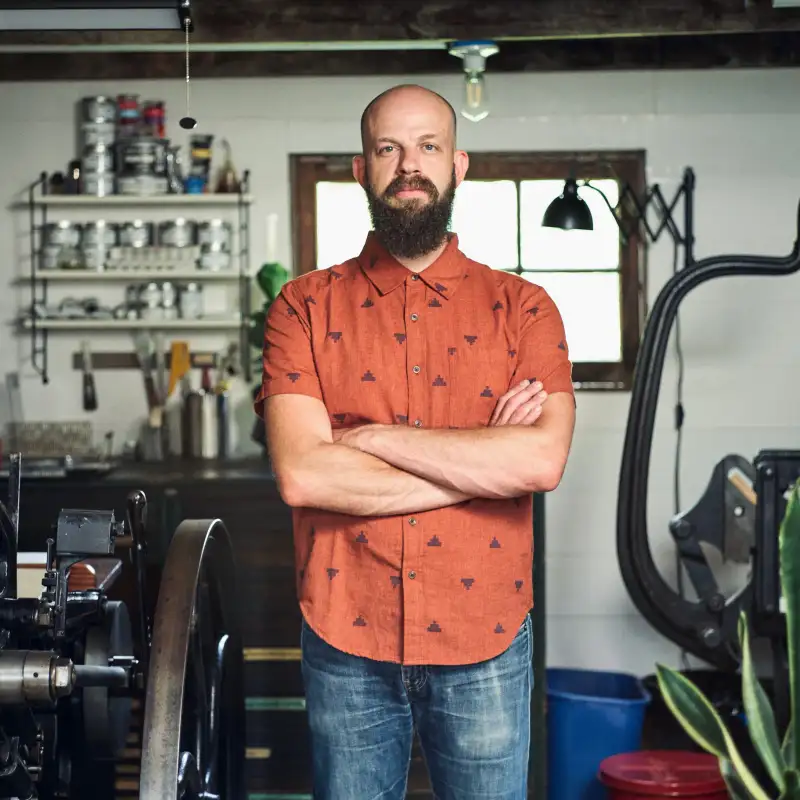
Download MP3Rob Lee: guy welcome to the Truth in his art, your source of conversations connecting arts, culture, and community. These are stories that matter, and I am your host, Rob Lee. Accept no substitutes. Today, I am thrilled to welcome my next guest on to the program. A graphic designer and artist based in Takoma Park, Maryland. He's the co-founder of No Plan, a full-service graphic design letterpress and art studio that combines modern design with century-old vintage equipment. And they are guided by the belief that embracing unpredictability leads to fresh perspectives. Joining me today, please welcome Jesse Kirsch. Welcome to the Truth in His Art.
Jesse Kirsch (No Plan Studio): Thank you. Happy to be.
Rob Lee: Thank you for making the time. See how it feels like it just naturally flowed into the BS we were talking about to the actual podcast.
Jesse Kirsch (No Plan Studio): So this is the real thing.
Rob Lee: This is the real thing.
Jesse Kirsch (No Plan Studio): We're recording for a mixer there. So it's all Oh, all right.
Rob Lee: All right. It's a good way to use yourself into it, I think. People are nervous. People are always nervous.
Jesse Kirsch (No Plan Studio): And um it's like when you go to the uh doctors as a kid and you gotta get a shot. It's
Rob Lee: like just
Jesse Kirsch (No Plan Studio): a little thing, here's the sucker. Boop. Yep. Speak yourself up. Yeah.
Rob Lee: And then once you're there, it's not so bad. So you know, as we were talking a little bit before I actually hit the record button, you know, I I've been uh, you know, kind of following you, following no plan for a little bit, you know. I'm glad we were able to make this happen.
Jesse Kirsch (No Plan Studio): So um to start off, this is a different version of how I normally ask, but let's dip into the lore.
Rob Lee: What is the origin story?
Jesse Kirsch (No Plan Studio): What is your introduction to art design? Give us the the quick rundown. Yeah. Uh I mean, I guess I can go way, way back, which wherever I want to go, right?
Rob Lee: It's all
Jesse Kirsch (No Plan Studio): you're on you, sir. Uh so let's see. Um I'm one of three brothers, so I'm the the middle child. Um grew up in New Jersey, um, just outside of Princeton. My mother, um, crafty person, uh, also early childhood education. My father dabbled in photography and a computer programmer uh for his career. Um it really like it starts out with all three of us were very artistic growing up. Um it was like the thing that we did. We we really didn't do much else but drawing, craft, art. I mean, and our parents were always a hundred percent on board and uh wanted us to do it.
They were all in from the start. Um I mean, my first real like kind of dip into it was fifth grade when I realized I was good at um drawing cartoon characters out of magazines. So I you know, I've got my pile of Mickey Mouse and Donald Duck and Sonic the Hedgehog. Um, and I was like, okay, I know what I'm I can I can do this. Uh I'm actually decent at it. I found something that I'm good at. Um, And, you know, like then it just became sort of my core identity from I mean my son, my younger son is in fifth grade, so I guess nine or ten years old.
Um yeah. Um and so like my dad brought home Coral Draw Um very early on. He's like, hey, here's this computer design software you can use. And I was like, this sounds cool. Um and so I was doing that before I even like knew what it was, really. Um and then my younger brother was doing it, and my older brother's doing it. We're just collaborating.
Um the big project that I always like to bring up is that we uh the three of us ran a um designed, created, uh, and ran a haunted house um out of our parents' basement.
Rob Lee: Wait, what hold my right? What?
Jesse Kirsch (No Plan Studio): That's pretty nice. Yeah, this was like the first sort of full collaborative, interactive piece of art really that uh that we did. Um and it went from like, you know, getting a couple dozen, maybe a hundred people coming to our house, going through the basement. We hung up paper walls and like jumped out at people. Um I mean, I started this when I was nine years old, like around the same time.
My younger brother was seven, older brother forty, so thirteen. Um, and we took over the basement. Um and it just turned into this project that we just absolutely loved, and it just got bigger and bigger and more ambitious.
So we went from doing you know the paper walls to like designing sets. By the by the peak year, I think we did it eight or nine years. Um peak year was like we had literally built a you know Victorian home set in our basement with a soundtrack that we put together. Uh there was lighting, sound effects, we had like twelve friends, actors who were like part of the production. We built a cemetery out of chicken wire, and um we really I think we went all in.
We designed the flyers, uh, we did a website, um in the end we I think we got like two 2500 people coming to our parents' basement over the course of a couple weekends, a few weekends.
Rob Lee: Wow.
Jesse Kirsch (No Plan Studio): Hold on, hold on, hold on. I I I gotta interject. I don't drive a lot.
Rob Lee: No, no, no, that no,
Jesse Kirsch (No Plan Studio): no, please, but I gotta interject like it it it almost it it's
Rob Lee: fair it almost has this fairly obvious sort of like oh I've always worked around these like hyper like it's a lot of moving parts here. It's always been this family collaborative thing that's been there. I'm hearing that even going way back to sort of you're saying what, nine is windy
Jesse Kirsch (No Plan Studio): years old, yeah. I
Rob Lee: mean, I I dressed like Jason for like six years during that time for Halloween.
Jesse Kirsch (No Plan Studio): I didn't have like a haunted house in my we live in the projects, but I didn't have a haunted house in my my basement. That's crazy. Yeah. Uh it is crazy. I don't think I would let my kids do the same
Rob Lee: thing, uh to
Jesse Kirsch (No Plan Studio): be honest. Um we I mean again, my parents, they just were like, yes. All they said was yes. And um to the point where we took over the entire first floor of the house that we had at the queue line.
People would wait two, three hours to go through a five minute show. Um and um so like it was really this, and this is what we worked on year round. So we would go to antique stores and find a cool chandelier or a cool frame that we could be able to put in there. We developed the story, we would build the props, um, and it would all accumulate in this uh the show that would kind of be this uh you know, super stressful and hard experience, but super gratifying and just really I don't know, very uh instrumental in like my early uh artistic design career. Um and really just like the collaborative part of it of creating something for the community that people could experience. I think that was uh
Rob Lee: something that just really stood out. I mean that's that's that's awesome. I mean, you know, I've said this and we're we're not done there because we're we're still in what single digits, maybe your teenager at this point, you know, as far as
Jesse Kirsch (No Plan Studio): the the three line goes, but uh
Rob Lee: you know, I I look back like you know, I was sharing with you like uh being in front of people is so nerve-wracking. I I do all right in it, but I'm a
Jesse Kirsch (No Plan Studio): perfectionist, I guess.
Rob Lee: And when I was a kid, uh my mom would remind me, she's like, you know, you were a master of ceremonies at like six, right? Like you were on stage in front of people, just I was like, no, I wasn't. She's like, you absolutely were. Here's some terrible grainy video if you would gi I look super cute. Giant glasses, suit, and you were like singing lean on me or what have you. And I was like, I don't think any of that ever happened. This
Jesse Kirsch (No Plan Studio): is
Rob Lee: something else. This is not real.
Jesse Kirsch (No Plan Studio): So it's on the VHS.
Rob Lee: It's a Psyop. I don't know.
Jesse Kirsch (No Plan Studio): It's not real. Uh but yeah, and I I I kinda see some of those those elements when
Rob Lee: I when I'm at my most comfortable, it's just like, oh no, this is the thing that I'm doing. And when you're describing that one, you're you're you're you're getting the support from your parents just to literally partition off a chunk of the house. You're working with your brothers, and it's a all year thing. It almost has I've had a few folks on recently that and they're talking about planning out like a film festival. We're doing this all year, and I can't wait for this one day, so I can't start the planning all over.
Jesse Kirsch (No Plan Studio): Yeah. Um right. It was just as soon as the you know the weekend was over, it was ready for okay, what do we do next
Rob Lee: year?
Jesse Kirsch (No Plan Studio): Uh and it kept us busy. Like we we we stayed out of trouble because we were just working on this. We were like literally all summer long. I don't think we you know, we went across the street, we were parked across the street the for summer camp.
Um, but you know, we'd be brainstorming over there. Um so that was really just like a the current that kind of got us moving. Um we all ended up being the uh uh voted class artists in our respective senior years of school. Um so I it was also noticed. Like, you know, I'm also I a little more extroverted now as an adult. I've learned how to to do it, I think.
Rob Lee: Um You're doing great.
Jesse Kirsch (No Plan Studio): It helps. It helps to get through life and also run a business and all those things. Um but you know, I was pretty I was very behind the scenes. Like I I did okay in school enough, and but like I being the haunted house guy with a people knew they were excited to get the flyer at school and I liked being the ones behind the curtain.
I was doing the control booth where I was doing the sound effects and the lighting um and like putting it all together, but I had no desire to be jumping out or being part of the sort of the the the forward facing or the you know part of the show. Um yeah, so anyway, that's kind of where it all started. And then so I said choral draw as well. Uh you know, my my dad, which is if if anyone doesn't know it, it's um I believe it maybe pre-dates Adobe Illustrator. Um but it is basically a vector design software. Um so my dad being a computer programmer just enjoyed getting, you know, interesting new things. Um I think we have like a gateway 2000 or some, you know, that was one of our more powerful machines. Uh but he's like, here's this cool new thing you could do on the computer. And we would get on there.
My younger brother Josh and I would like design and write books. Um One it's called like dirk and dretch. It was like these blobs uh that go do things. Um and then he also got a dye sublimation printer, which uses heat, I think, to like print off of like ribbons of color, and it was really interesting.
Rob Lee: We just do foil and like gloss, and it was really
Jesse Kirsch (No Plan Studio): pretty cool.
Rob Lee: Uh
Jesse Kirsch (No Plan Studio): um I don't even think there's printers that can do that now. So
Rob Lee: we so we've gone backwards. Yeah. And I will say Coral Draw was doing things in 1994, 96 that Adobe Illustrator still can't do. So um but you know, I I did switch the illustrator camp at some point. Um no.
Jesse Kirsch (No Plan Studio): You've so you betrayed us. I know, I know, and I'm keep thinking about going back, but it's been too long. Um but so yeah, I don't know. We were I was doing that, it was designed stuff on the computer. Um and technology seemed very exciting at the time. Um you know, it felt optimistic.
Rob Lee: So ha having that and still we're we're here, having that sort of technology, because you know, like you you touch on sort of like I have an old I have a younger brother, I'm I'm the the oldest in the the house, so I have a younger brother and um I just remember when my dad just like they're they're not computer people or they're not our people.
Jesse Kirsch (No Plan Studio): They they've been around it, but not necessarily that. So I was like used to draw all the time, comics, writing, all that was I was the artist person in the house, right? And um so I remember my dad would would come in and he's like, Yeah, I got this computer, and it's all this suite of software.
Yeah and so you mentioned like some of these things. I was like, oh yeah, yeah, yeah. I remember that. Absolutely. I was doing very inappropriate things with it, but yes, I remember this.
Rob Lee: And uh but I but I was saying sort of my interest and my um comfortability with maybe using technology and kind of like tinkering and figuring things out, whether it be you know, gravitating naturally toward um like audio, like like like things of that nature. I got this handy, you know, recorder. It just was a thing that fell to me from goodwill.
Jesse Kirsch (No Plan Studio): Or I remember um my first mixer. This is so corny and so nerdy.
Rob Lee: Um I used to rap in high school, right? And it was not great. I used to rap in high
Jesse Kirsch (No Plan Studio): school and I was trying to impress this girl, and I said this on this podcast before. I was trying to impress this girl, um, and
Rob Lee: there was I guess a dubbing machine in
Jesse Kirsch (No Plan Studio): the back is being thrown away in the back of an elementary school near my um my my house at the time, and
Rob Lee: I remember going over there, I was like, I wonder if this works. I wonder if this is a thing. I'm just scrounting for technology.
Jesse Kirsch (No Plan Studio): I got it super heavy, bring it back to my to my parents' basement,
Rob Lee: and then I realized it had power, I put a tape in there and I recorded a rap song about McBeth and the cadence of DJ Clue.
Jesse Kirsch (No Plan Studio): Sweet.
Rob Lee: So I did that to
Jesse Kirsch (No Plan Studio): impress someone
Rob Lee: in sort of that comfortability and having sort
Jesse Kirsch (No Plan Studio): of the
Rob Lee: hey, here's some technology, here's the here's a computer, play with this different stuff, and
Jesse Kirsch (No Plan Studio): just yeah
Rob Lee: having that access and that entry point. Would you say that as far as your early interests was just being in that sort of environment and kind of where it it feels like you know, creativity was sort of like pushed and as you you touched on it kind of kept you guys out of trouble.
Jesse Kirsch (No Plan Studio): Was that something that kind of started that direction and you kind of took the baton and kept rolling? Yeah, it just felt right, and I yeah, I think any sort of technology felt like a tool, uh another, you know um another paintbrush or a pencil that in the toolkit and um being able to experiment with and have something to do with it. um was always a big part of and still is part of the practice of uh creating stuff i don't do things in a vacuum i'm not the type of artist who just can be in a studio and be like I'm just gonna mess around and see what happens and explore even despite the name of no plan um I've that part I need I need an external deadline motivation something to do it for else I will do nothing um so I kind of create I look I seek out those opportunities and um or they come to me and I feel like that's so my dad bringing home software and then just having a reason to use it so creating a book or creating flyers or working on the haunted house is always like the end there was a destination in mind of where we could go with it and it was more about like trying to find a way to it's
Rob Lee: kind
Jesse Kirsch (No Plan Studio): of experiment that way.
Rob Lee: That that makes sense. So I discovered no plan being like somewhat local I I floated around over there to the Umbrella Art Fair about a year ago
Jesse Kirsch (No Plan Studio): and you
Rob Lee: know and the next one is on Horizon so I'm curious what was it like to be a part of the fair or be sort of recognized in this stage of your art and design career really because you
Jesse Kirsch (No Plan Studio): know I'm a lowly podcast from up the road and I became aware you and I were talking so
Rob Lee: yeah I want to hear about that a little bit
Jesse Kirsch (No Plan Studio): yeah I mean that was the first art fair I've ever been in um I have had lots of I don't know it's I I jump around a lot so keep me keep me focused but I I I have other designer friends I have a uh letter press printer friend who was also the uh my mentor at Pyramid Atlantic in Hyattville uh shout out to them um James Quigley he he's the one who taught me letterpress printing uh but we've had conversation arguments I will
Rob Lee: say that's
Jesse Kirsch (No Plan Studio): rebranded arguments where he's like you're a designer you're a printer you're not an artist like those are inherently different things and I said I couldn't disagree with you more like sure you can be a designer and you're solving a problem and you are you know busting out a a I don't know a brochure or putting together a website or whatever it may be um like sure maybe that is a little bit more of like you're less of an artist and you're not thinking with a more artistic creative bent like you're you're making it look good and you're making it function well um I'm trying to think how I'm bringing this back around but like so like I was I've been a graphic designer for 20 plus years. That's the title that I still call myself because that is the job that pays me money. And so to say like to look back even five years from now to say like hey you're going to be in an art fair and you're gonna be exhibiting um three pieces of work that uh you know uses a neon real hand bent neon uh from the neon two bender that you met a couple years ago and have worked with on Sandish project uh and that's and it's gonna be purely art like it's purely just like creating a project an aesthetic a feeling I mean there's a there's certainly stories behind it but like it was an amazing experience that I had never fully gotten to feel in the past like I've done design work and I and I you know big part of the business and most of the business is still like logos, graphic design branding. And my younger brother Josh, like I said, like he was more in the creative artistic uh he's a sculptor he's more in the fine art world. He had exhibited some work in college and I had seen like oh he's just making cool shit um and people come up to him and be like you that's that's amazing.
Tell me about why it's like this and you know as a graphic designer it's again it's another behind the scenes situation um for the most part and while that's I highly enjoy that part of it I had never been like in the front of things and so or just be able to create something for the sake of creating something. And so like the no plan and I so yeah I'll go back to like why the name no plan and why um it feels right. I think it well for one it resonates I think a lot of people resonate with it. I think everyone has their own story of like there's your creative process and things kind of go astray and you kind of go where you know go with the flow and see where it takes you um I mean my story has just been like I don't know it's good it's nice having this conversation just to like look back and talk about it. You sent me some questions beforehand and I said they're great questions. I did not prepare for this at all. So that's you're
Rob Lee: good.
Jesse Kirsch (No Plan Studio): That would be
Rob Lee: planning ahead and I don't do that. I think so like just let it flow.
Jesse Kirsch (No Plan Studio): So the you know I I think so my my wife Diane is also a graphic design. I should put that and we worked together. And we met uh almost 20 years ago we were set up by a mutual coworker and friend uh we our we met at Gutenberg the
Rob Lee: musical
Jesse Kirsch (No Plan Studio): um with our love of graphic design and and
Rob Lee: fonts um and I
Jesse Kirsch (No Plan Studio): asked her out I said like how do how do uh would you like to discuss the pronunciation of Helvetica Noi or is it new?
Rob Lee: And somehow she said sure yeah that sounds great and like here we are we're married uh I think we're going 15 years now somehow um it's good but like hey uh font joke right at the
Jesse Kirsch (No Plan Studio): beginning
Rob Lee: um
Jesse Kirsch (No Plan Studio): but like I don't know I was gonna be a set designer and then I was gonna be a graphic designer and I was gonna be a set designer again and then I went back to graphic design and I thought like I'm gonna just work for myself. That's not working anymore. It like kind of dried up.
The wave that I was on at school disappeared. I wasn't finding freelance work I started applying for real jobs and like I didn't like them so I just continued as a freelancer and moved out of New York City and we moved to Portland Oregon um which is a whole other story but it was great we were there for two years um still the freelance thing was offered a job um at a really cool design studio called Ziva um decided like I don't want to I don't know I committing is hard for me I guess um putting a stamp on myself to say like this is my job and this is where I'm gonna go every day even if that was what I was doing uh is always hard for me to like pin myself down um I like to leave things open to an extent um but like the name yeah then so like we were trying to come up with a name Diane and I we were like let's start uh a studio I was like we took some letterpress classes at pyramid and we're like we need a we need a name for ourselves and for two three years like we just we're putting throwing names at the
Rob Lee: wall
Jesse Kirsch (No Plan Studio): yeah and they nothing would stick and one day I was like what about plan press like you would need a plan to go into something and then you print and like the alliteration sounds nice and she was like that's interesting but like what about so she said like what about no plan and I'm like that's interesting. Yeah that's like it's a negative but it's also positive I don't know there was something there was um there was more to it like plan like you kind of get it right from the start like yeah you have a plan um so when she threw out no I was like okay that's interesting because like now you're asking kind of asking a question like what does that mean? Everyone has their own interpretation of it um some positive some negative they're like what the hell is no plan mean and I'm like whoa whoa like I don't know what does it mean to you that's usually the question I ask um and we so we went with no plan um because it really felt like one we could not come up with a name our our plan of figuring out a name wasn't working uh my idea of like having a creative career in graphic design and working at places that were exciting wasn't quite working um yeah it was one point where I was like uh again I think this was so we um uh decided to have kids I was like I'm gonna grow up I'm gonna get a full-time job I need the benefits I need a solid paycheck so I I did that um and so that was when we moved back to the DC area she's from Vienna Virginia so we came back to meet be near family and um you know I did the full-time job thing for the first time in my life committed um and you know like it was fine I wasn't really working my way up again like I didn't love being nine to five or like having to butt some seats like if I showed up late they'd call me out um I wasn't doing enough extra create like there's all this stuff that just wasn't working for me and so I kept you know I jumped from one job to the to the next and um it's just like okay I don't really know what I'm doing. I don't know where I'm going. Do I want to be a graphic design anymore?
Um some point I was thinking what else can I do? Maybe I'm a co maybe I can go into coding. It's like design adjacent. I don't know. That's and it's interesting, it's solving problems. I did some HTML and CSS back in high school. Um it changed quite a bit.
Rob Lee: I realized um I'm
Jesse Kirsch (No Plan Studio): also glad I didn't go into coding now, looking how things are I don't know.
Rob Lee: We I'm sure we'll get to the AI question at some point.
Jesse Kirsch (No Plan Studio): Um And so I went the other direction, I did the letter press class.
Rob Lee: I was like, cool, let's just like go backwards in time. No, I I I think I think that I think that there's merit in that though, to sort of sort of give give you a give you a second there. I think that there's mer merit there too, of like, you know, and we'll definitely go into this a little bit further later, but you know, I have the sort of coding thing, or even going back to I what I would have mentioned because I thought it was funny. Like when it was coming up with like when you're coming up with like the name, like uh plan, plan studio. Like, hmm, how about no plan? I could just almost see you saying, Hey, hey, what was that again? No plan?
Jesse Kirsch (No Plan Studio): Almost like in a movie, almost cinematic style. It's like when they say the name of the movie in the movie. You're like, no, no, you have something there. You know, all while you're throwing dry spaghetti towards a wall to see what was stick, and nothing is sticking. Nothing's sticking.
Rob Lee: And and it hits you. And so the the name of my sort of production company other does is contrarian aquarium. And my partner was just
Jesse Kirsch (No Plan Studio): like, you are contrarian aquarium, so that should just probably be the n here's the thing, women are just smarter than us, is what it is. That's I think that's the lesson. I think that's what I'm getting.
Rob Lee: Yeah,
Jesse Kirsch (No Plan Studio): we we're gonna say it here. That is true. Yeah.
Rob Lee: So having that, and you know, you'd mentioned like earlier, sort of that conversation around whether design is art and sort of what the intent is and and and that sort of stuff. I I encounter that as well um because the sensibility, I suppose, is that and I like to look at it more archival, more hum it's so many different things that it falls in, right?
Jesse Kirsch (No Plan Studio): Yeah.
Rob Lee: But then when I talk to people who are of it, and it's like, oh no, you're you're doing curation. There, you know, they'll start saying different things. It's like this is maybe art's adjacent, and I have shied away from that that term podcasting because of what it is right now. It's just two dudes talking about sports, you know, whatever the the thing is.
Jesse Kirsch (No Plan Studio): I don't find that particularly interesting.
Rob Lee: You know, and you know, one of the things that I I aimed for, I think I was sh was sharing this um early, early on when we first got on, was this sort of notion of the timeliness of it. Like I like to work with people who like, hey, man, I remember we did this interview four years ago, I would love to
Jesse Kirsch (No Plan Studio): tap back in.
Rob Lee: I like
Jesse Kirsch (No Plan Studio): the timeliness of it. And part of that, and this this applies to I think
Rob Lee: sort of the territory where we're at, is you know, you're based in to Tacoma Park, right?
Jesse Kirsch (No Plan Studio): And having those ties to the the sort of DMV, obviously, with your your your wife and partner with the no plan being bridged from Virginia.
Rob Lee: Like this is a person I you know I'm referring to, uh YTK is a rapper. I saw him in DC. He's he's Baltimore based, and I'm like, yeah, definitely that local component
Jesse Kirsch (No Plan Studio): of you see almost like, hey, my countryman or my you know, my statesman, like how how's it going? Why is that important to you? Because
Rob Lee: I've I've been around um there's a design firm here that has sort of the same, you know, idea and that same concept of we gotta be hyperlocal. We gotta be connected to the community, and that component influences their work. So why is that hyper locality important to you and how does it influence your work?
Yeah. I I didn't realize how important it was until I it happened. Um I think you know, there was uh there was always this piece lacking in every job that I had done prior where I would do the work, the project would seem exciting, and then it would go out into the world and I would never see it again. And I would not know what happened to it, how it you know, did it succeed or not? Um I don't even know who the client is because it was underneath a creative director and a project manager, and like I was there to do one presentation or whatever, you know, like there was a lot of a lot of barriers um to the work that I and I was just like not having this connection to it.
Um and I just kept happening over and over again, and I found it very unfulfilling. Like Yes, I'm a creative person, but I want to be doing it for a reason, and I want to be able to see maybe the impact that it has. Because I you know I I don't want to do work for nobody. I want to do work for other people for other you know entrepreneurs um and see how it ends up in the world.
So you know it I took the let like I said like I took the letter press class instead of doing the coding class. And I was like I like this is interesting. Like this has a history to it. There's a bunch of stories in the press itself, the the type that you're using and like real people were doing this work well before and like as their careers um for man I don't know uh three Gutenberg uh so it's been it's been a long time and like I feel like that that connection to the work to the um within, it within like the world that you do like you can be a designer here and you can be doing work for anywhere in the world and it happens all the time. And I just that wasn't doing anything for me and the pandemic happened as everyone remembers or has blocked out. And you know I was doing the full time job uh at a creative marketing agency here in DC and um it was fine. Again the work was okay.
I just didn't have that connection. All of a sudden I was in here in my garage um this is my 11 by 17 foot you know garage that's connected to our house um I'd been you know I've been doing some letterpress printing thing and that was fun. I was like actually creating prints and cards that I was trying to get out and sell within um you know in DC uh shop made in DC um which is a great you know uh launch pad for create being creative and also like making money off of it um and getting your name out there and all of a sudden I was like had the printing presses sitting right next to me and I was doing my design work on my computer at this desk and um the day job was still happening. I was feeling very like cool. I was just about like you know I was starting to have some runway with this letterpress thing. Now all of a sudden all the stores are closed like I need a reason to print something.
I'm not again like I'm not just gonna do it to do it. I need like a reason and um I don't remember exactly how I came up with the idea but I was like I'm gonna do I'm gonna design and print three letterpress prints um for Tacoma Park like very specifically that I will sell and then I will donate all the the uh profits to um two grants within the city to give out to businesses that were struggling being shut down. So um I did I think I uh I think I printed like I don't know 400 or so prints. I ended up raising around 10 grand um donated like all of it. I was like I don't I have a full-time job just like I would like to help out um all of a sudden I was like within the community I wasn't commuting to DuPont Circle and back and being exhausted. I my kids were also very young at the a at that time and I was just exhausted and all of a sudden I'm home and I'm like I did these prints and um you know people were buying them and that felt good and being able to like contribute to the community where I live also felt good.
I there's like dream in my mind of like um when I grow up I want to like live in a community where I know my neighbors and you know be a part of it. And I hadn't really felt like that up until that point. So you went from because like I I I see sort of the the thread because I'm always looking for this the story
Jesse Kirsch (No Plan Studio): thing right and you
Rob Lee: know when I go to these shows like I was saying I go through like who who's the person that's gonna you know get my
Jesse Kirsch (No Plan Studio): eye I'll say this before I go into this other uh observation yeah
Rob Lee: the name the the the name no plan definitely intrigued and piqued my interest when I was at Umbrella. I was just like what are they about?
Jesse Kirsch (No Plan Studio): I've literally what I wrote down that's it's in the notes right and
Rob Lee: yeah the other thing which I think is very uh pressing is you and your brothers went from being the the haunted house guys to now you're the the print you know sort of community helping folks out sort of guy doing covet
Jesse Kirsch (No Plan Studio): that's yeah
Rob Lee: that's what was happening that's seems it seems to be a bit of a theme there over the course of a couple of decades.
Jesse Kirsch (No Plan Studio): Yeah yeah interesting yeah right I never really thought of it like that. Um yeah it was like a different way to like do something for our neighbors and it was um it just yeah it's it was something that felt uh fulfilling in a way doing design and printing, which can be very like much like a job. Uh it felt all of a sudden it had like a meaning and there was reason to do it that was more than just bringing home uh a paycheck.
And so it was literally like, you know, I did that. Uh one of the our unofficial mascots in Tacoma Park is Roscoe the Rooster. Uh Rogue Rooster that just would like run around the uh neighborhood in the 90s. Um that had like a this Chicago Park is a fun a fun place.
Rob Lee: Uh
Jesse Kirsch (No Plan Studio): we also had a um uh motor cat, which is um a cat that would ride around on the front of a the owner's Suzuki 900 uh throughout Tacoma Park.
Rob Lee: So
Jesse Kirsch (No Plan Studio): wild place at Motor Cat. Uh also around the same time in the late 80s and 90s. So there's like some interesting stories. I keep saying like we need like what's the next wacky animal in town. Like it hasn't happened since the 90s. So um still looking.
Rob Lee: But maybe maybe that's your next calling, though.
Jesse Kirsch (No Plan Studio): Maybe that's your next calling to have like the wild animals is like, now I have this as well. Uh that's just Jeffy again with the dog. With the kite dog or whatever. Yeah. Uh exactly. So like there's interesting stories to that. And like people respond to Roscoe because it's like, I don't know.
It was just free spirit, and it's a progressive town, and like just interesting stories. And so I created that print, and then one of the owners of the local coffee shop reached out because they saw that the Roscoe print and said, Hey, would you mind if we use your design for a t-shirt so we can raise some money for our furlough employees? And I said, you know, they were like, Can we pay you um for the design? I was like, listen, let me design the shirt. Let me just let me put it together, and you can do whatever you want with it. Like, I just but I don't want you to mess it up.
Rob Lee: I am an artist, you know. I want I want like I want the end product to look good. I don't want something to get like messed up in the process. Um and they were like, sure, absolutely. So like, so all of a sudden this print turned into a t-shirt. And then I started seeing people around town wearing my Roscoe shirt. Um and I would see these Roscoe prints and the other prints that I did.
Azalea City is uh another nickname for Tacoma Park uh for the Zaleas that were planted by its founder in 1800s. Um and so like I would see these prints like in the windows, walking around town, and then all of a sudden, you know, like the owner of the coffee shop says, hey, we're opening up a butcher shop in town. Um we have you know, we worked with like a designer overseas, it's not the right vibe. Uh do you do this sort of work? And I said, Yeah, sure.
Um I can do that. And so um I worked on this new logo and brand for this uh this butcher shop called Soko in town. And I was like, okay, this is the first time I've like done a brand outside of like full-time work for almost nine years. And like, this is fun again. Like this is and I'm like doing something I can go and see it in person. Um and that was like, you know, that you're asking like the community part in the hyperlocation, like I can literally see what I what like what I'm doing, what Diane's doing, who's has now like um gone from graphic design is ventry more into illustration. So we're like adding that part to the business where we not just do design, but we can do uh custom illustration. And she's wanted to focus on that and do children's books. So she's like really focused in on it. So it's adding another level of our skill set.
And like we see this work out in the real world, and it just started to snowball. So like the day job, which I was still doing remotely, you know, the company got bought out um and my all my colleagues either got laid off due to COVID or quit because whatever reasons. So I was just there collecting a paycheck and doing you know, work that wasn't that interesting, and the work was drying up pretty slowly. Like I saw the writing on the wall um that like I was gonna lose this job at some point. Like, there's no question. Like they they're going out of the design world anyway.
It was like bought by some defense contractor. I don't know. Um, I don't know, I really want to do that either.
So I'm like, eh. So I was still doing that, and then the work just started to pick up in Tacoma Park. Uh I biked by uh Lost Soc, which is a coffee roaster here in DC.
They were opening up their first cafe uh just a mile from our house. And I was like, cool, All right. You know, and it looks like they're the design's okay. Like I think they could use a they're opening up their first cafe.
This is like a big deal. They should really also like it's called Lost Soc, and their logo was a sock, and I'm like, it's not lost if you can see it. So
Jesse Kirsch (No Plan Studio): you know, I I think it's it's funny how like you're peppering in a little bit of that that art guy smugness. Like, yeah, you know, you know. I have a little
Rob Lee: bit of a I but the game recognized game.
Jesse Kirsch (No Plan Studio): And but And let me let me slide this in real real quick where
Rob Lee: I again it's this notion of being able to to see your your work um out there and you can see the sort of like just being out there, being around and being involved in the community, you know, not just I'm making something, you know, especially now, which is probably where this AI question will float in.
Jesse Kirsch (No Plan Studio): But you
Rob Lee: know when uh when I was doing ads for folks, I'm like, you can hire someone who doesn't care about your business who will just give you this sort of influencer vibe, the same sort of
Jesse Kirsch (No Plan Studio): come with me as we go to blah blah blah.
Rob Lee: Where I was doing ads for folks, I'm like, well, this is read by someone that's local, that's someone that's speaking to the audience that you have one location.
Jesse Kirsch (No Plan Studio): So I'm invested ultimately is sort of the point. And in it, you know, I know folks don't have crazy budgets, and I was not looking for crazy money or anything along those lines. But it's like, let me do this for you because I know this will be done right. So when I'm doing an ad for someone, don't just reach out to Spotify to have them do an ad for you.
Rob Lee: Hire someone like me that's local that is gonna
Jesse Kirsch (No Plan Studio): be a host red ad, and it's someone that's actually you know into the thing. So it's usually coffee shops, it's been a restaurant. Yeah. And you know, they're here here locally. There have been a few things named after me. It's a cocktail and a coffee.
Oh, yeah, both named after me. And I then I had a signature roast as well. And it's like, I love this, right? And I had a you know, signature dessert for a little while as well. It's like a banana foster cinnamon roll.
Rob Lee: It was it was very over the top, but in it, you know, it was actually not a cinnamon roll, the dessert waffle, because it was you know, it's gonna be on point. Um sort of the point of it all is that's the trade. You know, it's just like I do this thing, maybe with this media thing, maybe with this archival thing, but it's not like your stuff is gonna get missed, and I'm
Jesse Kirsch (No Plan Studio): someone of the community, so you're putting back into the community.
Rob Lee: And that example that that you're touching on with sort of the locality of having different mythical animals and having them represented in the branding.
Jesse Kirsch (No Plan Studio): Oh, this guy's from here, he gets us, he gets what we're doing. Yeah. I it's I think it's uh how everything is online disseminated to wherever in the world, like it's um everything used to be local.
I mean, wasn't it problem I mean, not maybe in no in our lifetime too. Uh, but like things used to be like if you needed something, you are not going outside of a mile of your hometown, right? Like everybody, everything you need is within your community. You've got your cobbler and you've got your butcher, and you've got your milkman, and you've got like everything's there. Um and you know, at some point everything has uh everything does, it changes and like everything's now worldwide.
You can get anything from anywhere at like you know, just place an order to you the next day. Um and so like that part that has been lost has I think I don't know, I was feeling it. Um and I know that people are especially feeling it now. Um and like it's right, it's like an investment in your community.
Like, yes, like it's also it's a paycheck is part of it, but we're like supporting each other. So like it felt great to create um a design for a place in town that like I know I will go and visit and I will get a cup of coffee and you know, I will feel good about the work I did, and they'll be able to say hi and I can say hello back and how's it going? And like they're real people too, they're just locals. Um, they just want to build a business that they can also connect with their customers and the community and um yeah, and all of a sudden this is like I'm like, oh alright.
Uh this like kind of just came out of nowhere in a way where I was like, this feels good. Um I didn't know what I was looking for. Uh I didn't know what I was gonna do with the design degree. Um like I really didn't know where to take it, and all of a sudden this thing started clicking.
Rob Lee: It's something about the response as well. Like, you know, so the the the coffee I think they have a location in DC, but I was um affiliated with uh ceremony.
Jesse Kirsch (No Plan Studio): That was the coffee shop I was affiliated with, so I had a signature roast
Rob Lee: and the
Jesse Kirsch (No Plan Studio): proceeds went to you know a nonprofit that I was working with at the time.
Rob Lee: And I like the the the bags all had this sticker and it had like the logo I was using at the time,
Jesse Kirsch (No Plan Studio): and the logo is a drawing of me, right?
Rob Lee: And I remember it was a few different times where the the different people that were um selling the the ceremony roast or have you, they would look at the bag, look at
Jesse Kirsch (No Plan Studio): the sticker, then see me in the line. So if I oh no, yeah, I'm literally the guy, and I would do the face, uh you know, and it it's sort of connected in that way, and I'm like, yeah, there's something about it.
Rob Lee: And it it's like when you see the person, when you see that no, they're they're doing what they're saying, especially with this sort of negative effect, and this is where the AI thing comes in.
Jesse Kirsch (No Plan Studio): Where I know specifically for like restaurants,
Rob Lee: if I see some some AI poster for a
Jesse Kirsch (No Plan Studio): restaurant, I'm like,
Rob Lee: all right, I already know there's a certain degree of me not expecting
Jesse Kirsch (No Plan Studio): the food to look like that. But
Rob Lee: it's like, come on, guys, can we and you can hire someone like and and I'm not telling people how to do that business, we're all entrepreneurs in some way, shape, or
Jesse Kirsch (No Plan Studio): form,
Rob Lee: but there are other options that can be done. Like you could reach out to someone, such as yourself, you can
Jesse Kirsch (No Plan Studio): reach out to someone like me instead of over indexing, maybe diversifying and maybe applying
Rob Lee: just a different way of thinking, other than I don't have the time for this,
Jesse Kirsch (No Plan Studio): or I
Rob Lee: so I just need to go into Gemini or something and fart something out that isn't really representative of your brand, and it's going to be short term,
Jesse Kirsch (No Plan Studio): and
Rob Lee: I think for some people, maybe myself, maybe a fellow snob as yourself,
Jesse Kirsch (No Plan Studio): it's
Rob Lee: almost indicative of is the food gonna have that same lack of attention to detail as this. What corners are you cutting to make this, I guess.
Jesse Kirsch (No Plan Studio): Exactly. Yeah. Yeah, there's um I I mean, and like I I've been seeing a lot of posts on Instagram right now that said, We're sorry, we're not gonna use AI anymore.
We heard you, and like we didn't realize what we were doing at the same time. And some you know, some are trying to cut corners and just trying to get something cheap and fast. Uh that's certainly part of it. I think there's a lot of it is like a uh um educational component too. And I think there's a part where it's like I didn't even know it's possible to work with somebody locally. Like I don't know what you like what's a graphic designer.
I don't know. Like they they're looking for a a logo, but what does that actually mean? Like this might a logo is just like a a drawing of something that's supposed to represent something, but like a brand, quote unquote, or a vibe or whatever, like their ethos, their story needs to be like translated visually into something. And I think those are the most successful places are the ones that kind of can like understand it um as a much bigger holistic picture of like yeah, we're working with somebody locally to to roast our like to help roast our coffee beans and like we care about this. We taste every single batch, and like we worked with a local designer to create our identity, and like we do collaborations with other businesses in town, and like that says so much more about like the company and because I'm sure like you know, you can I don't know. I mean, I don't I can't tell the difference between many coffees. I
Rob Lee: was honest.
Jesse Kirsch (No Plan Studio): But like if I had to choose between Starbucks, which is right down the street, um, or lost stock, like it's an easy easy solution for me. Like I know exactly where I'm going because there's one that just feels like part of the community that is here for everybody like who actually lives here. Uh there's so much more to it. There's like and I think that's what's lacking one of the things that's lagging AI just like there's no story behind it. It's stolen artwork that's put through a grinder and then spit out on the other side. You said a gr you said fart it out, like that's great.
Rob Lee: Um, Don't bet.
Jesse Kirsch (No Plan Studio): Like, there's something wrong with it.
Rob Lee: So obviously you're going to a Starbucks then.
Jesse Kirsch (No Plan Studio): Oh, yeah. No, yeah. Oh, I feel yeah. It's I'm I'm honestly surprised. Like uh Chicago Park is known for like its small uh local business
Rob Lee: and like sort
Jesse Kirsch (No Plan Studio): of anti-chain. Um somehow a Starbucks opened up. Um I'm like, fine. you want to whatever. I go to like I'll go to Dunkin' Donuts occasionally or or you know, if no other option, I'll go to Starbucks, it's fine. It's just a big corporation. Like they were local at one
Rob Lee: point
Jesse Kirsch (No Plan Studio): in Seattle, right? Like they have a story. But I don't know, they sold their soul, let's say.
Rob Lee: Um you mentioned Duncan, I was gonna say that was
Jesse Kirsch (No Plan Studio): that northeast right there, it's that jersey right there. I I hear more and more. If you go up further north, it's just like nothing but Duncan. That's right.
Rob Lee: But yeah,
Jesse Kirsch (No Plan Studio): yeah, it it it is that that thing
Rob Lee: where when I go to a different city, what that's what I'm looking for, you know, like I could easily go for the creature comfort, you know, and say, let me have Starbucks or have you. My palate, which I get joked about this if I you have a strong palette. I do. I do have a strong palette. And I can just tell the coffee from okay coffee and and so on. And generally speaking, when I come from out of town, I am going to sort of the maybe the local or maybe the it could be a small chain, but it's something relative to that that area.
And generally, my rule of thumb is I'm gonna get myself a cortado with three shots, because that's what I how I like to roll, and I usually get a bag to go for my my partner when I bring back from travel and I'm
Jesse Kirsch (No Plan Studio): looking at the design, looking at the cure that's paid to it, and that's a shorthand for me of all right, kind of beans of these. It's just like the branding in the story as you're touching on. It's the story of it. Yeah.
Rob Lee: Baked into the visual Because I can't taste the coffee before I brew it, but if I at least see a bag, that's a slight shorthand that this is fire. I I apply that same it maybe it's simple, but that same approach to when I buy wine. I don't know anything about wine.
Jesse Kirsch (No Plan Studio): I'm like, that's some really cool design. I hope the wine is good because I'm already buying this. Yep. Yeah, I mean, right, that's a big part of it. It's like you're trying to get somebody to to purchase your your goods. We live in a capitalistic uh society.
Like we just have to sell our stuff. But like something that has a story that has the real people behind it, someone who made a decision to do it this way, not looking at metrics of like, how did this test compare to this
Rob Lee: one? And like
Jesse Kirsch (No Plan Studio): all it's like the data involved. Like who I don't know. Ignore the data. Like look at the the person behind it. What what's what are they doing? Right? Like what's their background? Who do they work with? And how does it represent itself to like the final thing here?
Rob Lee: That's the thing. Like you know, I'm a data analyst. That's that's that's the uh the the the day job, right? And you know, so when I have these conversations with folks who start touting out those different details, oh I'm like, yeah, so you know, who's an impact and what's the RI and all of this different stuff, number of unique impressions. I was like, you're just towering vanity metrics. And I'll put it this way. When I walk around Baltimore, I've had different instances, like, yo, there's truth in this art right there,
Jesse Kirsch (No Plan Studio): or
Rob Lee: you know, my I was having like one of those down to the dumps, like, uh man, I don't know if my work is hitting. And we're me and my partner were walking, I'm like, ah, we'll see.
And I'm in like our arts district, uh, one of our arts districts coming from like the train station. Dude points out of his car, yo, raw almost gets into an accident. I was like, how do we quantify that right there? Is it the insurance? Is it the deductible? Like, how do we quantify that piece um right there?
Jesse Kirsch (No Plan Studio): But it's it's sort of you know, that
Rob Lee: you're a known commodity, which you do is known. So I would imagine when someone like sees your work and uh is this takes me to my next to final question in this sort of
Jesse Kirsch (No Plan Studio): main
Rob Lee: part is you know, having all types of stuff, like when I go to again, sort of the entry point for me talking to you today was through umbrella, and you know, I I make that initial pass.
I think I was there for like maybe an hour, maybe an hour and a half, and I'm always looking for like, all right, what pops for me. And so when I think about you, w what is the most ambitious design that comes to mind? Why was it ambitious and and ultimately how did it turn out for you? Mo the more recent designs.
Jesse Kirsch (No Plan Studio): Yeah, I mean I think the most um ambitious and biggest project I've done was uh I was asked a couple uh two or two and a half, three years ago, um to do an installation at uh the MBC affiliate here in DC.
Rob Lee: Yeah.
Jesse Kirsch (No Plan Studio): They had just done a recent renovation of their broadcast um studio and you know, it's a nineteen fifties building. Gensler architecture had just redone the interiors. Uh that was Gensler was also one of the places I had
Rob Lee: worked.
Jesse Kirsch (No Plan Studio): Uh side note that wasn't my speed, but
Rob Lee: and so what they do good work. Uh but what what ends up happening is there's a couple of walls left blank um within this renovation.
Jesse Kirsch (No Plan Studio): And one that as right as you walked into the lobby was this twenty foot wall, eight foot tall, completely blank. They left it open for whatever reason. Um I just got a random email once from uh a producer
Rob Lee: there
Jesse Kirsch (No Plan Studio): who I had met at a happy hour three years prior through ShopMade in DC. Um she's a soap maker on the side. We were just chatting, and then years later she comes back and she says, Hey, we have this big wall. Um we know that you like Neon. We've seen it in your the work that you've done with your signage. Uh we have this big wall. Would you be interested in talking about creating something for it? Um that involves Neon. And I was like, Is this a real
Rob Lee: email?
Jesse Kirsch (No Plan Studio): Um
Rob Lee: love neon.
Jesse Kirsch (No Plan Studio): Love Neon.
Rob Lee: Yeah, I was just like, okay, yes. Uh they wanted something dimensional too.
Jesse Kirsch (No Plan Studio): They're like, we don't want something flat, we want something that like has presence that can uh speak to the you know, the the history of broadcast and the TV station um that kind of brings all these ideas together into one that like really makes a presence when you walk in so you know where you are. And I was like, sure, I can do that. I've never done that before, but I can do that, absolutely. Um it was a my main criteria for projects these days um is like is this interesting? Have I does is like is there something in there that I haven't done that I can learn and like experiment with? Um, you know, like am I gonna be able to do something new? Am I gonna be able to use my background? Am I gonna be able to all these things? Like just is there gonna be some creative fulfillment somewhere in here? And so I said yes, and um, you know, I I didn't quite know what I was getting into to an extent.
I knew they wanted neon. Um I mean I went into it pretty confidently, knowing like I've met a bunch of amazing makers in the area. I have been working with Eric, my uh two bender up fr up in Philly. Uh, you know, I know some woodworkers that I'm friends with, metal worker, my uh my brother, you know, all sales metal working and fabrication, and I've got the design eye, and I can kind of pull all these pieces together. And so I went in like thinking like I can I can definitely do this.
Um and I did, you know, in the end it all came together. But there was certainly a lot of you know, big portions of it where I'm like, this is pretty involved. Um I mean, it's got neon, it's got um metal, fabric, wood, um acrylic, uh you know paint, like it's all it's like a three-dimensional mural. Um and it's basically like abstracting um those old broadcast uh TV uh test screens with the lines, and so it's based on that, and like it was telling the story of broadcast and um all these things put together.
And so it's a hugely ambitious project. Um I had to rent a space here in town. I knew a uh local realtor who's like, Yeah, you stuck to this guy.
There was a space that I was to be able to rent for a couple months um and like build this piece and all these moving parts, and um, you know, every day I'm like, uh God, this better come together.
Rob Lee: Like I'm out of played myself.
Jesse Kirsch (No Plan Studio): Yeah. Uh I'm like, I hope this doesn't break. I hope this you know, all these things. But I you know, I just it was exciting. It was like something new and exciting. Um, And, you know, it all came out and it still worked,
Rob Lee: uh still turns on.
Jesse Kirsch (No Plan Studio): Um And like, yeah, it was just this new piece of my creative practice that I had not really thought I would ever be doing. Um it was the first piece of art uh that used neon.
And I was like, sweet, cool. Now I can now I know I can make art using Neon. And Umbrella, you know, I think day I believe Peter found my work through the NBC wall and was like, hey, do you want to be part of umbrella? And I was like, oh man, I've heard about this for
Rob Lee: years, like
Jesse Kirsch (No Plan Studio): I get to do something, and it was just amazing. I and um they just gave me the reason to like create the next thing. And um and so I used all this information that I've garnered over the years and I don't know, put it all together into like some new pieces and I just want to keep following that path of like what's next, and
Rob Lee: uh that's what it sounds like though, like when despite sort of the the I guess the safer in the office route. There have been times throughout your story where it you're you're kinda in a better spot where you're doing things that feel like it speaks to your soul, whether it's the community piece, whether it's taking these these different um skills that you've recruited over the years, and it seems like almost in a way that you're your time traveling in some
Jesse Kirsch (No Plan Studio): ways of
Rob Lee: like what you just described, working with your brother again. It's like, oh,
Jesse Kirsch (No Plan Studio): we're back. And you
Rob Lee: know, to make it all like sort of full circle here, it's just like you're saying that project is what had Peter find your work and then I found your work through your being in Peter's show.
Jesse Kirsch (No Plan Studio): So that's right.
Rob Lee: Neon brought
Jesse Kirsch (No Plan Studio): you here. It's just I love all the connections of like what leads to the next thing and I have no idea what this, you know, interview might lead to or who might hear
Rob Lee: it.
Jesse Kirsch (No Plan Studio): Or, you know, like if there's ever a time where like we see each other in street like who knows. Uh I I all of it I just think it's really cool and I don't know where anything will go from here. Like I really don't I can't tell you what I'll be doing in a year. Hopefully I'll still be working and we we'll all be alive. Ash?
Rob Lee: Perhaps because there is no
Jesse Kirsch (No Plan Studio): plan.
Rob Lee: Thank you.
Jesse Kirsch (No Plan Studio): Woo see you know what that that's that's exactly what I wanted right there and actually that that hits the
Rob Lee: that hits the the main parts of the the main conversation So as you know you've you've listened to a pod or two. Um I got two segments I gotta wrap up on here for you and because initially, right, when I wrote this, you only had two rapid fire questions. And because you said some really interesting stuff throughout this conversation, but specifically early on you've earned two more. So now you have four rapid fire questions.
Jesse Kirsch (No Plan Studio): And then we'll have a stage advice and then we'll close out.
Rob Lee: Um so the thing with rapid fire is you as you know you you want to just whatever is the most succinct version of it 'cause it's like people will spend time thinking about it.
Jesse Kirsch (No Plan Studio): I've asked people what's your favorite ice cream? Well it's like no no no you know it's vanilla. So don't even you know. Yeah. Do you know I also want to open an ice cream shop in town. I
Rob Lee: mean
Jesse Kirsch (No Plan Studio): I am a podcaster I could do ads for that. You know we're talking about local I'm somewhat local. Yeah.
Rob Lee: Um you know Robley ice cream flavor would be amazing. Anyway um so rapid fire.
Jesse Kirsch (No Plan Studio): I got four here's the first one.
Rob Lee: So earlier in the beginning of the podcast you mentioned haunted houses.
Jesse Kirsch (No Plan Studio): So in Europe haunted house um what is your favorite scary movie? Flair Wish Project.
Rob Lee: Also local Yeah.
Jesse Kirsch (No Plan Studio): Uh I'm not a big scary movie person either. I don't like being scared maybe anymore, but I was talking to my son who's doing a project about the Salem Wish trials and I'm like, you know, it's this other witch and I was like that was an amazing movie and experience.
Rob Lee: Yeah oh man Kuwait everyone thought it was real and like
Jesse Kirsch (No Plan Studio): you couldn't do that that you couldn't do that today.
Rob Lee: So anyway, like a wish prize. The closest thing we had to that is what paranormal activity when we're like are these people still alive?
Jesse Kirsch (No Plan Studio): Where are they at?
Rob Lee: And that's still like sixteen years ago you can't do it now.
Jesse Kirsch (No Plan Studio): Like you're saying
Rob Lee: yeah one of the things you had a nice bit earlier and I gotta give you your kudos on it. There was a font related joke that shouldn't
Jesse Kirsch (No Plan Studio): mention.
Rob Lee: So what is the most overrated or overused font in your opinion?
Jesse Kirsch (No Plan Studio): Oh God.
Rob Lee: Yeah getting deep into the font now you about to be real font political here. Uh overused font uh I I mean everyone anyone who knows um Trajan I or Papyr I mean there's like the cliches but um I will say I do your research on comic stands you'll have a real appreciation of the history of where it came from.
Jesse Kirsch (No Plan Studio): You'll see it in a different light. I don't hate it as much as everyone else does. Um but Trajan it's like the movie poster font.
Rob Lee: Okay.
Jesse Kirsch (No Plan Studio): You'll see it uh you'll n once you know what to look for it's everywhere and it makes no sense. It has nothing to do with the story anything. So I
Rob Lee: like it.
Jesse Kirsch (No Plan Studio): It
Rob Lee: also came from like a column in Greece like the Trajan con like there's no reason anyway I I can go on forever. So what's gonna happen is I'm gonna start doing all of my emails with Trajan, Trajan font.
Jesse Kirsch (No Plan Studio): And just one of the fonts that comes with your computer. I think that's why it's used so much but yeah.
Rob Lee: So you're you w which what you you're doing within your studio that has this sort of historical component, right? You have modern design with sort of century old equipment and techniques.
Jesse Kirsch (No Plan Studio): And I would imagine you get some interesting sounds from the this equipment. What is the most satisfying sound in your studio? Uh it's my Chandler and Price ten by fifteen Platin press from uh Cleveland, Ohio. It's from eighteen ninety wow um it it's uh I mean it's a hundred and forty years old and it it's a treadle press so like no motors and I've just moved my foot up and down and it just makes this like clinking and everything moves so smoothly. It's um yeah it's uh you've yeah if you never heard like a printing press from that era which I'm I would
Rob Lee: say most people
Jesse Kirsch (No Plan Studio): have, uh it's pretty yeah it's cool. Um there's something yeah there's something really interesting about and how quiet it is at the same time. Like it's a sixteen hundred piece sixteen hundred pound piece of cast iron and it is a whisper with like just some clinks and
Rob Lee: clanks but it's um
Jesse Kirsch (No Plan Studio): it's really cool. I
Rob Lee: mean well you mentioned the size that's that's absolutely adds a bit more texture to that. I mean if you want to record some I can put some on the back end of this podcast, some of that whisper
Jesse Kirsch (No Plan Studio): quiet.
Rob Lee: That's great. And um also yeah sort of like accruing um you know uh tools and uh from from that era equipment
Jesse Kirsch (No Plan Studio): from that those just
Rob Lee: wow it's it's kinda one of the things where yeah you know I don't know how this is made. Well it's made with a equipment that looks like this.
Jesse Kirsch (No Plan Studio): That's super heavy and and it's still a marvel. Yeah there's so much that we we just get the end product we don't see what's behind it. Um how's
Rob Lee: the
Jesse Kirsch (No Plan Studio): software how things are printed in the past. And even today, like go go to a modern printing you know uh print shop with a giant press it's pretty amazing that all this stuff works. Um
Rob Lee: That's good.
Jesse Kirsch (No Plan Studio): we've created some interesting things with uh in the society I would say
Rob Lee: so this this this next rapid fire this last rapid fire is still related in that that Halloween era 'cause they're recording this in October in spooky season so I might as well. add.
Jesse Kirsch (No Plan Studio): Yeah, spooky season, that's right.
Rob Lee: So if you can go back. You know you 'cause you said you were the sound guy, you were behind the scenes.
Jesse Kirsch (No Plan Studio): Mm-hmm.
Rob Lee: W w what's that your favorite like Halloween related sound effect because i
Jesse Kirsch (No Plan Studio): i is it the just you're like yeah dub this one a little bit or uh that's uh man that's a good question.
Rob Lee: Um I mean
Jesse Kirsch (No Plan Studio): we just I I don't know if I have like an answer of my favorite one, but I just also remember you know I think maybe you could still purchase these, but you would get a
Rob Lee: cassette
Jesse Kirsch (No Plan Studio): that has like Halloween
Rob Lee: sounds and it would be right like the ooh and then there's the chainsaw
Jesse Kirsch (No Plan Studio): sound and then there's the screaming um and it's all you know who knows who recorded it. But uh these cliche sounds um that'll that brings me back to yeah we would take those and sample them and like put them in the in the soundtrack. Uh they're all good in my book. As long as it's pre nineteen ninety nine
Rob Lee: I g I could almost hear because of the New Jersey connection. It's just like ooh Taylor Ham it's like
Jesse Kirsch (No Plan Studio): what's like why is that in there? Yeah I looked at uh reference it you know I like to be timeless.
Rob Lee: Uh but
Jesse Kirsch (No Plan Studio): yes prior to nineteen ninety nine because things started to shift a little bit during that era and um
Rob Lee: but yeah having something that's a bit further back it it has a different so you can almost hear that sort of crackle like it was
Jesse Kirsch (No Plan Studio): recorded with maybe a record or something along those lines and then yeah he got it on the cassette. Yeah.
Rob Lee: So there's the rapid fire. We got that out of the way. Now for the sort of um culmination the the sage advice. So the way the sage advice goes it it's sort of that the question with a little bit more depth to it and doesn't need to have a really big and in breath the answer sometimes the answer is the answer but there's a lot of pressure to have everything figured out to have the plan, the brand, the five year vision. No plan. Seems to embrace
something different. What would you say to someone who maybe has an idea but hasn't built a plan yet whether it's in design, whether it's in art, whether it's in you know opening a s a coffee shop with a sock logo.
Jesse Kirsch (No Plan Studio): What is what's the thing that you would share you know as far as advice to folks who
Rob Lee: have an idea don't necessarily have a plan yet. Yeah.
Jesse Kirsch (No Plan Studio): Uh I mean not to sound cliche but you don't need a plan. Uh part of the love hate relationship with the name too. It's like I think it's a good name but sometimes they say too much. Um no I think it's like just going after it. I mean what what are you waiting for? If it doesn't
work out try something else. Um no one's getting any younger uh the world's getting more complicated by the day. I don't know. Um if you have an idea, I don't know, just see w where it takes you. Try a class reach out I don't know like reach out to somebody on the street who's like opening a business and say hey I create I don't know any sort of art. Like could I hang it up on your wall maybe and they might say yes. They might say no, but like you're not gonna get anywhere if you don't try anything. So um I
don't know. I just say like don't you're your your biggest obstacle is your own mind, I think is you're just gonna talk yourself out of it. I did that forever. Um not saying that I figured everything out either. I have it.
But like I've taught myself out of so many things. Like I'm not ready, I gotta keep learning. That next class, um we'll do it. I have a everything needs to line up correctly in order to like make that jump.
Rob Lee: It's like just jump.
Jesse Kirsch (No Plan Studio): I don't know, just do it. Like
Rob Lee: it
Jesse Kirsch (No Plan Studio): might who knows, yeah. See where see where you go.
Rob Lee: Yeah, and I think that's I think that's wise advice, and you know, what I'm even hearing in there is like you said, you might go past a place and see a person has the business, talk to that person, connect with that person, um, engage with that person.
Jesse Kirsch (No Plan Studio): I think w one of the things
Rob Lee: that is embedded through this conversation has been you're out there in the community. You're being of service to the community and your work, and that's yielded these different connections of being out there and kind of doing it. And you know, I I like that honesty there of like who said it all worked out for me, who is that it all has worked for me when it when I wanted it to work, but you kept getting it in gear and doing it. So I think that that's just really, really tight. And I think that's where we can end um for the podcast today. So there's two things I want to do as we close out here. One, I want to thank you for coming on to the podcast and spending some time with me. This is uh it's been a long awaited thing, and I'm super like happy we're able to to chop it up and have a conversation. And um secondly, I want to invite and encourage you to share with the listeners where they can follow you, where they can follow no plan, all of that good stuff.
Jesse Kirsch (No Plan Studio): The floor is yours. Um well, first off, thank you uh for reaching out. First podcast, I was saying like I've never been on one, so um uh now I can say I've been on a podcast. This is fun. It's just fun
conversation. Um so thank you. Um And, oh, yeah, so where can they find me? Uh come to Tacoma Park. Um Honestly, I yeah, I'll be in town. I walk around.
Rob Lee: Um
Jesse Kirsch (No Plan Studio): great place to see uh uh the work that we're doing. Um we we've had one uh article that said uh the town is our portfolio and like to that that is like the physical incarnation of like the the work that we're doing. Um but if you know if you're not local, uh we're on Instagram, uh No Plan Studio uh is our handle, and then our website, uh no plan dot studio. Um three years out of
Rob Lee: date.
Jesse Kirsch (No Plan Studio): Uh uh and then uh no plan dot press is where uh we occasionally will create and sell uh letter press goods um amongst other items like hats and stickers and other things that um are interesting. So I would say those are the spots.
Rob Lee: Thank you, and there you have it folks. I want to again thank Jeffy Kirsch for coming on to the truth in his art, spending a bit of time with us and shared a bit of his story with us. And for Jesse,
I'm Rob Lee, fan of their art, culture, and community. And and around your neck of the woods, you just have to look for it.
Creators and Guests