Kris Fulton of Sophomore Coffee on Building Trust Through Consistency and Why Physical Presence Still Matters
Download MP3Rob Lee: Welcome to The Truth in Its Art, your source for conversations connecting arts, culture, and community. These are stories that matter, and I am your host, Rob Lee, except no substitutes. Today I am thrilled to welcome back a Baltimore based coffee roaster and the co-owner of sophomore coffee. Sophomore is one of my favorite cafes and spaces in Baltimore. I visit every Sunday.
It's almost like going to Mass, but for caffeine. And with that in mind, you should go to Sophomore and ask for the Rob Lee and my guest and his team will get you right. But without much further ado, please welcome back to the program, Chris Fulton. Welcome back to The Truth in Its Art. Thanks for having me. Thank you for being on and as I am one to say, this is a theme.
It's been so long since you've been on here, but this is a theme. I'd like to thank folks for wearing their glasses on the podcast. Often we have these faux apholical people.
They just have contacts in, LASIK and all of that. I understand the health stuff, but when someone puts their four eyes on, I do appreciate it. I feel like a kinship.
Kris Fulton: You know, I found, I should know this phrase by this point in my life now, but I'm not going to lie that recently I was told, I'm not new to this.
I'm true to this. I've been wearing glasses since I was probably two and haven't looked back. But, you know, I get up in arms of people that wear glasses that don't need them. So no, I'm a real one. Even though I can't really see my eyes in the glare, I'll have to fight through it. Otherwise, I can't see anything at all.
Rob Lee: That's funny. I've been wearing mine since three. And one of the things that my partner says, you know, she's like, when you know you take your glasses off, your eyes disappear. And I was like, I don't like that. I don't like this dig right here. So, yeah, you know, starting off, you know, you were on the podcast, this is the illustrious podcast in the early, early, early days.
We're well over 900 episodes now. And you were in the single. You were in the single.
Almost like the best players on the Yankees, if you will, they all have the single digits. So like you were like maybe episode three or four. And that was early days for sophomore and early for this podcast.
So we've both grown since that time. So for the folks who are just discovering you and you've done all types of press, who are you and what's sophomore all about?
Kris Fulton: Yeah, I mean, I'm a coffee nerd. I think at this point now I've attached a couple other titles to my name, not ones that I'm like shouting from the rooftops in terms of Plummer and Janitor and Counselor and Delivery Driver, et cetera, et cetera. But yeah, through and through, I'm a coffee nerd. And I'm just mostly a simple guy for the most part. I mean, a lot of my life is really set around running this coffee shop, which has been a dream and aspiration of mine for a very long time before we opened it. And without knowing exactly all the ins and outs and it takes to run a small business, kind of throwing myself into it and really kind of getting, you know, for lack of a better term out to my ass, particularly with the time to be open to open 2019 going to 2020, which kind of knocked all of us under our asses.
But, you know, everyone had a different version of 2020. And I've been doing that for six years out of that. It's an interesting kind of hearing at that time, what people are going through. And obviously, I'm kind of like with people, even the process for that time period as well too.
But yeah, I'm a lover of coffee. I'm not Baltimore bread native necessarily, but definitely Baltimore is its home. You know, I did the whole go out there into the world and find myself in and came running back over here. And I really just love this place as not only a place to kind of establish myself professionally, but definitely places to have myself personally. Since we talked, I've gotten married, I bought the house, been to drop on the podcast, haven't had expected the child in September also too. So then I'll start a family here as well.
And what did that reaction look like? So yeah, so now I feel like, you know, definitely my adopted name for sure. And you know, I've been living in a Marion's most defined life at this point now as well. But yeah, through and through, I'm just a coffee nerd trying to make people's lives a little bit easier and also trying to get my point of view and perspective out about the things that I really love and appreciate. And I feel honored to be a part of it.
Rob Lee: Yeah, that's wonderful. And you know, I thank you for giving those details and before I move into this sort of second part of the question, just, you know, quick synopsis is going to come through further in the pot. But what's sophomore all about for the folks who have never been there?
I know that I did a panel relatively recently. And the person asked me, she's like, you're a coffee person. Because I was like really cross fallen that I had to have some substandard coffee from a chain that was at the place.
And you don't look happy about the coffee that you're having. I was like, it's just not sophomore. And she was just like, what is sophomore? And did I gave my should be alone?
I was like, it's like magic, right? Firstly, you know, because I'm making up words when I'm really excited. So for you to be on tape, you know, give us that quick synopsis of what sophomore is all about.
Kris Fulton: Yeah, sophomore is a community neighborhood coffee shop. I mean, that's pretty much what it is in and out. I mean, we sought out, we sought out to open up a neighborhood shop, something that could be very coffee focused. You know, I enjoy collaborating with other people, definitely other folks in the food and beverage industry. And before we open up sophomore, I was working for other coffee roasters and working hand in hand with other folks in the food and beverage industry. And this really kind of being attracted to the level of quality and care people are putting into, you know, restaurants and bar programs and that kind of thing as well.
And, you know, in the moment, I've been able to have this experience of big coffee. I've been wanting to just, you know, apply that to something in the Baltimore. And you know, when I left Baltimore, there were a lot of different coffee spaces.
I've helped to open up Tarleton. That was one of the companies there. But not a lot of places that I thought were kind of focusing on the quality of the product and also the quality of the service at the same rate. But those are kind of the two pillars of our business. So whenever we bring somebody onto the team, I kind of start off with that saying that, you know, for me, for two new things we do here is make up like today.
Focus on coffee quality and focus on the quality of the service with our guests and people that come inside of there. So, you know, you literally wouldn't even be here. We would be having this conversation and also all of our staff has been for its community and the people that kind of thought stranded us and supported us throughout, you know, the hardest times of starting a business and sustaining the business throughout the pandemic, of course. But yeah, through and through, we're just a neighborhood coffee shop.
I mean, it's really simple as that. I think that coffee to me is really interesting because it can be more than just coffee. It can be a lot of different things. But for me, I think I love coffee so much that I just wanted to place where I could just focus on that. And I think that my experience of being so interested in focusing on coffee is lovely to have experiences in service where they're very awkward and very personal or very, you know, you're not on the same page because either the person just woke up and you've been up for a couple of hours or you're talking down to them about some stuff they don't even know about or even can even consider or think about when they walk through the door, looking for a cup of coffee. And actually, I wanted to kind of trip that away. I just wanted it to be something where people could feel like they were just in a coffee shop if they wanted to or if they wanted to go in a deeper dive and kind of figure out some more stuff about this thing that we seem passionate about.
If they were kind of interested in any kind of direction, we wanted to create a space where that was an open conversation and something that felt comfortable. And yeah, I could say that in some areas, they were pretty successful, but that's two things.
Rob Lee: That definitely ranks true with the experience that I've had within sophomore and within sort of those opportunities that, you know, we've worked through like literally, there was a TV show that never came out that, you know, you gave me a cupping lesson on and I burned my friggin nose. You remember this, you remember this thing probably. And so definitely the hospitality, the environment, the sort of coffee thing rings through and then sort of, you know, doing a business through these years from pre-pandemic, pandemic, sort of slightly post-pandemic, maybe a different version of it. And, you know, six, seven years is a lot of different things, but those hallmarks, those pillars, they remain true and they remain strong.
So going back, you know, prior to your time in the industry, and I always like to ask these sort of questions, what was the memorable coffee experience, the hospitality experience for you? Like that really sticks out. You're like, that's good service. And perhaps, you know, that gave you some juice on what did you want for sort of the coffee experience that you're sharing with people, the hospitality experience you're sharing with people. And what made that experience memorable for you?
Kris Fulton: Yeah, so it was definitely working at the four seasons. So the four seasons of Baltimore opened up in, pretty sure it opened in 2011. And I got hired to manage a cafe that was there, the cafe it was called LaNelle. And, you know, the cool thing about this project is, you know, even, I don't know, 10 plus years later, 15 years later, I still talk to people about that. They still think about that place and that experience. And I think it was very pivotal for the Baltimore food and beverage scene at that time.
And I think it definitely resonated with the people who were able to experience it because it was so unique to what people were used to experiencing in Baltimore in terms of the elevation of service, the, I know, obviously the just outright luxury of the hotel and of all the different things they put inside of there. But no, I mean, I think up until that point, I was just, you know, little punk kid just working on coffee on the side, because it was just a fun job. And I'm not, no one ever believes me, but I'm not very extroverted as a person. I'm very introverted. But if I'm in a controlled environment, or if I'm in a place where I feel comfortable, I can definitely open up and, you know, obviously in coffee, without being part of your job, I'm talking to people, asking about how their day is, kind of filling up this like, dead space where you're making their drink, I kind of honed that skill in that space.
But it never really had an experience of coffee that was elevated in any kind of way. So, yeah, so I kind of worked, I had been around food and I think, you know, we're about the same age. So, you know, food network was popping off.
I was watching Iron Chef and all kinds of other stuff like that. So anyway, I had known that there was a level to food and to that industry, but definitely I never seen it applied to coffee. I think the most I'd seen was just, you know, your Starbucks Dunkin' Donuts, 7-Eleven situation, or your local cafe. And I think the assets of being in a local cafe, where you do have regulars and there's a rapport and, you know, more of a focus on your personality and be more personable. I think that was definitely more attractive to me at that time in my life, definitely in terms of trying to be, figure out who I am as a person and also meet new people and be in environments where I could feel, you know, a little bit more connected to people versus just out there in the regular world. But yeah, going to the Four Seasons and, you know, ages being in that environment where it's like high luxury, I think maybe been till Four Seasons once in my life before that, but had no business being inside of one, honestly. My grandfather was a businessman, so he, you know, was taking trips all the time and was always, you know, the best hotel he could ever be at. Half the time he had no business being at those hotels either, but I think that that was my only real, like, kind of exposure to that world whenever they would come through and like stay at a nice hotel. So yeah, just being in that environment and having that be, had the base level be much higher than anywhere else I've ever been before.
It's where it's like, this is our standard, you know, anything below that is wrong, you know. I think kind of being in a mindset and then applying that to coffee and a cafe, it really just opened up my mind to like what this could be. Now, in that same scenario, you know, it's very rigid, it's super corporate, there's all these structures.
I mean, one of the big things that I remember when I first got the job there, and it was kind of to a credit of like how much they want to be to work there, essentially how desperate they were to have someone to do this job, essentially, where I kind of superseded a couple of different parameters just visually because I had, you know, I'm covered in tattoos, I had like big, big age ears and all that kind of stuff. Things that are very normal in the coffee world or that are very not normal in the four seasons world. But I think that was a very unique thing to Baltimore also, too, where it wasn't just me, but a lot of the people that they hired for this project were outside of the norm, you know, quote unquote norm of what they typically would hire, you know, for a luxury hotel. So that whole entire project had, you know, in every aspect of the hotel, you know, not just the cafe, but housekeeping, front desk, etc., etc.
You know, you're working with the working class folk in Baltimore, and that's what you're pulling from, you know, and maybe not as polished or as, you know, pristine visually as you may have in some other markets, but, you know, that level of hospitality, that level of service, you know, that's, you know, recall Trump City for a reason when it comes down to it. So I think that they had different ideals of how things were going to go. And then they had to kind of like bring that down a little bit or at least kind of readjust what the expectations were to what Baltimore could actually revive.
And then, you know, there were some really good moments coming out of that. But ultimately, I just kind of felt like the whole structure, that corporate machine wasn't really working for me, definitely personally, and trying to operate in that environment where I really appreciated the level of attention to detail and the quality and all that kind of stuff. But I just didn't like the kind of like whitewash, you know, style of service you had to give. You know, you really couldn't give your full personality there.
You really couldn't, you know, be true to who you are, who you are as a person. And I think it also, when people walked in there, they also didn't feel comfortable either because they're walking into a space, expecting to get a cup of coffee and they're like, oh, whoa, like, where am I? Should I be here?
Or like, am I even dressed well enough to be here? That kind of thing. So when you're feeling comfortable and when the guest feels uncomfortable, and you're just trying to do a simple transaction, you know, really kind of creates this volatility that just becomes the main focus of what everyone's focused on is, you know, me trying to make people feel comfortable, them feeling immediately uncomfortable. And yeah, I just really wanted to get rid of all that. But that was my first exposure, though, of, you know, what it could be. And that's probably where the idea and kind of the, you know, if I had to track it back into my history, probably the first, you know, thread of sophomore kind of first started there, like, I love this part of it, but I hate these other things. So like, where can I get to to where I can enjoy this part, but kind of leave this other part behind? Yes, like, it's, thank you.
Rob Lee: And it's this thing where you, you take what's useful, what serves you, and you leave the rest. And, you know, two things that come to mind before I move into this next question is, you know, the standard piece, right? Having this sort of elevation piece, like, I've been having more conversations because despite being in this podcast game, 17 years now, and doing this particular podcast, it'll be 70 years in July, suddenly people are like noticing the thing and all of that. And I've been getting more of this sort of influencer, like vibe. And I'm like, I'm not knocking influencers, but I don't do a breathy come with me as I go to flippity flippity. That's not really what I do. And, you know, I'm a podcaster and I, you know, have a journalistic bent to it, thus by the style of conversations I have and the attention that I do with it. And, you know, as you were touching on, like when a person comes into your spot, it is sort of this delicate dance where you're trying to make the person feel comfortable when you're trying to ensure that there's a good experience doing the same thing in this where if I just come on, I start just peppering you for questions that feels more like an interrogation versus a conversation, you're not comfortable, you're going to be very short in the answers and it's going to be a bad experience for all involved, including the listeners. And that's the thing. So sort of my approach and again, going back to it, you know, I'm a six foot four giant black guy and I've, you know, as I've gone into some of these spots, I'm more and more aware of it. So when people see me at IRL, they're like, you're not who I was expecting.
I was like, really? It's like, what's different or more were you expecting exactly? Exactly. Or like, I used to hear this all the time, you don't like a podcast. That's like, that's a wild thing to say. What do you mean by that?
What does that even mean? So that's the thing. And or, you know, there was one thing that we talked about, we're not going to mention the actual sort of event, but let's just say it was an award. And as you remember, having a very weird situation and then the thing where I'm being honored at and one of our fellow citizens here treated me as if I was working there and talked really down to me because I looked like I was quote unquote, the help and one that's already crappy, but sort of the experiences of that and of these other things I use to have to determine based on like there's a sort of quality of experience I'm trying to do in a sort of quality of content I'm trying to do. Yeah.
Which is why I really don't do video because I don't know if I have the capacity to do it the way that I think it should be done. Yup. Yup. Yeah.
Standard to me. So, you know, these are all of those things and that kind of guides and drives sort of the relationships I want, the connections I want, the interactions I want. So like, you know, there's only a few places that I've actually worked with and collaborated with, you know, people talk about like, how do you monetize it? It's a monetizing game. Not all money is good money. Not all relationships are good ones. So I try to work with people that I like.
And lastly, before I move to this next question, that even goes into who I've had back on. Not everybody has been a fun interview, you know, and I'm not thirsty for interviews. So, you know, there are some people that's like, oh, let me do a deeper conversation. Let's catch up.
Let's do these different things. And what's the storytelling narrative and the niche and all. And some folks are cool and some folks stories are interesting, but maybe that combination isn't there. Maybe they're not necessarily good on Mike or maybe the conversation was really weird. I've had some weird conversations in these years. Yeah, that's yeah. Yeah. So it's just yeah, I mean,
Kris Fulton: yeah, that was going to say kind of speaking to what you're just saying there. I mean, I think that, you know, ultimately podcasting, I mean, it could be informant. I mean, inherently it's informative, you know, a form of journalism when it comes down to it. But I think that the way that I consume podcasts and kind of how your podcast works is more of a conversation, right? And I think that similar to coffee and the things that we do are things that people do all the time and people have access to openly. People have conversations all the time. Obviously, people have free access to coffee.
Sometimes it literally is free or, you know, basically next to it. And I think that that becomes a challenge of like, you know, when you do find that there are different qualities or different levels of things. And this is something that I really love about life in general is that, you know, I'm, I've always been very into not necessarily stuff, but things and, you know, whether it's a process or like, you know, at one point I was really in the skateboarding, and then I got really into bikes, and then you're really into record collecting, and right now I'm really into baseball. So whenever I get into something, you know, kind of a big part of me is like wanting to consume as much of it as possible and like, figure out stats and look up different, you know, items or whatever else it might be. So I love that there's something like that for everything. And I love talking to people who have a thing that they love so much that they know so much about it. And if it's not that I'm interested in, but I'm interested in the intricacies and the details within it, I think that's amazing. But then to try to present someone all that stuff upfront or kind of your perfect, or everything you have inside of your head upfront and kind of spit it out at them. There's also a nature of like, you know, talking to people to where it's just like, you can see in the conversation, I know you've seen this probably as well, where someone's just like, their eyes rolling back, or kind of like, waved over, and you're just like, wow, I completely lost the plot.
And Sharon, I'm really excited about, but now I'm just like talking at this person. So I do feel like there's, I'm feeling this synergy between what we're talking about in the sense of like, you know, I've gone into deep dive of coffee, because I'm interested in it. But because people have a relationship with coffee in general, like not every single person, but a lot of people do, especially here in this country, have some kind of relationship of coffee to some degree. And not everybody knows that it comes from a fruit, or it comes from certain places, or it can be processed in kind of way.
And it actually doesn't really matter. It doesn't necessarily go into the enjoyment of drinking a cup of coffee, you know, knowing about the audio equipment that you're using, it doesn't go into the enjoyment of podcasts, necessarily, but these small little elements and these small little details that we assess over, I don't think people know about them specifically, but they do realize the difference between, oh, I listen to Rouse podcast that has a certain kind of feel certain kind of tone to it. I don't know what that is. But I know that I like it, you know, and I do feel like people have a similar kind of experience with what we do at sophomores, where it's like, I don't need you to know how much coffee we're weighing or all these that are things that we're doing. I think they're important because I have learned over time that they are important. And I want to, you know, uphold this product at a certain kind of level. But that shouldn't be the entry point for you to enjoy what we're doing, because what we're doing is something that I think should be accessible to everybody. Yeah.
Rob Lee: So going going back into to sophomore, and I think that's a really good context, I think it may answer one of my later questions, but so, you know, going back into to sort of sophomore and, you know, literally, we're almost like in terms of this work and sophomore is a bit we're almost twins, you know, everything is really interesting. So I wish we're so what does it feel like to be approaching a thing's around this time would be seven, seven years, right?
Kris Fulton: Yeah, we just had seven a week ago, April 13 was our seven year anniversary. Yeah.
Rob Lee: Yeah, nice. Nice. 13. I know.
Kris Fulton: I know. I mean, technically, we've been working on this project. And I use the we kind of universally, but I've been working on this project. Technically, we started at the end of 2017, we first started doing demolition, but we really kind of started it in March 2018 with, you know, lofty goals of opening up later on that year, and then hit the realism, you know, front of things, you know, and that's just kind of like, Oh, this thing I thought was going to be really simple and easy to do is actually one of the hardest things I've ever done in my life. And there's no real like, you know, our space is 700 square feet, but we did a full build out. So when you're doing a full build out of any kind of space, it, you know, obviously, to a certain degree, there's a scale to where it does matter, but even starting off at, you know, 300, 700 square feet, you're starting from scratch, you're going to go through all the same hurdles and hoops that anyone that's doing, you know, 1000, 3000 square feet, you're going to do all that too, without really understanding the knowledge of like, this nasty is going to take the accuracy of this project all the way through. But yeah, seven, seven, eight years, I would say eight years really of like working on the project and seven years of having the shop open.
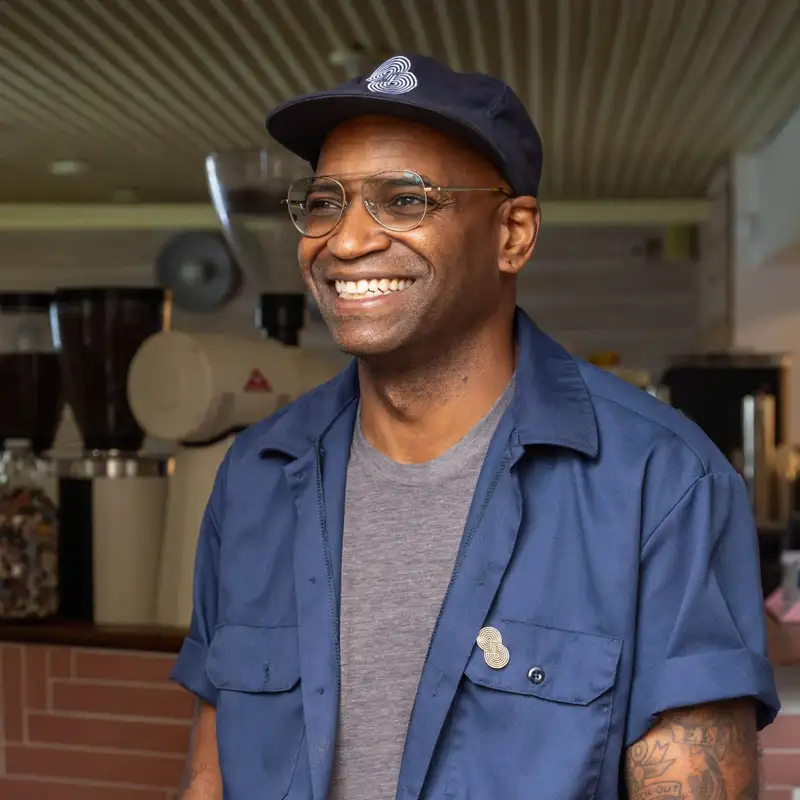
Rob Lee: So what does it mean to, to hit that milestone from a an industry standpoint? And I'll give you this context. So being a podcast coming up on a thousand episodes, I'll be at 1000 probably early next year. And yeah, and, and, you know, because I am in education space and I'm teaching like, you know, students podcasting, I tell them about this, this, this idea, or the phenomenon called pod stopping where folks will do maybe 10 episodes that are done intermittently, no real cadence to it and kind of give up. So being able to do a season, be able to do 20 episodes, 100 episodes, whatever is different milestones within context. So from an industry standpoint, as far as cafes, hospitality, coffee, you know, seven years seems like a long time, or is it a short time? Like, where is it at? And what's the feeling like for your big, you're wearing your brand right now, by the way, all over.
Kris Fulton: Yeah. I mean, seven years and our industry is basically your dinosaur. Like it's, it's almost like a metric that like, not many people hit. I don't know the actual numbers, but I would imagine if I had to just like guess, even just like in the makeup of our city, I would imagine that once you get past five years at like five to 10 year mark, it's probably like 25% of people, for 25% of businesses that opened up, you know, probably make it to that point. Realistically, probably even less than that. I mean, the majority of food businesses close after the first year, even getting to the first milestone is the first year, you can get through a full entire year of business.
You're pretty much like, you know, hey, great job, you know, I think that for me, it was always, let's get through the first year, then it was three, and then it was five. But so much of that was completely obliterated when the pandemic happened. So now it's like, in that context of the pandemic, being opening up right before it, like in not even a full year, we were open for, you know, we opened in April, you know, 2019, and then we closed down. I think it was March, as when we ended up closing in March 2020. So we were like, maybe just shy of getting into our year. I know for a fact that we were closed at a year anniversary, because I remember that feeling, like, oh, we made it through a year. We're so close.
Okay. And then, you know, at that point, the notion wasn't like we're done, but it was also like, I don't even know what the world is right now. And, you know, so I think that the metrics now are kind of the getting through this particular seven years, I think that that means, you know, even more, even more now.
I mean, the weight of that is like astronomical. And, you know, and obviously the wake of the pandemic has been incredibly hard to operate, not just that, you know, year or two, where we were like really in it. But, you know, everything that's happened since then, and even still now, has just been made it even more challenging every single year. So at this point now, I mean, yeah, I feel like being doing this for seven years now is almost, I wouldn't say unheard of, but it definitely is like a pretty, there's not a lot of people at that level, I would say. So yeah, it means a lot, honestly. And for me personally, you know, I'm not really one to give myself flowers, I'm not really one to like, be too nostalgic about things too much. I think that this business kind of requires you to like, think about what's happening that day, that week, and then to kind of like, wipe clean what happened the day before, you can start to kind of plan for the future, but you can't plan too far ahead, because you plan too far ahead, you're not going to be ready for what's going to come around the corner, you're not expecting it at all.
Or potentially those plans that you have, if you invest too much into them, they could lead to a dead end, you know, it could be dropping them, you know, tons of money or tons of energy or whatever, that doesn't go anywhere at all. And, you know, we've had versions of that kind of throughout the past seven years or so. Going back to baseball, and one thing that one of the reasons why I really enjoy baseball is that I've kind of seen this parallel analogy to baseball, it's running this business where it's like, you think about baseball as if it's a 162 game, so there's like, there's a lot of baseball you've got to play, you also may have a really good game, and then the next thing you have a terrible game, and it kind of doesn't matter because the next day after that, you've got to play baseball again. So for us, it's very similar to where it's like, we're open seven days a week, which, you know, in and of itself is something that's a pretty unique thing, you know, for a lot of food spaces to be open that many days. And that was something that, you know, reestablished before the pandemic that I was like, yeah, catfish you open every single day, you can't be coffee every day, we're not expecting every day to be a busy day, but we're definitely expecting some kind of food traffic or some kind of business every single day throughout the week, and there's a demand for it, for sure. And then after the pandemic, you know, we, you know, readjust it, obviously, but I think new businesses starting up afterwards, they've been like, oh, yeah, maybe we should be closed a day or two, which makes complete sense. And I'm 4% for that. It just so happens that, you know, our business model doesn't really allow for that.
And I think that the expectations of being available for people and whatever capacity you can be is something that I also hold as a pretty high standard to our business as well too. So not only has it been seven years, but it's been, you know, almost every single day of that seven years operating the business and having to wake up and get up and get things going and get through the whole entire day and clean up and then go home and think about it and then turn around and do it again a couple of couple hours after that. So, yeah, no, the seven years is pretty substantial. And every year to be going on from from this day forth every day, you know, is a pretty big deal to me.
Rob Lee: Yeah, it definitely tracks it. It's one of the first things that on because I'm in that neck of the woods on the weekends and I've been there pretty much every weekend. And that's why sophomore started the weekend ritual. And literally the first thing that I do when I get up because I'm the person that goes to get the coffee as you probably noticed.
Kris Fulton: You know, tomorrow does two some time. Yeah, on occasion, on occasion. But it's one of the things where the first thing I'm going to do is check like, all right, and, you know, like clockwork, like, you know, bad weather, different things happening is like, we're open today. And it's like, all right, cool. That's a reliable thing. That's the thing that's that's earned trust or what have you. And I think it earns bandwidth and also being that sort of neighborhood coffee shop is like, you're in the neighborhood, so you're part of it.
Rob Lee: And that's the other thing. And one bit that out there out there before I move to this next question. Jurassic Perk. Since you're a dinosaur in the industry, I feel like Jurassic Perk could be a thing. You can keep that one. That's for you. You know, we're friends. That's for you. You can hold on to that.
Kris Fulton: I'm gonna bake that. Yeah, yeah, yeah, just saying, you know, it's gotta be out there. It's gotta be out there somewhere. But I'm gonna bake that.
Rob Lee: I have another ridiculous question that's been rapid fired ever late to the name sophomore. And I think you're gonna like it. I love that. So one of the things that I am, because I drink a fair amount of coffee, I've had my two triple cortados today, because I'm a mad man.
I'm also serving as the coffee sherpa for my family. Really, realistically, I got my dad who's like 72. He's like, oh, let me get a black guy. I was like, yo, what are you doing? And he's like, that's kind of what I drank. I was like, you should drink less of that. You should switch to iced coffee on occasion.
And my brother who probably shouldn't really be drinking coffee because he just has some caffeine sensitivities. He enjoys the ritual component of it. And he wants to be a part of it almost like someone who is an NA drinker, it's like non alcohol. And he's like, yeah, let me get um, let me get this matcha latte. And I was like, there's caffeine in that dog. Like, what are you?
It's like, that's not coffee either. So what are you actually choosing? And I feel like I'm doing the, because I'm somewhat knowledgeable and having conversations with you and being a nerd about it, making them, making sure that I'm buying a good coffee or somewhat informed of what I like and what I don't like. I pass that knowledge on to them. So as a person that's a, as you said, self-professed coffee nerd, you've gotten some press and alcole over the years. I want to put you on a spot. What makes for a good cup of coffee?
Kris Fulton: Ooh, I think the best thing about a good cup of coffee is intention. So if you have the intention, if you have unintention, when you make that coffee, it's going to be good. And I think that I'll keep it as base level as that because ultimately good is a very subjective term. It's like one of the funniest things that I get asked all the time is like, what's your best coffee?
Or like, what do you drink? And it's just like, for you to ask me what I like, what I think is best in order to, for you to inform yourself as to what you should be doing is kind of funny to me. But, you know, I do feel like that's someone putting their trust in me and also telling me that like, Hey, you know, I'm uncomfortable right now making the decision for myself, which is, you know, we've all been there. And I'm looking to you as the expert to let me know like how to do this so that, you know, the value or the dollar amount that I'm spending, you know, I've got to get into the best value out of that. And that's a huge part of service right now is that, you know, things are incredibly expensive. And that was something I think that we were trying to like tip to around particularly in coffee for a very long time, because, you know, coffee is to be dirt cheap. And a lot of the reasons why coffee is dirt cheap was because, you know, it's processed based on slave labor. So you have to pay the people to pay the coffee, but you can keep the coffee very cheap. But as, you know, things like that started to change as the quality started to improve as people started to look at different parts throughout the coffee chain to both elevate or maintain the quality of the coffee along the way, which comes with more costs. And then now other superficial things like tariffs and gas price changes and the pandemic and da da da da da.
You really can't shy away from the cost of things anymore, you really have to be upfront about it, because you can't be a viable business otherwise, like you can't do the things you want to do as a business, you can't support yourself or your family, you can't support other people, you can't grow. So at this point now, if someone's coming in and they're like, what's good, you know, I really, I really think that I always laugh that he's kind of funny to me because I'm a random math person, like, Oh, what do you think is good? But, you know, I do think that that's a lot of responsibility they're putting into, you know, hey, I want, I want to, I want something good.
What do you think I should go for? But I think that the intention of how you make coffee is number one. And I hear this all the time from people when they're making coffee at home, like, Oh, I make my coffee like a very, very certain way, and I do this and I do that and you this and do that.
And sometimes it doesn't even line up to what I think is, you know, technically right. But they produce the results that they're really excited about, and they are able to share that with somebody else. So too. So I think having an intense, and whether that be, I'm going to make it this certain way that I like, that's kind of how I did the coffee initially was that I love the fact that you could like make it the way you wanted to make it. You know, so when I was making coffee with my dad, or getting coffee with my dad when I was really young, you know, I like to try all the different, you know, creamers, because I was like, Oh, which one's the best creamer? I got to try them all because I'm not going to take your word for it.
You know, that was me as a kid is I'm never going to take your word for something. I'm always going to figure it out my own, even if that means I'm going to get burnt, you know, along the way by trying a couple of nasty flavors, like, well, I want to know what I think is right. And then I'll know what's right from that point, you know, so I think just having some good intention, what you're doing, obviously, sourcing good coffee is the number one as well to you.
And the raw ingredients of coffee and water are, you know, inherently important to making a good cup of coffee as well. But I really think intention is, you know, a big part of it. And, you know, maybe that that love element people talk about sometimes to make something with love. But I think that that's what I've seen what I've found in myself when I've, you know, now that I have a palette for coffee, and I can objectively talk about what's good and what's bad. I think that the intent of doing something, you can take the intention and something also to and you really can't come around to something randomly.
That's really great. Coffee is not something that happens randomly. It's something that has a lot of intention put into it. And as you learn more about it, you realize, oh, this isn't something that just happens. Like, this is something that was intended to be a certain way throughout the whole entire process. So intention from, you know, growing a coffee all the way down to how you brew it, and honestly, even to how you consume it, I'm sure, and without even knowing the answer to this, I'm sure that there's a cup in your house that you're like, this is the cup that I use for drinking coffee out of this is the right cup, or there was a journey to find the right cup to drink coffee out of.
And, you know, and that to me is like a really cool thing. Because even if you don't have like a knowledge of how to make a good cup of coffee, people have like their favorite cup, you know, or their favorite, you know, playlist when they're making a coffee also to their favorite time of the day. So like, I think just that intention of, you know, where you're consuming, if you're like, oh, I love sophomore, I'm going there, I'm not just going to go for any old coffee shop, I'm going to go to this place, this place does it well, like that intention of choosing a place to go get coffee leads to good results too on top of that. So yeah, I would say intention is number one.
Rob Lee: That makes so much sense. And I'll add this in as an anecdote before moving to this next thing. Yeah, like even when you speak on intention, it's almost like they sort of stamp, right? Like, what you guys are doing with sophomores doing it's to me, it's stamped. It's just like I trust it.
And I haven't gone in the wrong direction in anything there, whether it be from some of the ingredients that are being used and the initial iterations of the Rob Lee, if you will, you know, we'll go with that. I troll people with that. I was like, go mess with my friend, Chris. Go mess with him.
Kris Fulton: It's happened a few times. It was like, okay, yeah.
Rob Lee: But even with some of the stuff that pops in there, one, it's a culture person as a person with taste, right? I see different things that I've gotten from other places that are there, whether it be in the sort of the Uzu drink, so have you, or the sort of like the iced coffee or the desserts or in any of those different things that are there. It's maybe I'm not into that particular flavor, for instance, like passion fruit for sake of argument.
And I'm allergic to cherries. But, you know, there's a stamping that goes through. It's like, this is good because it's here.
It's a short hand that's already there because it starts off with intention, with quality, and that trust is earned over repeat visits on and on and on, and has been steered wrong. So one thing I'm curious about, because I have a book, I have two books, I have two coffee related books I got for Christmas one year. One is, it's sort of like a log of coffee shops. So me and the partner, we were going through and I was like, all right, how do we rank all of these places? We do that. We will rank a place because you want to, you know, like, where are you spending your money? And how are you spending it?
And what was the experience? And there's a tier to it. And one of the things that came out of it was I class because I'm a culture guy, I class places that roast their own stuff in a different level. It's like, that's a different one. And it's like, you know, not blowing smoke up your ass, but like sophomore is number one, but then also number one in the sort of roaster thing is like one and one. So talk about the significance, right? Of being a roaster as well as a like a cafe, a coffee shop, a third space, all of that, but the importance of also being a roaster. Totally.
Kris Fulton: Yeah. And I think I would categorize it as a different thing also. And the funny thing is that, you know, we never intended to be a roaster. And I was definitely not the catalyst of doing this. I have worked for roasters in the past.
And I have roasted a coffee before also too. It's a pretty boring job. It's a incredibly boring. It's like, you're putting in coffee, you take it out, you like let it sit inside for a minute, you take it out, you put more coffee in it, you take it out.
And I had no real like interested in honestly, to be real for you. I think particularly if you're looking at the funnest jobs in a coffee company, definitely barista for one number one. And then maybe it's the job I used to do, which was education and training, which is basically just getting in and talk about coffee and play around with it all day, which is also great. But no real like, there's an intent of like, you know, hey, I should give you this information, but really it's like, hey, we're just here to have fun and like play around some coffee.
But the roasting really came up out of the pandemic. So, you know, we were closed. And at that time we actually were, and this kind of goes back into the initial idea of sophomore, of like, you wanted to focus on, you know, good quality coffee and service. So for me, I'm all about outsourcing anything that we can when it comes down to it. Now sourcing the roasting would kind of be a no brainer for me. And you know, when it comes to coffee, I think that there's a lot of really good coffee pretty much ever right now. And obviously with the way the social media works, and the way that our transformation works, you have access to good coffee from all over the world now as well too. So like now is the best time in the world to be drinking coffee, because you can really get whatever you want whenever you want it. So with that mindset of, you know, consumerism, it's like, you know, I don't need to reinvent the wheel here.
There's already great stuff here everywhere. I think at that point, it's really just trying to align yourself with the company that has a spectrum of flavors that you enjoy, that ideally is doing work in the way that you'd want someone to be doing it, you know, whether that be buying coffee from certain areas or giving a certain amount of certain amount of money to the producers, that kind of thing too. And a lot of things that I knew kind of were much higher than where I wanted to start. But when we were closed, you know, we had this thing where we were only closed for about like five weeks or so. And hindsight, I wish we'd stay close for longer. But we were closed for about five weeks. I was like, I got to get back open again, I got to get back open again. But in that downtime, people were asking to buy coffee for a month like that's a copy.
And I was just like, well, that doesn't make any sense to me because I'm not open. I'm not buying any coffee. And I'm buying it from somebody else.
And they're also closed too. So like buy from them, you know, like, why would you buy for me anyway? I'm like middle person, essentially. And without I realized that moment without having the cafe element without having that notion of like, making the coffee and then thirving it, it's kind of like, we don't really have a business. Right. So that was a huge like red flag to me of like, Oh, my business may not be relevant anymore in this new world we're entering into.
So that kind of notion. And I have a, you know, good friend who's out in LA, him and his wife run to cafes and they had just started risking around the same time. And so I'm talking to people in our market, of course, but also people outside of our market as well to kind of see, you know, because everyone wants, you know, experience in a different way. And he really kind of peppered into me like, Oh, you need to start risking, you need to start risking like it's been so great for our business to cut our, you know, cost down.
It allowed us to create a whole new revenue stream, it allowed us to extend the branding out also too. That was the first itch my ear about it. Then from that point, it's getting access to a roaster. I mean, that's another big hurdle is that you have the piece of equipment that costs tens of thousands of dollars. If you don't know how to use it, you have to find someone to teach you how to use it, you define a space that will allow you to use it and learn also too. Then you have to take a huge sleep of faith of just trying to figure it out. Investing money and time and energy, and doing something that you're just trying to figure out for the first time while there's people who've been doing it for decades now. To not get into that whole process of learning how to roast, what I'll say is that through that process of learning how to roast, I already have this inherent sense of responsibility to copy, again, more of the service track of things. Then I realized that there's a huge responsibility to just not only choosing what you copy to present to people, particularly when you're roasting, you have access to every single copy that's out there, essentially. There's copies that are traded to single people and deals outside of the whole entire market.
But instead of just what a roaster is presenting, I'm going off of what can I see and what can I find? That was fun to have the expanded box of crowns. Like you start off knowing there's 12 crowns in a box, you're like, these are the crowns and these are the colors. I'm going to figure this out between these. And you go to a different class or you go to a print house, you're like, what the hell?
There's like 48 crowns over here? Like I'm over here using red orange and orange red and all kinds of other crazy stuff. So I think that I got a little bit excited about that notion and learning something new.
And again, I'm a copy nerd, so kind of going through the deep side. And there really wasn't anything else going on at that time period either. So it was just nice. Everybody else was like, I don't learn how to bake bread. I don't learn how to roast coffee. And this is going to be relevant to my actual job. So it started off as like a business move of like, we did do new revenue stream, we need to be more profitable.
And it really kind of turned into a higher level of stewardship. And it's something that I try to not wax too poetic about, but it is something I feel very, very tied to when it comes to coffee and why I'm still doing this. I've been working at Coffee Now for 20 years.
This is very much my career and what I intend to do for the next 20 years when it comes down to it. And when you do get into roasting and get into the higher, not higher quality wise, but you get into the things that happen before you get to a bag of roasted coffee, you start to realize how much of a big entire system this whole entire thing is and how every single person along the way is dependent on the person before them. And also the person after them too, in order to get this one product, all the way to its end consumer, which is the person drinking it. So the farmer who's growing the coffee plants never ever sees the end result of what's happening and they're putting in full total confidence into the person that they're passionate about to you. They're sometimes not even processing the coffee. They're just picking the cherries off the tree and then sending it to somebody else.
And they're like, cool, I hope that works out for them. So you really feel a higher sense of purpose necessarily. I try not to talk in these really ethereal terms, because it's a very tactile thing to me, but you do have a higher level of responsibility and stewardship of this product.
You're kind of taking that on. So for me now, roasting kind of represents just a deeper understanding of what's happening in the whole industry, but also a higher responsibility to our consumer. And we're fortunate enough to be able to then serve to the last person that's going to touch this coffee, this bag of coffee, this drink, whatever it might be. And so yeah, I'm taking all of that quality that was put into the green coffee when I bought it and trying to maintain. And I don't think there's much we can do to elevate coffee necessarily once we get to it. In my opinion, I think that really what we're doing is unlocking different flavors, we're showing our perspective as a rooster of what we think is good, quote unquote good.
And what we think is interesting to present to the people that are buying coffee from us. But yeah, for me now, it's really just a responsibility. It's just a higher responsibility to the thing that kind of supersedes just being a product that I'm selling. Now I'm a part of the life and the kind of the life, the lifeline of this actual product, starting from place of origin and ending in the cup that someone's going to drink. So it's just a higher sense of responsibility for me. But without being said on the business front, we wouldn't be here right now if we didn't start roasting.
There's just no way. It completely flipped our profitability. It allowed us to actually start working with other companies now through wholesale. So actually, in this last quarter of years came out of between January and March, sales inside of the shop are super slow. People aren't leaving their house because it's super cold, there's just snow, no one can leave their house at all. And having a wholesale account that's buying coffee from you, that's seriously the same stuff, of course.
So maybe they're not buying at the same rate as they will in a couple more months. But even just having another revenue stream that's kind of sustaining the business in those downsides, wow, I mean, it really just kind of flipped over, flipped the whole entire script in terms of, is this thing that we're trying to do actually impossible? Can I grow professionally within this? Can I grow financially within this individually also too?
Is there any kind of future that we can present to our team members also as well in terms of, like, hey, this isn't just like a job that you're doing for a year, but this is something you can do for multiple years because you can sustain your livelihood while doing this also. Yeah, the roasting definitely, yeah, it's just funny to me that it wasn't at all something that I thought you would be doing if you asked me in our first interview. I'm sure I didn't mention anything about roasting at all because it wasn't at all in my mind. But now it's so core to me as a professional and also such a part of our business that I'll be doing some version of that for the rest of my career in coffee for sure.
Rob Lee: Yeah, thank you. It's one of those things that I have this running thing that I do when I go out of town, obviously I've gone to 17 coffee shops and every time I visit because I'm just there, just free basis. What else would you do?
Literally, literally. Podcast, nah, coffee. But one of the things that I enjoy doing, I will go to a place, especially if they roasted or at a minimum, it's their coffee, sort of that vibe will have you because I want to, if I had a good experience, I'll get my coffee. If the coffee is good and I have certain metrics I judge on, I get for the most part, I think relatively simple drinks and it's almost a chocolate chip cookie test.
If I go to a bakery and a chocolate chip cookie is bad, yeah, I can jam with it. And I kind of do the same thing. If it's like, I'm going to get either Cortado, I'm going to get probably iced coffee, probably a Colbert, something of those, but something for the most part, relatively simple. And if it's a good experience, then I'm likely going to get beans, I'm going to get stickers, I'm going to get a shirt, whatever.
And I bring those back as gifts. I remember one time in Philly, I went up just for a visit and they had their signature roast or what have you, and it was the anniversary roast. They started in 85. That was the year I was born. I was like, I got to get a bag of this, it was like serendipity.
And it turned out to be really tight and it was really good. And that's because I've gone to that place multiple times. That's the coffee shop, one of the two coffee shops I go to in Philly. And the same thing applies for any city that I visit multiple times. I'm looking for that coffee place and part due to, again, the intention, sort of, do they roast something. If I just need a coffee and I'm really curious, need to caffeine fix, I'm not going to, but I could go to a Dunkin, I could go to a Starbucks.
But I'm likely not going to because of the, I don't really like to change too, too much. So I got two more real questions I want to hit you with. This one is sort of a two parter. So you talked a little bit about the industry a moment ago, and what are some of the industry trends that you're super excited about in coffee and hospitality, things of that sort? And what are ones that you're like, let's shelf these for a bit.
Kris Fulton: It's so funny because I think that, you know, when you're running the business, you become so isolated in a way that you're kind of just like focused on like, what are we doing?
How do I get through this day, this week? Do you kind of almost don't care what anybody else is doing or what the industry is doing at large? I was actually just about to go to a coffee conference last week.
It was supposed to be out in San Diego. It was like my like opportunity to try to tap into the industry at large, kind of see what people are doing, what's going on or whatever. I'll sign up to this Instagram because, you know, looking at social media, I think is basically you're just getting presented what, you know, someone or something wants you to see. It's not necessarily a, in my opinion, like a good representation of what's actually happening.
You got to get out there and see for yourself. But this conference is great because it kind of brings, it's a centralized event and brings people from all over the world, definitely country, definitely the world to one place over this one thing that we all interact with. And you kind of get a chance to see how people are approaching it slightly differently. Right now, one of the things I'm really excited about is probably, you know, and it's showing my age in coffee also, too. It may be my little bit of my being the small business center kind of mindset of it as well. But one thing I'm excited about is automation. And it's kind of like a buzzword because I think in any industry, automation is kind of like, you know, the depth sentence, you know, to labor force when it comes down to it, because if you could automate something and take it away from human hands, you're taking away a job, you know, the very least one job, if not multiple jobs, when it comes down to it. And I think that, and that understanding is very present, you know, I think definitely in coffee and other industries as well, too. But I think that coffee, in addition to a bunch of other industries where automation is present, there's still a huge element outside of the automation that you can't automate.
You can't automate service, you can't automate quality, you can't automate taste, you know, you can't automate preference, you know, when it comes down to, you still have to have a human element or some kind of perspective that's kind of driving that. But you can use automation as a tool, and it can be a really great tool in order to take away and kind of simplify all these tasks that become complicated over time because you're trying to manage this thing and that thing and this thing and that thing and this thing and that thing. And eventually, once you kind of have to look at everything, you know, on a piece of paper, and you know, one thing that's been great about being in this business for seven years is that, you know, I'm slowly pulling myself farther and further and further further out of the business, though I'm not so granular, I'm looking at, you know, one tiny little detail right out of the close, I'm looking, trying to look at as many things as possible at all times, and you start to realize that there's things that you do, or things that your team does that just don't really need to be done, you know, or things that can be done or simplified in a certain kind of way, in order to maximize the things that are really important that you do, or the things that people that resonate with people, maybe they're the things that actually add value to the business or add, you know, some kind of monetary value to the business. And for me, automation is really kind of just a tool that you can use to kind of maintain quality. And, you know, when it comes down to coffee, there's so many different things that you have to, quote unquote, think about as you're just pulling a shot of espresso, if some of those things can be taken off the table so that I can, instead of looking down at the thing, be able to look up and have a conversation with you, that to me is well worth whatever amount of skill there is in being the person that can do that thing, you know. And, you know, ultimately, I don't think that it's, and this is talking very specifically about the kind of automation I'm talking about, which is really about, you know, equipment, there's some techniques also now too. There's a big conversation in coffee right now about pre-bashing espresso, and this is not a coffee podcast. I'm not going to go into what that even is.
You can definitely look it up right now on YouTube if anyone's listening and you're like, what does that mean? Like just type it into your algorithm and it'll, you'll get spot out a bunch of things about automating or batching espresso, but I think that it does kind of bring up a whole conversation about, you know, what is espresso, what is quality, what are the things that people, consumers are actually coming to you for, and what are, what is coffee when it's a beverage in and of itself, and what is coffee when it's an ingredient for another beverage also too. And I think that those things are part of that conversation. So I haven't really implemented any of this stuff into our shop to show, the conversations we have between our team and things that I'm kind of like tapping into here and there.
But yeah, that's something that kind of excites me a little bit is looking more into automation and ways of maintaining quality and also allowing for more hands-on service. Things I think that we could probably get rid of at this point now are just, you know, any kind of like snobbery around coffee, which I think is pretty like, like overdue now. You know, if we were talking to me, you know, 10 years ago, that's like the height, you know, when I was working in that before seasons, that's like the height of coffee, snobbery and like, you know, 2012, and we're like, hey, you know what, you know, you're talking about, I know what you're talking, I know what I'm talking about. And I'm going to talk down to you right now because you don't know shit, and you don't know what's good or what's bad, but I do. And so, you know, snobby little like, you know, 25 year old barista, I can now have some authority over you, you know, doctor or a lawyer, whoever you are, because you don't know anything. And I don't know, I think there's a certain type of person that gets, you know, kicked out of that for sure. I can't say that I'm not kind of person. I definitely like fell into that camp after a time.
And a lot of it really, in my opinion, was kind of just trying to legitimize the thing that we were trying to elevate. You know, again, my coffee starts, you know, basically free 5 cents, 10 cents for a cup of coffee. And now we're trying to get people, which is kind of funny now, because, you know, $5 is like a base level for coffee now. But at the time, it was like trying to try to get someone to send $5 a cup of coffee was like, you got to like, you know, jump and dance and like, really make this a whole situation for someone to actually even just know, invest their money into something that should cost double that, you know, when it comes down to it, make some effort put into it. And then now, you know, fast forward 10 years later, and it's like, you'd be excited to see a coffee for $5 now, you know, but I think any kind of snobbery around coffee or any kind of like, you know, hierarchy, I think it all has to go.
I mean, I think at this point now, if you're engaging with coffee and industry at large, if you go back to what I said earlier about if you're showing some intense or intention, how you're, how you're serving, how you're presenting that, I think those are all things that, you know, should be able to drive your business way more than trying to talk down to people or trying to elevate this product by acting so wholeier than now. And also people are just smarter now too. I mean, there's so much more information.
I mean, the jump in technology information from 2012 to now is, you know, light speed, blindingly fast. More and more people are talking or telling me things about coffee now, which is kind of funny, like, oh, here's your dinner date, Joe, that's the thing about that. I'm like, what are you talking about? Like, you even know what you're talking about. So you can't even really approach things in that same kind of way of like, I know all this stuff and all this information, you don't know it, because all this information is out there now. You know, we've been talking about it for the past 10, 15 years now, and people have made books and put things on my YouTube channels and all that kind of stuff as well too.
So the notion that you know more than somebody else is already out the window anyway. So I think it's just kind of like, let's just enjoy this thing together. And also let's just take a second from our crazy days and our crazy lives to kind of just enjoy the simple thing that, you know, to me is really amazing in both in favor and also just how it came to be and how it comes to be, you know, just kind of been life in general right now. And let's put a lot of stuff aside and try to just come together, you know. I'm not going to go into a whole like the world's so divided that we need to find ways to come together and da da da da da da da. I mean, I think that's just inherent to human evolution and our survival as a species that we kind of find a way to kind of come together, you know, when it comes down to it. But I think that, you know, I don't think coffee needs to be one of those battle rounds, you know, when it comes down to it.
I think that we can just lean into service and hospitality, have a perspective and have some intent on where you're trying to present and let the rest kind of be for itself.
Rob Lee: You know, when I had the great coffee wars of 2024, you know, it was the purest of the black coffee and these latte freaks, these latte lunatics I like to call them. Yes. Latte lunatics is pretty good.
Yes, pretty good. I mean, look, I was a marketing guy, I don't know what to tell you. So here's the sort of last real question I have. And I don't think it's a super long one. But, you know, I noticed baristas and just folks that are in there, especially in sophomore really, really, really good memories in terms of remembering what a person likes or pulling the order.
I'll give you this. When I was unemployed years and years ago, one of the things I would do every morning was do a Luma city. I would do a Luma city course and it had like a sort of cafe exercise for you to remember people's orders. So I always think of that when I go to a coffee shop and you have a rush in this sort of scenario. So how, you know, what do you attribute to like, you know, baristas and just coffee folks have really good memories? And how do you kind of stay sharp during those rushes? It's like, oh man, oh, you wanted a latte with nothing or you can't have a dairy or you need to be gluten or whatever. Like how do you keep it all straight?
Kris Fulton: That's so cool. I mean, I thought about this before and I like to mention it whenever this a question like this is asked because for me personally, it goes back to my first coffee shop job was just at a local coffee shop that's now the funk. But one of their in their training manual, one of the things that they were really harping on and they weren't even really doing anything, you know, if you look at it from hindsight for sure, nothing like unique or revolutionary or special, they're just a neighborhood coffee shop. And they happen to, you know, they roasted their own coffee, which I don't think they did. They got it from somebody else to put their name on it.
And they did have different origins and different blends and that kind of thing too. But one of the main things that they talked about was what they call the cheers mentality. And we may even talk about this in our first, our first conversation, but it just stuck with me and it hasn't ever left. Because I thought it was such an interesting way to approach a job that I thought was just like a random job I was taking. But it was all about, and it made like an arbitrary number. And I do think that the percentages isn't necessarily important. But the whole idea was that you either know 70% of your customer's names or their drink order. And I think what that, what I learned through that process too was that, and I'm really bad with names. I'm like, not the worst person with names, I'm like, pretty bad with names, I'm very good at faces, I'm pretty bad with names.
Rob Lee: Yeah, Kurt, I know exactly what you mean.
Kris Fulton: Because for me, it's just like the name is like almost, I mean, if you have a name that's a part of your personality, it's a little bit different. But the name is almost kind of, I mean, it's, you know, most people weren't, didn't choose their names, they were given their names, you know, and they kind of, there's like, oh, I guess I'm Rob now, you know. And then maybe you've kind of developed what being Rob is over some time or whatever, or you put that apart of your identity of like, I know for me and my name, like I'm Chris, but Chris is the K. And that's because my dad wanted me to have the same initials as him and my brother, and he just named you Chris with a K. And all of a sudden, that's my whole identity, my whole entire life is that I'm Chris with a K, you know. And so anyway, outside of something like that, I think that names are kind of, even when I meet people, it's hard for me to kind of like, hold on to that as a part of something I take away from interaction, because there's so many other things to know about a person, you know, how they dress, you know, how they're looking at you, how they know what they're talking about, how they talk, all these other details that I find way more interesting than somebody's name.
But with that being said, their coffee order now, though, I think is equally interesting, because, you know, people have such a specificity to how they ordered their coffee, they know what they like, maybe they don't always know what goes into what they like, but they know what they like, or, you know, quote unquote, know what they like. And yeah, I think kind of being able to hit that nail on the head and make that connection with someone where you, there's just something about the connection of like, someone walks up and you say, Hey, you're usual. And they're like, Yeah, I'll take my usual. And I think that like, as a consumer, having a usual, there's like no higher level of coolness in a place than being like, I'll take my usual. Because that just means that you have committed yourself and you have bought into the experience, and you've gone enough to create that relationship.
And that's really what it is. And the reason why we know, and it's easy for us to remember these drinks and these, you know, and sometimes names also too, but mainly the drinks, is because we created a relationship. And that's not a one way street, it's a two way street, you know, that's both the person coming in and ordering something that's both us being there and being present also to, and being able to make that thing the same way every single time that goes back into systems and things we work on, you know, on the bar and that kind of things well too. But yeah, it's really kind of a calling card, it's a fingerprint, you know, so it's almost as no one's order becomes as simple as as knowing their name, you know, it's like, I don't have to think about someone with what's this person's name when I see them, if it's someone that I'm familiar with, I'm like, Oh, hey, it doesn't matter how many people are inside of the room, you know, that person's name. And that's exactly what happens to their order, it becomes a part of who that person is comes apart of your relationship with that person also to, and that's really the basis of my relationship with a lot of people inside of my shop is figuring out what they want to drink for coffee.
And it goes from there. And I've, you know, I've made friends, I've, you know, casual friends, close friends, people that, you know, that I see almost every single day of my life, more so than my actual family, my, you know, my true friends, and you kind of build this report relationship over that initial understanding of like, what is it like to drink, you know, and that responsibility also to often rear the first interaction people have throughout the day. Sometimes we're the first thing people are consuming or putting into their bodies. And that's something that I really take highly and always have them working in the food industry about people are consuming what I'm making, like people are putting it into their bodies, you know, and that like that lower responsibility is kind of crazy when you think about it in that way, that you're just walking to a random place and being like, cool, I'm now going to put this into my body. And I'm going to assume that you did all the things you need to do to make sure that this isn't going to kill me or make me sick, you know, and you know, and then the times when it doesn't and you get sick after that, you're just like, ah, you know, um, so yeah, it kind of becomes a part of the lifeblood. But for me, you know, that that's kind of hand in hand with being a barista is like knowing the person and knowing the person is knowing to drink, you know, and that's kind of that's kind of it.
But it really is that building up a relationship and building up that rapport because you come in, you know, every single weekend, that commitment you have to our business, which really distance from you, eventually, some from you want to support the business, of course, but initially distance from you just being a cup of coffee, you know what I mean, and then resonating with whatever it is that we're doing, whether it be the flavor of the coffee or the vibe of the space, the person on the counter or that kind of stuff. But yeah, it kind of becomes something that becomes inattricable to that relationship. But it really does kind of highlight these relationships that we have with people. It highlights our sense of community that I think can be a very loaded term nowadays, talking about community and like, what is that?
And like, who is that with my community with and that kind of thing too. It's a very simple, it can be a very simple thing or can be a very complex thing. And I think that when you are mixing in things like community and family and all your better terms when it comes to something that's consumer based, it becomes very infectious and also very insidious, also too, it can't become that way as well. So I think there's also that level of trying to maintain that purity of that connection with someone when ultimately you are selling them something. And I talk often about being friendly, not familiar with people, because sometimes through the course of seeing somebody every single day, you're like, oh yeah, we're cool. And then all of a sudden you say one thing or they say one thing or you say one thing, you're like, oh, I actually don't know the person at all.
I just know them from like, we're doing coffee in the morning. So you got to maintain that balance for sure also too. But I will say that more often than not, I've been able to kind of expand out of that tight spectrum of just being friendly to somebody and getting them what they need. And that just comes from repeated visits. We have people that come in almost every single day and you do become a part of their routine, a part of their life, something that was really highlighted in the pandemic was that people definitely not coming to talk to somebody, because it wasn't safe, quote unquote, to see people. They're coming to a space where they felt safe because we have put in some steps in order to provide a sense of safety. I don't know if there was, I don't know what that is.
And that's a whole different conversation and podcast to talk about. But I do know that there is a sense of safety and there's also a projection of that you can do for people. And sometimes you don't hit that mark, it just doesn't, people walk in and they're like, no, not for me.
And they walk right out. But if you again, go back to going back to intention, if your intent is to provide space for people, the whole space for them to create a space where they can feel safe and cared for and thought out, thought after people will attach to that. And that time period, people really needed that and it really attached to that for sure. So that just kind of became part of our business, really kind of more so than provide people with coffee. It was like, oh, no, we're providing interaction and service to people and creating community with them, even if it is a one-on-one kind of situation, we are providing that service for people, essentially.
Rob Lee: Yeah. It works. And definitely that piece is going to come back when we get to the stage advice. That's sort of it for the real questions. And now I want to move into, I've got four rapid fire questions. You don't want to overthink these. These are ridiculous in some regards. And I'll start off with this. We were talking about the specificity of orders, right? So recently, what is like the most specific coffee drink that you've made?
Kris Fulton: Wow. Oh, wow.
Rob Lee: Is there anything one that you're like, really? This is eight Splendors? You sure?
Kris Fulton: I mean, there's a whole bunch, I could say, obviously. What I will say is that this is insider baseball for sophomore. So we measure everything on a scale. So whether that be the coffee grounds or the whole bean coffee, we measure everything on a scale. Everything measures on a scale, coffee, water, syrup, all that kind of stuff. So we don't often tell people that, that if you order a 12-ounce drink, you're going to get 30 grams of syrup inside of it. But we know that internally.
But as we do try to, everyone that works there, we all ultimately want someone to walk away with something they enjoy. Again, I'm not drinking. I'm making something. I get enjoying out of making this, conserving it to you, but I'm not drinking it. So if you want a large latte with extra sugar and cinnamon and all kinds of other things on top of it, I want to make the best version of that for you because I'm excited to do that for you.
And I'm excited to see you enjoy that drink when it comes down to it. So along the way, we've kind of given people a little bit of that insider baseball. So what I'll say is that some people come in asking, specifically, I want 40 grams of this, 30 grams of that, half this, half that. One of my favorite orders is one of our regulars who comes in every day.
And it's also just between hot or rice, but she always gets a mocha with extra chocolate and vanilla and then also extra hot if it's going to be a hot drink. So nothing super specific that kind of jumps out. We kind of kept things very simple also to you. That's another part of our first space is that when I give you every single option underneath the rainbow, because I think that's kind of a little bit absurd. In my opinion, if you have everything, then nothing can be good essentially, versus just having like a small amount of things and being confident about that. So there's not a lot of things people can really do in our space to go too wacky. But I will say someone comes in asking for a specific measurement of things based on weight. That's like you've got a real one.
Rob Lee: So I've paired pastries with sophomore coffee. I remember there was a chocolate situation years ago where me and the partner had to snob off with one of the chocolate experts that came in. It was some sort of relationship.
Kris Fulton: We showed off. We OG's. I know. Being around for so long, I have to go back into my mind. I'm like, oh yeah, we didn't do that.
Rob Lee: One of the things that I like to do, this might be the adult robbery, is I like to pair vermouth with iced coffee. Like a sweet vermouth. Oh, I'm into that.
That's what I'm doing. It pairs well. Do you have a favorite combination that you like to pair? Whether it be hot coffee or cold coffee or just leftover coffee with? Are you all here, Terem, suing it up? What's your favorite combination with coffee?
Kris Fulton: Wow. So you already said it earlier in the podcast. My most favorite, I'm a very boring coffee drinker. I really only enjoy a lot of things, but I only really gravitate towards either drip coffee or espresso.
But I think that my favorite pairing with coffee is a salted chocolate chip cookie. You get it. That's the number one thing for me.
So if I'm in a place, I'm right there with you. That's the first thing I'm going to try. And I think that that pairing of salty and sweet and obviously the bitter elements of the coffee, sometimes the fruitiness of the coffee and the fruitiness of the chocolate, I think that those two, that combination of a drip coffee and a chocolate cookie with sea salt on top is like my most favorite combination ever. If I were to redo software as a concept, I would make sure that I had just those two things on the menus together.
And I thought about that before I actually before two, pairing those two things together. And actually that all since back from my time at the four seasons, because the cafe I worked for had this like insane barona chocolate sea salt cookie. And I never had salt on a cookie before. And I was like, why are we putting salt on cookies now?
What's going on here? And it completely just like imploded my brain like completely imploded it. And I've never looked back and put salt on everything at that point. That's great. That's great.
Rob Lee: That's a good combination. And also kind of works with sort of the first conversation you we had your conversation and the first time we talked was part of a sort of a two part episode. And the other half of that episode was with person at a coffee shop. So what do you know? I mean, a cookie shop side. What do you know?
Kris Fulton: Oh, yeah, yes, yes, I remember. Yes.
Rob Lee: So this one is sort of goofy. And it's a callback to something I said earlier. It's not really as much of a question as more of a confirmation of what could this work potentially. So Starbucks has the whole Starbucks reserve, right? And you're being an extra bougie. Would graduate studies by sophomore be the equivalent?
Kris Fulton: I think that or the one I get the most is junior. I think that's the next thing we do has to be called junior coffee because I get that all the time. Yeah. But yeah, and honestly, I know it's kind of a funny question. But I do think about that because I do think about, you know, when I talk about automation, that's kind of almost the opposite direction of what we're talking about now is kind of like, you know, how do you simplify things? How do you make it more accessible? How do you make it easier to train on and easier to quicker and faster while making equality? But again, the coffee nerd part of me wants to find ways of slowing down, of being very specific and very intentional, kind of bumping out that intention even more. So to a level to where there is maybe like a coffee or macaste somewhere, and we are starting to see that now more and more.
I think the first coffee shop called Endorphine in LA, they're the first coffee shop to get a James Beard nomination. And that's pretty crazy. And this is the person who is one person, super intentional throughout every single aspect of their space. And they are providing, you know, very focused, you know, service to on top of that. And yeah, I would love to do something to that effect. And I try to find opportunities to do that here and there. But yeah, I'll have to put that put that name into the mix. But junior coffee is the one I hear the most that I might have to be number one whenever I do another thing like that. But yeah, something was like a lot of intention, very focused to be a really fun product to work on.
Rob Lee: Yeah, a little little dark blue label sophomore, I like it. Yeah. So here's the last sort of rapid fire question. And this is definitely just a yes or no one because I was looking it up. What is it? Is that coffee yes or no? No.
Kris Fulton: Look it up, folks. Look it up. Yeah, not for me. Once you look it up, you'll see why I said no me Dylan.
Rob Lee: Yeah, exactly. You're gonna have some fun in there. So let's go back in with the last question of the day. And this last question is my sage like advice, it's a new segment that I've been using for for this season. And it's sort of like a little bit more of an insight question deep in the insight. So folks make coffee, you can make coffee at home, right? They can also go to a big chain, but there's a certain value in a reputation of being the neighborhood cafe, the neighborhood coffee shop and cafes are third spaces and indicators in my opinion of the health of a community. So with that in mind, what is the best advice you can give to someone wanting to enter the industry considering all of the things that we've talked about intention and sort of this quality component, this sort of cure the stewardship, what piece of advice would you give to someone who's wanting to enter the industry with all of what we've discussed so far?
Kris Fulton: Just be a sponge. I think that again, I mentioned nowadays, you know, when I first got into coffee, there really wasn't and I hate to like, sound like the old guys still again, there really wasn't that much information about it. It was just like, there are things people were doing, people are very much in their own little islands and kind of doing stuff here and there, sometimes debated to the mainstream or into, I remember there was like a series of like, like, BHS tapes of this guy, I can remember his name, I think it ended up going to DVD eventually, where the guy was like making tapes and DVDs about making latte art and other kinds of crazy stuff like that.
But now you can really just kind of go on your phone or on the computer or wherever, kind of just kind of, you know, take a deep dive when it comes down to it. But whenever someone's looking to open up a coffee shop, I always say, I always ask them, have you ever worked at a coffee shop? First of all, because for number one, if you're looking to run a coffee shop, you have to envision that at some point you're going to be working in that coffee shop also too. I think there's owners that are want to own a coffee shop, but I don't want to work in it. It's just like, well, hate to break it to you, but you're going to be spending a lot of time working in that coffee shop unless you pay somebody else to do it.
If you have it like that, then there's that. But in general, I think we're attracted to that idea of creating a third space or the vibe or the feelings of the vibe they have inside of a coffee shop, they get really attracted to the vibe and the aesthetics of it, more so than understanding the day in, day out work of maintaining and running a coffee shop. So I always say, outside of being a sponge, get a job at a coffee shop.
And if you can get out of a job at a shop that you love, that's great. We're often to not, and it's the experience that we have at our shop is that one other way that I'll get myself flowers is that we have a very high retention rate. So we don't have a lot of turnover. I have somebody on my team who has been on the team since before we've been open still.
They've been on our team for seven years now. And outside of that, the next person is I think four years outside of that. So, and those are not normal numbers or normal amounts of time people work in coffee.
I would probably say a shop maybe a year or two is probably more a regular average, probably a year more so. So clearly there's things that we're doing well in terms of providing things for our team and providing a good space for them also to people to want to work there for a long period of time. But if you can get a job at a shop that you love to kind of get an idea of like, how they put that stuff together, because as a guest, I love just it doesn't happen often if I'm on vacation, I'm also going to a coffee shop or going to a restaurant, because I want to experience what somebody wants to present to me.
And I want to be able to kind of just fall into that, you know. So you're not always picking up on all the small details. Now I'm a detail guy.
So I will be looking around at random stuff and oh, what's this cup from and oh, what's that thing over there, you know? And that's just me as a nerd. But in general, I think that a lot of people don't really look into that stuff. So they don't really know that it's not just wave of a wand and the coffee's great. It's like, no, you have to go through all this stuff, you know. So I just say, yeah, be a sponge, take as much information as you can and whatever sources you can take it. And then ideally get a job at the coffee shop and kind of just see, hey, do you like working as a barista or working in a coffee shop before you put in all the time and the energy and the heartache and the just absurdity of opening up a coffee shop?
I think that that would save a lot of lives. People just got a job in the coffee shop first before they took on the ownership of one because it is a different type of business for sure than what people expected on the outside than what did on the inside. Absolutely.
Rob Lee: Taking a look under the hood.
Kris Fulton: It's important and I'm going to get ready to close out here, but it definitely is important where
Rob Lee: when I talk to folks and I'm coaching them or trying to give them advice on going into this, like, don't just jump in it, have some intention, have some reasoning why you want to do it and do some reps, listen to podcasts. There's so many people who don't touch them and don't listen to them, don't interact with them. When I teach my class, I'm like, so what's the podcast that you're listening to? Oh, I don't listen to any. I watch video shows. That's like, all right, cool.
That makes sense. Maybe you want to take from that, but this is all your podcast. There's a lot of things to consider. But this notion of you're taking from until you get your identity of the thing that you want to do, you're taking from sort of other places and other experiences that you have. And I think folks miss out on that and also being involved in it. So like, you were talking earlier about sort of other means to bring in revenue, sort of roasting being one of them, right? And one of the things that I've started doing is, I do a lot in this, and not only like doing the hosting, the booking, all of the different things, but also I'm engineering like while we're doing it, right? And I've picked up engineering gigs, just doing that because people get intimidated. It's like, I don't know how to do this. I was like, hire me.
I can do it for you. And it's a low lift and that's a revenue poll potentially. And it's just sort of these different things. And I can give that back around like sort of insight and support in it. And it just comes from the sort of wealth of knowledge that I'm applying to it.
And I just think having that experience of being around it, like loving it and wanting to do it, but having that experience being around it will take you very far. And so that's just a piece of I'll close out with. And so on the actual close, there's two things we want to do as we wrap up here. One, I want to thank you so much for coming back onto the podcast. This has been a great time. Yes, it's been a good conversation. I think we covered a lot of ground.
And secondly, I want to invite and encourage you to share with the listeners where they can follow you, check out sophomore, all of that good stuff. Stameless plugs here. The floor is yours.
Kris Fulton: You love the plug. You love the plug. So I will say if you want to experience sophomore, no, we're rough to you. You got to come to the shop. We're open every single day from here on the avenue and 23rd Street in Baltimore, Maryland, the greatest city in America. And outside of that, you know, we try to maintain some of the presence on these other channels, you know, out there. But I will readily admit that I am the worst at keeping up with that kind of stuff because that's a whole different podcast to talk about. But, you know, I think that I really, there's so much to do inside of our space and so much of what we're doing really can't be displayed outside of just being there. That I kind of like the lack of information out there. It's the kind of draw people to kind of have to come in and kind of see what we're all about. But without being said, I am trying to get back up on doing our newsletter, which was something that we started doing last year that was a huge benefit to the business because, you know, there is a lot of stuff going on and people do want to know what's happening and people don't have the capacity to drop inside your shop all the time or talk about what's happening.
And it is a nice way to kind of go directly to the people who have already been inside of the shop or people who are already interested in knowing what's going on and kind of give them information directly. So let's hope, and, you know, hopefully now we're putting that intention out there into the world in this podcast. So we're getting the newsletter back up and running again soon. But, you know, we're on Instagram, obviously, of course, too, a couple of little visual takes on what we're doing there.
And, you know, in the stories, we try to, you know, keep people up to date with what's happening, you know, kind of in a day more or less. But yeah, we're a neighborhood coffee shop, so you got to come through. And we'd love to have you there.
Rob Lee: And there you have it, folks. I want to again thank Chris Fulton from Soft More Coffee for coming back on to The Truth and the Zard and catching up with me and in earnest and doing a full interview. You know, this is kind of a second interview, but really a first that we had the full story as it is now from Chris.
So for Chris Fulton, I'm Rob Lee, saying that there's art, culture, and community. In and around your neck of the woods, you just have to look for it.