“There Are No Problems, There’s Only Solutions”: Chef Nicholas Martino on ABOVEGROUND and Egg Yaki
Download MP3I am on
Rob Lee: Welcome to the Truth in its Art, your source of conversation connecting arts, culture, and community. These are stories that matter, and I am your host, Rob Lee. Accept no substitutes. Today I'm thrilled to be joined by my next guest, the owner of two Washington, D.C. based institutions.
We have uh Above Ground and Egg Yaki, which are both in Union Market, and my guest's food is contributing to the Washington, DC food scene. And he's here to tell his story. Please welcome to the program, Chef Nicholas Martino. Welcome to the Truth in His Art.
Chef Nicholas Martino: I'm great, man. How are you, Rob? Thanks for having me.
Rob Lee: Man, I am what's the saying that people float out there. I'm living a dream. I I don't know if that's quite it, but um I'm I'm trying to make progress. Yeah.
Chef Nicholas Martino: Progress, not perfection.
Rob Lee: So you know, I like this. See, that's this is that's the mentality of a chef. It's just like, look, we'll we'll pivot. We'll figure it out. Yeah. So, you know, to start off these conversations and I'm like really excited that we're able to to do this for one.
So again, thank you for for making the time to to come on. And if I've been following a social media present, I was like, this is a superstar. I got in my midst. And um, so I'm super excited to have you here today.
And to start off, I would love it for you to introduce yourself, what's your background, where'd you grow up. Just build a tea. Or whatever the appropriate thing is. Uh shall. spill.
Chef Nicholas Martino: Um so my name's Nicholas Martino.
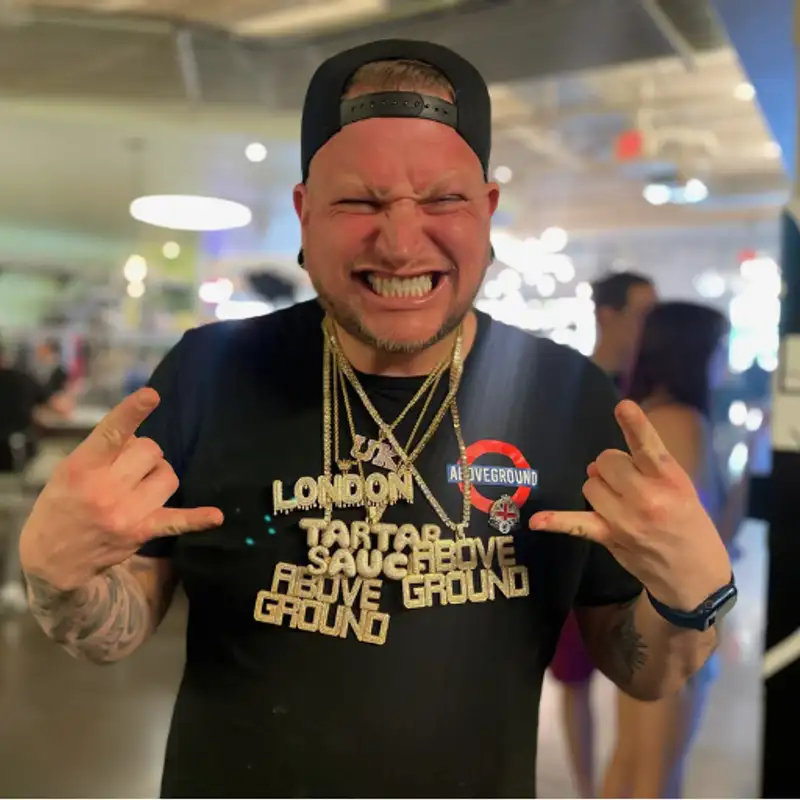
Rob Lee: Uh I'm a chef, human, uh, philanthropist, uh, lover, um, community activist. Um, but my you know, main skill set I'd like to say is cooking food. Um I've got two uh concepts uh inside Union Market. Uh one of them is British food um called Above Ground, and we're known for our fish and chips and our big fish sando. Um we also have savory pies, shepherds pie, steak and ale, chicken and leek, we sell sausage rolls, and also have a nice melange of British imported goods and um about 75 different rotating candies as well. Um we'll get to uh the premise behind that um after so the sister stalls for the next of it is called egg gyaki, uh, which started as just uh three omelets on the menu uh and it's grown to what we call the concept now in Japanese comfort food. So you could get um rice bowls, you can get breakfast sandwiches, um there's definitely a lot of egg all throughout, but it's pretty much a love lever to l letter to my travels through Southeast Asia. Uh I spent two years living in Singapore. Um and while I was there, I got to go pretty much all over.
So um, like one of our stable dishes to rock on is fried garlic from Thailand, crispy shots from Vietnam, spicy mayo, unagi sauce, shrimp, cabbage. Um so truly a love letter concept, uh, and it makes it super fun and uh allows for a lot of creativity. But Above Ground, which the is uh named after, you know, a play on the London Underground, their transit uh authority and system. And yeah, so it's the same almost the same logo, uh, but it says above ground instead of underground. Uh so we really play into that. The show uh the shop is uh, you know, got London Underground map, you know, it says Mind the Gap. Uh we have like a live ticker of train stations that come on.
Um Yeah, we just like to have fun. Uh there's big giant pictures of my uh ugly mug on the sides of the uh chip tubs that we sell uh our triple cloak chips in. Uh but really what culminated in like is kind of what's pushed me is is how I got into English uh cooking. But to take even a few steps back, my earliest memories of food are my mother pushing the bounds on probably what most kids would be comfortable with. Um, you know, I always say that my mom was serving me couscous before mashed potatoes.
And I I have a poignant moment in my childhood of my mom taking me to get sushi, and I was just like, it's a big wide world out there, and I I want to taste everything. So I started working at restaurants when I was 14 years old. I was a dishwasher at a golf club, and then I was a bus boy. Then I took a little break from that, and I worked at Wing Stop, so it was frying chicken wings. And then I ended up going back to the country club and pretty much working every position you could possibly imagine in the restaurant, in the kitchen, all of it. And from there, I was like, okay, I don't know if I want to cook my whole life. So I went away to college, uh, flunked out, um, just ate, partied and smoked a lot of weed, um, and realized that like the typical education cube was maybe not meant for me.
Uh I hadn't quite come to that perfect conclusion yet. But I, you know, spent some time. I went back to working at restaurants, uh everything from Subway to Red Robin, burgers and fries. Um, and I I kept some of that this original old school country club I worked at that I got to like, you know, watch all different you know, series and jobs throughout that. And so I just, you know, I think I just was instilled with work ethic in general from my parents. So every job I ever took, I just kind of did well at and was like well received by management, etc. So my sister calls me up, and she's just like everyone just you know hears that like my life is spiraling and nothing's really going good for me. Um a little dramatic, but yeah, I wasn't doing anything.
And I think I was about 20, so I'm went my sister. Was like, hey, look, there's a culinary art school uh close to Hershey, Pennsylvania. You should come check it out. You love to cook, you love food.
Why don't you just do this? And I just like on a whim, was like, okay, didn't fight AFL right, went up there. I went to culinary school, and while I was there, because I had a really great experience in front of the house. I uh took on a job as a waiter um for a forthcoming restaurant, which was named Devon, and it was named after a seafood uh well, it Devon is uh named after a British seaport.
Um so foreshadowing to how we end up in in England, and I like I'm really into this. They like had this entire training team from the Midwest come out, and it was like a four-week training process to open this monster of a restaurant owned by the Hershey Company, and I kill it, and I'm like labeled as like one of the trainers off the gate, and like, you know, I just I had this articulate way of explaining. We would have like 25 different species of fish on the menu at all times.
So the whole premise would be like all these different fresh catches every day, you choose it and choose your sides, and you know, they had steaks too. So all that's going real well, making more money than I'd ever made in my life. Um, you know, I was making six figures as a 25-year-old cash, uh, which for better or for worse was all amazing, and uh also, you know, didn't allow me to be completely focused at times, but nothing too bad happened.
Um, Well, so being like I was like the best server there, and we got a lot of celebrities because Hershey Park was there, and the Hershey Theater, and they had a big uh place for so all these different people would come in, um, Roger Waters, Akon, um Tom Hanks, like you know, and I'm always I was the guy taking care of them. And they're like, you know, like at this point, I'm like 100% like I'm gonna be a chef, but I could not afford to give up this cash coming into my pocket. So meanwhile, I'm going to culinary art school.
I'm working at this restaurant to stay afloat and live the wild life that I wanted to live. Uh in Walks, the culinary giant that changed my life forever, uh, Marco Pierre White. Uh Marco Pure White, um, most known for receiving three Michelin stars at the age of 33.
He was the youngest at the time. He trained uh Gordon Ramsey, classic French and English, uh, Mario Batali, Heston Blumenthal, some serious culinary giants, and then a smaller giant myself. He was at my table, he he was he was there with the Unilever group.
You know, Unilever owns everything. And Marco's the spokesperson for Noor bullion cubes. So that's the reason why they were there.
I didn't know that at the time. But it was like 15 executives in a private room, and I'm, you know, taking care of them, doing doing my absolute damnedness. Meanwhile, like I'm I'm like starstruck because this is someone I'm very familiar with, not only just very familiar with like idolize, you know, the original bad boy chef, the guy who made it cool to be a misfit and cooking.
And I'll never forget it. He goes, John, can I get another beer? And I looked at him like square back in the face, and I just said, I'll do respect. My name's Nicholas, but yeah, I'll get you a beer. And he looked square back at me and was just like, oh, you're really proud, aren't you?
And I looked him right back and said, shouldn't I be? My mother gave me that name. And to give you a little context, Marco lost his mother when he was six years old.
And I found out over the years that anyone who dotes upon their mothers or speaks highly or protective of, he really just take took a liking to. So somewhere during the meal, he was like, So, like, what are you doing with your life? And I was just like, Well, I'm I go to culinary school and uh, you know, I'm doing this, and he was just like, What do you want to do with your life? And like me, I'm like, I'm I'm you know, 21, 22 years old at the time.
I was like, I want to show my cuisine to the world, even though I could barely, you know, sharpen my own knives at the point, but I was excited and I and I was ready. Um he pulls out his server. I he asked me to pull out my server pad and takes a sheet of paper, writes his cell phone number on it, and he said, he said, New York or London, your choice. And he pulled a wad of a couple hundred dollar bills out, put it in my pocket, he said, make sure to take care of the staff.
So I go and I take a seat on a beverage rack in in the uh beverage station, my head spinning. I'm like, what? It's like I remember the very first time explained to my grandfather this. I was like, Granddad, it's like if you were at your local basketball court, and Michael Jordan walked up and said, Hey, do you want to come to Chicago and I teach you how to shoot free throws? So, like, it was it was a really intense moment.
And then I was like, oh shit, I still have this table I'm taking care of. Because he just ducked right out. But before he dipped out, he was just like, uh, come with me. Let's let's let's have a smoke.
And I'm like, oh, like, okay. And he just lights up a cigarette in the vestibule, hands me one. So me and Marco are smoking a Marlboro Red in the vestibule in a non-smoking restaurant, and I walked him to his car. So I head back into the uh dining room, and they're like, Where's Marco?
And I'm like, I I'm not his keeper, but I think he left. And um, they were like, Wow, you like had such a great rapport with him. Would you come to our business meeting tomorrow? And I was like, Yeah, uh, sure. Like, he was like, Marco's gonna be there.
We want to we want to keep him happy. So they sent me an address, and it was to a giant food store, right? But this giant food store happened to have a massive demo kitchen in it where they would like, you know, show you know, people how to cook ingredients or whatever.
So they rented that room out. I'm walking up to the to the giant, and this giant is across the street from my house. I lived about 30 minutes from Hershey, and you know, serendipity, you know, really was was helpful that day. And I I walk in there and he's super excited.
We sat outside and just kind of got to know each other for like a solid hour and smoked an entire pack of cigarettes. And uh I like now that my my mouse on fire, we're eventually like to go in to this meeting, and I'm handed an NDA. I didn't know what an NDA was at this time, so it's Unilever and their executives, and they're explaining their like international campaign with Marco involved in all this thing of these stock cubes. Uh, they had made a uh jellyfied one uh called Stockpot, and Marco was there to introduce it and show it to the executives, and I didn't know that before I walked in.
I I knew none of this. So I'm sitting in the back row, like the two cool kids with Marco, and he was just like, What's your mother's name? And I was like, her name's Colette. He said, one L, two T's. I was like, Yeah, exactly. And he proceeds to write a note to my mom asking if it's okay if I go work with him.
And you know, I mean, I'm I'm a grown man, uh, I'm 23 years old at this time. Uh, I didn't need permission, but like it it went back to the sentiment of him caring about people who cared about their mothers. So before I know it, we're in this demo kitchen. Marco asked me to come up to the kit kitchen with me. I had no idea again what was gonna happen. And we're making saffron risotto in front of 15 univ Unilever executives, and he's like, cut this, chop this, hand me this.
And and like we just sit there, and like I'd made risotto maybe once in my life in culinary school, but we did it, and I didn't fuck it up, and I was like, wow. So at the end of it, we it was a really great day, and you know, gave me a big hug, and he was just like, You got my number, call me a call me as soon as you're ready. And I was just like, Well, when are you back? When are you back?
I'll call you right away. And so I went and I got a passport for the first time. I'd never been out of the country in my life, and about six weeks later, I'm at Marco's um row home in West London, which was a former Russian embassy to the UK, and I I then jumpstarted my introduction head first into British cookery.
Uh, I entered in as a culinary student with unsharped knives to moved my way up, cut the tip of my finger off, had it sewn back on, fully immersed in British culture, and now I'm hand rolling my own cigarettes to the very last six months I was there. I was I was made it up to Sue Chef from a dishwasher with some culinary school in a big ego who could talk really well about seafood. Now I'm in one of the hardest kitchens I've ever worked in my life, where I worked breakfast, lunch, and dinner six days a week. Um I'm woken up on my on my the seventh day, my day off by the head chef at the time, and he shakes shakes me in my bed because I lived in a house across the street. It was called the staff house, like 10 chefs lived in there.
It was raucous. And he's he said, Do you want to cook for royalty? And I'm like, Yeah, chef.
And I like get dressed and everything, and I'm like, who's here? And he's just like, Princess Camilla. I had no idea who it was, but Prince Charles' wife. At the time, uh, the Duchess of Ross, uh, now the Queen Consort, that the Queen of England now, um, and she came to eat uh with a few friends, and the chef, Stuart Langdell was just trying to give me a moment and appreciate the hard work I'd done so I could have something cool like this to tell on a podcast 20 years later. And um, I cooked her an omelet Arnold Bennett, which is a Augusta Scoffier era dish of a lightly cooked omelet with smoked haddock and mornay.
I served it, she ate a green salad, and I walked out the door and went back to bed. Um I eventually made my way back home after about a year and a half and had to reset my tourist visa because I'm doing this all under the guise of being a tourist. Came home for about six weeks, flew back out from Baltimore to London Heathrow. I'm detained by uh British immigration authorities, and I'm put inside a detention center in the basement of London Heathrow Airport. And I was searched, kept in a cell, and eventually interviewed by uh immigration services and deemed that I was not justifiably in the country. Meanwhile, Marco's at the airport waiting for me outside, waiting for my grand return. I even called him and tried to have them speak with him, and they eventually um took my passport, they brought me out directly onto the tarmac with two immigration officials, and they put me in this like Pope Mobile looking like plastic golf card vehicle where they drove me on the tarmac straight out to the plane, and I was the last one to board the plane, and they and the immigration officials hand my passport to the captain and says that he'll give it to me when I land on U.S.
soil. So this is I ended up flying 5,000 miles one way, 5,000 miles out of the way. So 10,000 miles in a in a 36 hour period. It was very bewildering, and it was a real bum, but it allowed me to get a serious jump start on my career that led from working in restaurants in New York, Philadelphia, through Washington, DC. Fast forward 10 years after that, Marco and his team are looking for, and in for that 10 years, we did everything we could to try to get me back.
We tried to get myself a working visa, and the cards just didn't play out. So they're like, fancy Singapore. I got a message at five in the morning while I was drinking after hours at a bar, and I'm like, yeah. Three days later, I'm on a uh business class ticket direct flight, which is the longest flight in the world, direct from JFK to Changy Airport in Singapore, which then jumped into the next two years of my life opening up the restaurant, the English House, uh, Marco's first restaurant, Southeast Asia, and that was the ability as a chef that had at this point I had become an executive chef in numerous places. I carried his name on my resume, and it it was worth more than its weight in gold. You could possibly imagine. I mean, it opened doors for me that I can't even fathom.
And it's it's crazy that just his name did that. Let alone I felt like I I carried the mustard with me and like had the skill set too. So it was it was a good combination to have, and it allowed me to have a really good uh opportunities through my career uh through partners and restaurants. So I after two years in Singapore decide that it's time to go home, and I'm ready to be out on my own. I'm slated to open up a 400-seat restaurant called Uncle Pig, which is my moniker given to me by my niece Lila.
Uh I got this uh pig that's on my arm, and it was one of my first tattoos, and she calls me Uncle Pig. Um COVID comes crashing down. I look I land in JSK March 12th, 2020, one day before quarantine started. Um my friend worked at the three Michelin Star restaurant Massa, and I was gonna stay with him for a week. Like, this is my welcome party back.
He comes home from work that day that I arrived and just said they just closed my restaurant. And I'm like, what? He's like, Yeah, dude, I don't know what I'm gonna do. I think I'm gonna go to my parents' house. And I was like, all right, well, I gotta go see what's going on in DC. And I'm like on there, I'm like telling all my my family, I'm like, hey, I'm home, I'm I'm coming in, and they're all like, make sure you have toilet paper and paper towels.
Because at that time, you'd like there was a shortage, and you couldn't get like rubber gloves and masks, and like people were wearing underwear around their face. Um, and I was uh yet again in a bewildering moment where I was given this first opportunity to have like my own partnership fully in a restaurant with my namesake as it and it just comes crashing down. Um so I got to figure out how to make some money and figure out how to make my dream come true. I was so lucky that I was employed by a real estate developer who was gonna be my partner in this massive restaurant who gave me a job as a consultant. So for the first time in my career, I'm getting paid to do exactly what we're doing now. Talk to people through a computer, structural engineers, architects, um, other chefs being part of projects of using my culinary knowledge and prowess that I learned over the last 15 or so years to help people consult and open their own restaurants. So the first time ever, I'm not breaking my back, I'm not sweating over a grill. I'm I'm getting paid to consult on someone else for their own money. Life's pretty sweet until it's not because I am still a chef and I am still very driven, and I realized that working nine to five at a computer just wasn't for me. So I had ruffled up enough pennies and nickels at this point to where I was ready, and I I pitched my story to the woman who was cutting my hair.
You remember in COVID, we couldn't get a haircut for a while. And finally was able to, and I'm like, yeah, I don't know. I just I don't know what I'm gonna do.
Like I'd really like to open this spot at Union Market and start small rather than like this day. She was like, well, the CEO, uh, she's a client of mine. I cut her hair later that day. I'm on uh texting back and forth with her, and I'm in a meeting with one of the VPs of the landlord uh landlord's uh real estate company, spilling my guts. I'd I'd made a brand deck in a day and a half on Canva. Uh no idea what I was doing. I made a logo, and they were like, hell yeah, let's do it.
And then was birthed above ground. Uh I started out with a really small menu, and that is my truest love letter to British culture, people, and it's food. Um it has been since allowed me to continue on doing consulting while making my own namesake, being able to be a lot uh part of the DC food scene, um, starting a nonprofit for mental health awareness in the hospitality industry. It's called Chefs for Wellness. Um it then uh took you back into egg yaki because it was a love letter of what I was doing while I was in Asia eating low carb.
Um and I I did the egg yaki pop-up for a solid year by myself every day. So above ground had been open three years at this point, and it was just me in front of three burners cooking in a little tiny 50 square foot spot until it grew and grew and grew, and I signed a full-time lease on it, and now I'm running, you know, both concepts for our sixth year, and yeah, so my whole uh evolution approach of above ground in my branding came from when I opened July 1, 2021, it was peak COVID. Everyone's closing their restaurants. I and I'm I'm making the the moment to bet on myself in one of the you know, restaurants already have a very slim margin in how they are successful, margins, all that, but I decided to do it during a global pandemic.
Chef Nicholas Martino: See, Let no, let me let me stop you right there because I I I I want to be able to break it up because I'm I'm going through um I'm going through my questions and you're making my job look good. Because it's like, alright, that's like five questions I've already got an answer. So shout out to you.
Rob Lee: All I'll I'll keep them a little more specific. No, no, no, no, no. No, you're you're you're fine. You're you're telling your story.
Chef Nicholas Martino: That's that's the thing that's good about it. Um, but it makes me seem like I'm so good at this, but I'm not.
Rob Lee: Uh so let me go back and we'll definitely be going back into it, but it's a nice little um a little tease. Uh one thing I want to comment on. I like seeing your mug on my my fries or what have you.
Chef Nicholas Martino: Don't do that. I was like, I know this guy, I follow him on social media. And um, and and it and it's that, and that's definitely a question that's gonna come up a bit later, but I want to go backwards a little bit. Um So we all we all had these these moments where we get to the point you just you described sort of when you realize that culinary, that that food was your calling. And in that, what was the first dish you feel like you perfected and what motivated you to perfect it? Was it that time in like
Rob Lee: London where it's just like, all right, I gotta get this right. This is five thousand miles, I can't go back. Yes. Um And. that's where the Uncle Pig tattoo came from. It was my first tattoo, the pig with all the primal cuts, and it was first tattoo, and I said, I'm not a chef yet, and then I'm gonna get a chef tattoo. I have to come back as chef or else I'm a fraud. So that was like a big part of my my motivation. So if I'm thinking about the first restaurant that I took over as executive chefs, called the mill and Hershey, it's still open, and I'm still doing some of my food on it as well. Uh it was my first giant canvas to paint every color I wanted. And I was really into barbecue, and I had created this dish, and it was just called the house bacon. So Pennsylvania is known for their great agriculture.
They have fantastic farms in general. And so we we made this um nitrate free bacon, and it was hot smoked versus cold smoked. So essentially smoked pork belly that was cured with salt, sugar, spices, but it was dead tender.
Right? Already cooked because we hot smoked it versus cold smoked it. And I remember cutting it up and like first, you know, I just made it to make our own bacon in house for cheeseburgers, stuff like that.
And I had these hunks on the end of it, and like I'd have to cut it off to keep it like the cut straight. And I was just like, I remember I just threw one on the grill and like charred it up, and I had this honey glaze for another dish, again inspired by Marco, and I was just like, holy this is pretty good. So I wanted to do that that kind of practice of where chefs like reaches to the area, get flavor profiles.
Um Pennsylvania's known for their red beet pickled eggs, uh, and and their agriculture. So it ended up being called the house bacon, which it was uh I'd say it was a four ounce piece of bacon, so a quarter pound of bacon in one slice, right? Charred up nicely on the grill. Um we took uh raw Brussels sprouts and shaved them paper thin, like you would coleslaw with a whole grain mustard Dijonnaise.
So we called it the Brussels flaw. So that was on there, and then I took roasted apples, roasted beets, pureeed them together to make this apple beet gel, and it was this vibrant red streak, this neon green flaw, and this you know, ungodly earthy, smoky, grilled deliciousness, and it just I felt like I nailed it one because the dish was an absolute success. It's still on their menu to this day, and ten years, ten years it's been on the menu, and it just was it was this perfect amalgamation of texture, raw, smoke, salt, acid, and I was just like I can create my own food. So that that earliest on is is definitely something I feel like I perfected, and it was cool because it was a a unique own dish.
Chef Nicholas Martino: That's so what I'm hearing is this was uh Uncle Pig Origins in a way pretty much. Um that that sounds amazing, and it like I you know I've uh had the opportunity to just have a lot of cool conversations with chefs, and I've you know cooked with one of my favorite chefs, he was just giving me the idea of taste as you're going and all of this stuff. I'm like, I'm learning, and one of the the things that happens is I'm a little bit of a snob, I like what I like, and I'm able to articulate what I like. You see, nose up, Always I didn't deny it.
Rob Lee: I like the nicer things in life.
Chef Nicholas Martino: And and my partner, she was just like, Yeah, so she really comes to me and it could be a trap, right? Of like, yeah, so what do you think about this dish? I'm like, oof, do you want my real? She's like, no, please tell me. And I would go through, and I was like, well, need some of this to balance this out, da da da. And she was just like, alright, go on, keep keep going. She's like these interviews have been working
Rob Lee: out for you that you don't need stuff. And that's and that's the thing. So when um I think when we were down there at Above Ground, and I and I have a question centered around this, um, we we went there and it was like a long day. We were we were we were down for I think a literary fair, and we just popped over there to Union Market, and I'd been following you, and I was like, I gotta try this dude's food before I just like, hey, let's do an interview, and I've not sampled you, I haven't got high of your supply, as it were. And um, and she's a French fry girly.
Chef Nicholas Martino: So I I go there, I get a sausage roll that is the addition to what I'm already gonna eat. I have a side sausage roll. This is how I'm living, and she gets like the giant like order of the fries, but she was
Rob Lee: like 54 ounce tub of yeah, and a gallon.
Chef Nicholas Martino: she was like, This is a lot. I was like, it is, and we're gonna we've absolutely finished it. These were additional items, and we were just like, this is how a fry is supposed to be, it's not just this this sort of viral thing, and it was it just worked, it fit. So with that in mind, how how did you come to focus on British cuisine and and to it to an extent the with the Japanese or Southeast Asian cuisine at N DC. DC has the embassy, DC is a melting pot.
But why those two? Was it you know purely from the experience, or was it purely from you living and working in these places? But what was it about sort of British cuisine um on the interim to start off there?
Rob Lee: Yeah, no, that's it. Aside from the obvious of like my training and working with this culinary giant, I was also tired. So I was tired because I just spent two years over a stove working in Singapore, very hot, and I felt like now like people are paying me for my opinion on paper. And I was like, although I'd really enjoyed this era of creating new dishes, creating new dishes, I kinda wanted a break from that. And I was like, well, I love British food. I know it's delicious as much as it gets made fun of, and so I was just like, hold on a second.
But I the best British chef in the world taught me how to cook British food. I I could print this in my sleep. So I was like, this is too easy. And I was like, let's do British food. Fish and chips, DC's the most fried fish eating city I've ever been to. I grew up eating fried whiting sandwiches at the wharf. So I was just like, let's you know, this is not fried whiting or catfish from the soul food spot, but it translates. It's cr it's crispy fried fish and crispy potatoes. So I, you know, I took a chance on in COVID on British food, which people make fun of. Fast forward three years, we're doing pretty well, and I'm bored now.
So the inverse. And I'm like, I want I'm I'm finally developing a staff where I don't have to be there a hundred hours a week. I want to create something new.
I'm I'm in the I'm in the zone to create. So while I was in in Asia, I was trying to eat keto, low carb, but I was surrounded by such a beautiful array of ingredients. And so I started making these omelets. Where you would normally eat something with rice, I was replacing rice with eggs. And I ended up making these uh I called them lazy omelets, because I would come back in from exercising, throw all these things with in the pan with enough fat in it that when I cracked eggs on top, it kind of just made this lazy omelet, flipped it once, didn't roll it, slid it on a plate. I always had Japanese mayonnaise and crunchy this or crunchy that, and I was just like, this is pretty good. Um and I was like, I made this really cute logo of this egg that you know, and I knew like from opening above ground that not everyone knows what British food is, not everyone knows what the London Underground is. And I was just like, let's make it so no one could not understand what I'm doing. Let's put the word egg in it, take, which everyone knows from teriyaki, yakatori.
They might not know what it means, but it translates as Asian in an average consumer's head. Okay, what do we got? A we got we got Asian eggs.
How do we further stamp that into your brain? We make a cute egg with little watery eyes as the logo, and people walked up and were like, Yeah, I want breakfast, or I want eggs. And this is right when the price of eggs are going through the roof. Again, degree of difficulty again for you. Degree of difficulty, but they're still eggs and they still make money. Boom.
Yeah. And before I know it, I'm on two different news stations talking about why, you know, I'm making eggs. And while I was in Singapore, because of my love for eggs, I got a Japanese egg tattoo, his name's Gudatama, and so as the uh Hello Kitty fam. So I already had this, and then I got the egg yaki tattoo on my arm, and this woman's interviewing me, and she's just like, this is Chef Nicholas Martino, master of eggs with tattoos of eggs with his body, and now I'm like, I'm the authority on making money with eggs during a time where everyone else is complaining about it. I'm like, let's go.
Chef Nicholas Martino: Uh hold on, hold on. That that's that's funny. So I I I definitely, you know, I like to let folks know when they're doing stuff stuff right or doing stuff very well. And, you know, one the the first time that we we went to um Union Market, I noticed the branding for above ground. That was one of the first things I knew.
And then here's the thing. My brother, right? He's the social media food guy.
He's like, yo, you see this giant fish sandwich? You gotta go there. He'll never go. He'll ask me how was it? And I'll bring on one bag. That's how it goes.
And with you know, not being noobs and all of that stuff. Um, I think we went there the when we when we had the fries and sauce control, and we we saw the branding, and I kind of connected it because I was doing a research for you, and my girl was like, What's this cute egg place? The logo's really cool. She's like, it's super cute. And I was like, it's the same dude. She's like, No, it's not. I was like, it's the same dude.
Rob Lee: And that's literally what it was. This side of the aisle, you're in England. This side, you're in Southeast Asia. And I said, You don't have to buy a plane ticket or have a passport either. But that egg is so damn cute.
Chef Nicholas Martino: It it is. And so it's uh I'll I'll so I've interviewed um I've interviewed actually English up here in in Baltimore, and I've asked him, I was like, What's the test? What's the kitchen test if you can see it someone? And he was like, eggs. He's like, Can you get eggs right? And so it's sort of that kinship because I'll commiserate with the chefs. It's like, uh maybe. And so I'll ask you this. Um with you know, making we we talk about the proper British British food. You know, he throws out properties, yeah, yeah, proper.
Rob Lee: Yeah, our slogan is done proper. See, and what is the key to proper British fish and chips? Like, what's that? What's the key? Is it is it the oil? Is it a preparation? It's the ingredient.
What's the the key to it? Fresh fish, cold fish, dry fish, cold batter. Okay, that's important. So obviously fresh speaks for itself. You want the fish nice and cold because you don't want it to overcook. You don't want it to cook too fast. Generally, nine times out of ten, your fish is gonna be cooked completely before the batter's cooked. So any way you can slow down the cooking process of the fish, you're gonna get a nice juicier, you know, un perfectly cooked fish. Uh and the batter being cold, although that means may seem counterintuitive because we're trying to slow it slow down the cooking process of the cod, the colder it is, the the more glass like of a crisp on the battery you get. Because there's beer in it and water boils off at a certain temperature at 212 degrees, the alcohol is disappearing before that. So all as the steam is ejecting, that's what those bubbles in your fryer are steam coming out. The alcohol's coming out first and creating these micro pockets in the batter. So following just simple rules with it, fresh fish, pat it dry, cold batter, cold fish.
That's like that's the the top. Now, when it comes to the chips, it's a it's a more lengthy process, and I you know, we cook them three times. We won uh best French fries in Washington, DC by Washington City Paper.
Um we soak them in water for 24 hours, and then after that we cook them low and slow in a poach um for ten minutes, then we cool them off completely, and then cook them again at a higher temperature, and then we cook them in a very high temperature to order. Um the only other section of that, which would be the triumvirate of the batter, the chips, would be the tartar sauce. I mean, the front of my car says tartar sauce king straight across the front of it. And I say that because Marco Marco Pierre White taught me his tartar sauce recipe.
It's fantastic. There's more I always say there's more tartar than there is sauce in it. So there's more guts to the to the tartar sauce. It's chunky.
You could turn it upside down like a dairy queen blister. It's fresh tasting. You can taste the crunch of the shallots and the pickles and the pop of the capers. And you know, I I get a lot of flash from people that are like fries are super salty and delicious, but the fish is under seasoned. We season our fish to where it's just right. We don't push it too far, and we only season with salt, but the key is it's meant to be eaten with tartar sauce. And then also, if you're in England in general, the first thing you ask for is malt vinegar and salt.
People season their food themselves there. Not saying that I haven't adjusted things to fit the American palate, but that's not really my right to do. It's not my culture. I'm just trying to put on for the country I love. You've got cheesy song, put on.
Chef Nicholas Martino: Yeah, yeah. And it was another thing, and thank you for that because I I I reach for for the vinegar.
Rob Lee: I I I it's I don't know, it's just like this is the way it's supposed to be done. I try to be as close to a purist, like my favorite thing, like I love to go to New Orleans, right? And then that's a whole different podcast to talk about my love of New Orleans food. But I get real persnickety when I see some non-pork dishes. I was like, no, don't use Turkey, sorry. Doesn't work. And I I I get real again, it's not be nose up. But one of the things you
Chef Nicholas Martino: said in around like the sort of low carb, right? Um the the egg yaki piece there. So that's you know, you mentioned the the Japanese mayo, QP. I I get you.
I get you. And um I do and I I throw it out there, like I I you know, I like to smoke, I do crab cakes. I do the smoked crab cakes and one of those.
Uh I try to do a few things. And one of the other dishes I like to throw out is uh Giodon, right? And I have like the beef bowl and all of that, and people like, so do you do it over rice? And I was like, no, eggs. I don't I don't want extra carbs. And if with the QP and all of that, that's like that doesn't even work. That's like it's like a steak omelet.
Rob Lee: Like, what are you talking about? Yeah, it works great. Eggs are eggs are one of the most satiating foods on the face of the earth. Uh they do not give you high cholesterol. They only give you high cholesterol if you're eating a bunch of other BS. Yeah. But if you're if you're eating clean, they're they're great for you, man. Like it's it's they're almost the perfect food.
Chef Nicholas Martino: It's like a multivitamin in many ways.
Rob Lee: Yeah. Yeah, dude. You could you could eat a dozen eggs through the day and feel like an absolute king and queen at the end of the day.
Chef Nicholas Martino: So I'm gonna skip it, it's gonna be that and I like this one thing that i i it's been a through line and it's even in the description for egg yachty that eggs you you you wrote that
Rob Lee: eggs on my canvas and you know, places I've been, my palate, my dreams, the the you know, the brush that brings things to life, that's awful philosophy. So you know what else comes to mind in terms of philosophy in the kitchen, because I've heard this sort of thread of doing things artfully, doing things, you know, because a lot of times culinary arts is kinda excluded from the art conversation, but it seems intentionally that you're putting it in there the way that you've talked and the way that you've you've written about sort of you know, egg yaki is sort of your your approach. So talk more about your philosophy and perhaps how it connects back to art. Yeah, I I think that's really important.
I'm glad you asked that. One, I'm a huge art collector, so um I'm I'm into art, I'm into design, I'm into all those things in my outside of my chef life. Um and I think that my artistic side within cooking is what brought that out.
It certainly wasn't there before. And you know I always tell my chefs and I I say this is not we do not live in a box. I said you need to dream. It is okay to dream. It's okay to imagine, it's okay to make mistakes.
If you're if you're not feeding your brain in in accelerating its growth in some way, no matter what you do in life, you're gonna crash and burn, you're gonna get burnt out. So I t I say, you gotta find a way to be fun, to have fun in here. Like, we are strict on our our quality standards, how we treat guests, all that but we have to mix in fun. I'm the I'm the fun police. People aren't like I understand people have bad days, and that's totally fine too. But like keep your blood pressure low, keep your spirits high. Life life is hard.
And everyone has to show up and go and work a job. But it try to find joy in it. You chose to walk into here and it might just be a job to you, but feed your mind.
Get creative. I always i it's it's a round table discussion of what we do at any business, any restaurant I've ever been a part of. And that's like that philosophy, and so it it it feeds so much back to obviously that's you know, understanding art and the art of someone's mind, which is a different perspective, but also is pouring back to into the cups of your own people that are that are um you know, get earning bread with you and breaking bread to do this. So if I'm not if I'm not rooting for my team to live a better life, I'm not a g I'm not a good leader and I'm not a bus good business person.
Because if you're not fostering a culture that is positive for people, one you don't keep employees, or you have angry employees, which is uh leads to a bunch of different things. So it's funny that how just trying to dare to inspire someone to be creative and to add art ends up being a full circle moment of keeping the equilibrium in the whole uh zone, you know, peaceful and and collectively uh equitable. Um so like the the last part of it though is like the art side, you know, I spent lots of time. That uncle pig dish, the the house bacon, you know, it was vibrant and bright, and you know, although fish and chips is essentially one color throughout, except for the mushy peas. It's something that's always thought about how the fish sits on the top, does it look beautiful? And when I say does it look beautiful, it's not just appetizing. Does it look like something that the consumer could not make themselves? We want them to feel like this is not just beautiful, but then afterwards delicious.
So they're already in a great mood. So the philosophy behind that again, on both ways is daring to inspire to be creative, and to also make it paramount, even for what we call ugly delicious food. Fish and chips is ugly delicious. You know, there's it it's it's uh it's a pile of golden brown, a delicious pile of golden brown, but we find ways to neatly stack intertwine the chips so it sits super high. We put a uh British flag uh on the top, and you know, just little things like that. It's just small stuff, man.
Chef Nicholas Martino: Yeah, and that makes a lot of sense. There's uh cure and an attention to it because in on the surface, someone thinks of you know, food that's fried. Oh, that's quick, and that's sort of this and all of the and it's like no, the the way that you describe the the process of making the fries, the process of making the tartar sauce, the the process of making the fish is cure and attention, so that's there the same way as someone is being very like an artisan, not even artisanal, because I don't really like that word, but an artisan as in I'm stretching my own canvas. I'm making my own sort of like uh paint, I'm using this the the powder, and I and I'm making my own paint. I'm going through each step of the process.
Rob Lee: And there's something about being involved in that way, but you gotta have fun in it. Um, you know, I had a that the
Rob Lee: same brother I'm talking about from earlier. I remember it was one time where I was like, let me experiment in the kitchen. And I tried to make some beer battered fish.
Chef Nicholas Martino: It was an issue. I I I tried to just intuitively, right? And he was like, it's not like you kind of fucked up something in there.
Rob Lee: I was like, oh no, I did. I absolutely did. I was like, I'm gonna pitch this now. This is years later. Um I'm always the barbecue guy because I have the smoker and I have the grill and all of that. And you know, he he he he's on his kick of making oxtail, right? And I'm like, I don't I've never used this before. And I look up a few things, and I was just like, I feel like I want to do something burnt end style. I think I want to figure that out. So I smoked it and then I finished it in a high heat and I got caught off doing something else because I I fucked it, right?
Now here's the thing. It didn't burn up beyond repair. It was a little dry, so and it was overly seasoned.
So what did I do? Peel off all the meat that was on the bone, and I was able to put it in to some uh some beans that I had soaking. And I I'm really weird about eating my own food. Sometimes I tried, I was like, this tastes good. And my girl's uh pescatarian, she's like, this is delicious. My brother took the rest of it with him. So something that he's like, can you make this again?
Chef Nicholas Martino: And I was like, maybe. But it was something that in the past, you know, you mess up something, this is stupid. I I I screwed it up because I'm not a chef.
Um, but I came back to it, I was like, I'm caring to experiment and I want to try something, the antennas there. I knew I could save this and I have the confidence in trying to save it.
Rob Lee: Yeah, I I think never be afraid to make mistakes because that's when gross happens. Um And some amazing dishes I've ended up cooking, whether I smoked too much weed that day or you know, it just was, you know, out of my reach and my bandwidth of understanding of food.
Yes. Sometimes accidents happen for the best, man. And just uh I always we we do have another shame in the kitchen. Um there's no problems, there's only solutions. So mistakes happen all the time. It's just all about how we bounce back. 100%.
Chef Nicholas Martino: So I got one last real question and a few rapid fire questions. One of the good things about these conversations, right, is when I have a person on, I have a subject on who's very giving. What happens is normally I'll have like two rapid fire questions, and it'll be something that you said I was like, well, you've earned a third and fourth rapid fire question, sir. Uh so here here's the sort of last real question, and
Rob Lee: then the rapid fire, did I have the sage advice, and we'll be closed out for the day.
Chef Nicholas Martino: Um, I think you'll like this question. So I think I think of rappers, right? You know, you you've referenced Jeezy earlier, and rappers have this sort of uh, you know, the they they make music sometimes about their past lives. I was a drug dealer, or I was doing this, or they talk about future aspirations, those checks that they have in cash, that advanced they haven't gotten. Then some artists don't revisit their their earlier work
Rob Lee: because they're in a different pace place in their life. And again, culinary arts and cooking, that they're it's an art. So how do you look at food through that lens of you know where you're at now, making food that's representative of where you're at now, instead of like, all right, I now used to go to this, let me go back and play the hits, but it's just like this is my food philosophy in 2026 versus you know, this aspirational or this sort of you know, older sort of setup. Yeah, so you know, it was kind of that like above ground was that like ease down, execute what you know already. You don't have to use your ego.
I took my ego out. That's how I made above ground. The first time in my career, I did not have to think about the recipe.
I already have the recipes. Um And then I wanted to revisit creativity, which is why I went to a Yaki. And now that that's going, and it's slowly blossomed its own creativity to where I had it, I had one of my cooks create a dish, and my ego's so gone out the window, I was like, let's put it on the menu. And I'm like, any time, you know, I have two fantastic managers, and they're like, hey, is it okay if we do this? I said, This is your show right now.
I said, if you think it's best for the restaurant, do it. I like I've I've I've placed this level of trust in my in my staff, and a lot of this has to do with growth, therapy, finding yourself that that the longer the lease you give on those people that you trust, when you have the trust is key, the better everything gets. And so now I'm in this interesting world where I'm watching my concepts orbit and orbit really well, and I'm I'm I'm like, what's next? So I'm now feeling that because like, you know, not that the the creativity was taken from me, it was I I gave it. I gave I guess you guys run run with this. Like I created the foundation, just keep building it on top.
And if and if a build if a block doesn't stick, let it fall to the ground, and it builds the base stronger. Uh so I have a forthcoming restaurant uh that's uh spring. This is this is exclusive.
first public segment. Yeah, uh, I'm gonna be opening a restaurant that is called Ojisan Buta, which translates directly to Uncle Pig in Japanese. And it's as if A Yaki had uh a love child, and it birthed the pork forward version of its concept. Think of small kaiseki style plates with sake and Japanese whiskey cocktails uh in a really fun hit spot.
It's gonna be on 8th Street Northeast. Um there's gonna be things like uh, which is an uh another era of where I'm going after this, is I've I've gone to Mexico eight times this year, uh, and half of that was to learn how to make carnitas. Um but I will be doing a miso-cured carnitas with a Japanese Sancho Pepper salsa verde, and you know, making making tortillas with pork lard, and so it's not just so OG San Buddha, it incagulates me and kind of the philosophy of Japanese cooking, but there are no bounds, there are no limits. This is my big show in DC, uh, brick and mortar, full bar, open kitchen.
So long answer, short, that's how I want to be right now in 2026, is where we got a quarter left of the year, and by the first end of the first quarter next year, I'll be in a really great place of being able to deliver my art and my philosophy and all I've learned to this moment, include not just my training, but as an entrepreneur as a restaurantur, and give it back. That's amazing. Um I look I'm looking for my invite, man.
Chef Nicholas Martino: I gotta
Rob Lee: I gotta you. I got you, rob. When you mention like you know, Japanese whiskey, it's like, okay, you mentioned porn, you already got me. You mentioned Japanese whiskey. You now you really have me.
Chef Nicholas Martino: It's yeah it's it's one of the things and um that's that's fine it's great to that's great to hear um congratulations and just that's amazing seeing you know and I even like the the the philosophy there as well just you know that that piece around if the piece falls out just makes the foundation stronger and you know I've been hearing more
Rob Lee: and more of those messages because just for context before I move into the rapid fire this interview that you and I are doing right now that we're in a sort of uh last act of this is one of coming up on a thousand interviews I've done since twenty
Chef Nicholas Martino: nineteen thank you man and it's it's one of those things where you're like alright what's next where am I going and am I am I still enjoying it and being able to engage in these conversations like I love talking to chefs because it's always like all right I'm gonna steal some food knowledge firstly but secondly also let's hear about the process and there's some funky stories that are mixed in like you know it it it's it's a
Rob Lee: perfect industry for the underdog the misfit and you know those that you know just didn't think that you could do it like Biggie Small says uh all the people that uh uh called the police on me when I was just trying to make money to feed my daughter Yeah, yeah. so let me hit you with these rapid fire these are just quick ones quick ones
Chef Nicholas Martino: um so I I like to like to troll chefs with this one what's an ingredient that we won't find in your pantry in my pantry like the at home situation
Rob Lee: specifically fridge fridge or pantry fridge or pantry yeah yeah a large tomato oh hate I hate tomatoes on a sandwich it's not for
Chef Nicholas Martino: me wow okay okay yeah I I almost lost it last week I had a uh really good
Rob Lee: BLT it was on like some facaccia and uh it it hit it's a little too much tomato I was like this is a giant damn
Chef Nicholas Martino: tomato it's a little uh watered down and yucky it smells like a mop to me I don't know what it is I'm Italian man tomatoes are part of my life like I love them in so many forms I like Pico de Gallo if you have a beautiful heirloom tomato and salt and pepper on it I'm I'm down to eat that in the middle of the summer. You put it on my sandwich you're gonna lose me as a friend. Um now here's another ingredient right
Rob Lee: um but what's an ingredient that just and it maybe it's tomatoes again but what's an ingredient or dish that you just won't make you don't care who it is it's just like you know it's like let's say you're you're doing entertaining or something that's like hey you know this person really likes blank and I I don't make that I I can't make that I I don't know if that exists in my repertoire like I mean you could think of like niche things like the fish and like rancid fish dishes or things like that.
Blue fish yeah you know I I'm I'm open to it all man. I I I love to cook. I love to learn people's culture through their food. It's the easiest way for there to be found common ground is putting something in your gullet and tasting it tells you a lot about a a community a culture anyone. Oh yeah so I I actually I'm the anti on that I'll cook it all.
Chef Nicholas Martino: Love it in that vein I've watched a few of your uh demo videos where you're making dishes at home I see I pay attention you I'm over here researching my what's uh what's something like recently like you've made for the first time you're like all right I'm still kinda kind of messing around with this I'm getting there it's not quite there but I'm getting there because you
Rob Lee: I see the experimentation and it's very it's very insightful. Um like made in a video or just made in my house. Maybe maybe the video's not out yet for sake of argument. Okay, that's good. Um so on the same uh page as condiments people give me condiments all the time like people trying to sell uh this or that or anything so sometimes I'm just like whipping up the secret sauce I don't know how it's gonna come out so um I got this barbecue sauce from this guy he sells it in DC like you know on the weekends and I was I just got a new grill and I was I and I also got uh it's called the Butcher box so I get a month a monthly box full of meats manly but it's so great it's top quality meat all this so I'm like taking this barbecue sauce and like some chicken bouillon from Marco and I'm cracking some coriander seeds and I just I didn't even taste.
I'm like, I think I know all these are pretty good. And I just threw it in a ziploc, marinated for like six hours, came home, threw it on the grill, and I was like, boy. I mean, even like I sounded so next to my girlfriend we're eating. I was like, I said, I know how to cook. Like I nailed the the cuisson, the temperature of the steak.
It was cooked perfectly, and it was like I was eating like bulgogies at a Korean restaurant, and I was just like, dude, this is it. Yeah. Yeah. I was eating the leftovers cold all day today. That's that's a true sign, right?
Chef Nicholas Martino: I was like, yeah, I dug this. Um so here's the last sort of rapid fire question. And um we all have our ridiculous things that we we like. Um, and I um whenever I hit like a milestone, I rarely celebrate them. I'm gonna celebrate episode 1000, I think, but when I hit like 100, 500, what have you, I did something small for myself. It's usually like buying a goofy piece of jewelry, and it's like, oh, I'll get a hero, I'll get a like a necklace or something.
Nothing too garish. What is something like when you hit a milestone that or was something that you you've hit a milestone? What was the milestone? And did you get something for yourself that was like, I know these are super expensive. These are six hundred dollar sneakers, but I wanted those. Like just something that was just like this is an out of pocket purchase, but I made it happen.
Rob Lee: Yeah, I think I was having a good month, and nothing too crazy, but um uh foam posits, are you familiar? I am. Yeah. So I'm quite the sneaker collector. I've seen. Uh and I the the I had not owned a pair of foam posits, and I always wanted to. Something about the price was kind of like, eh. And like I grew up watching kids have 'em, but I didn't have them. And the cherry red ones came out, and I was like, I don't care. Where I I need these, I don't I'm not ordering these. I'm
buying these at retail. And I went and I bought like I said, and this was just celebrating a good good month of growth. I was in a good mood, and I went and I bought those, and then the next day I bought the black pair with neon green. And
then after that I bought the UNC ones, and I was just like, now I'm a phone posit. And it just was that. So, like, that's something in the most recent. One thing I'll say though, that I that I do that's odd. I gotta it. Yeah. one of my favorite things in the world. Okay. Yeah. And
I have one or five or ten every day. And it's nostalgic of childhood, but they made a version that's appropriate for a nearly 40-year-old. Is Kool-Aid jammers, tropical punch, sugar-free. Oh,
yeah. I get ten of these delivered every month. So nine times out of ten, whether I'm at my restaurant in my car or at my house, I got a Kool-Aid jammer on me. And they'll be on the uh the secret menu at OG Sambuta. So if you know, you know, we have sugar-free Kool-Aid jammers back there.
Chef Nicholas Martino: Oh, yeah. I got that thing on me all the time.
Rob Lee: Yeah, I keep those things on.
Chef Nicholas Martino: me. Like, I'm I'm constantly cracking a jammer. Cracking a jammer. That's I'm like, you're looking at crack a jammer. Oh yeah. So toast with that one. Um, that's fire. And and and thank you. That thank you for indulging. That's that's that's that's amazing. Um so we'll reset into the sage advice, and that's sort of like where we'll close out. Um,
so one of the things with and the whole thing with sage advice, it's just something with, you know, we have some fun, a little bit more depth to it, and just something that just that insight, and you've been very insightful in this conversation. So wanting run w running one restaurant, let alone multiple, it can even be more, is a difficult pursuit today, you know, than it was to say a decade ago. In DC, there's intense competition, social media influence pressure uh influencer pressure, like, oh, you know, come with me as I go to and then there's thin margins as you alluded to earlier. Affordability is a thing right now. There's still a lasting impact from the pandemic. I mean, you opened during the pandemic. Uh what's hard about your work in 2026 that most people out
Rob Lee: of solid to culinary industry just wouldn't wouldn't understand, and what advice would you share for folks that are in the industry? So something that folks that outside wouldn't get, and something like maybe helpful and insightful for folks who are in the industry that are feeling that crunch. Yeah, um, so I've had tremendous growth over the past year. We're we're up almost like 75% in a year, and typical growth is about three percent. Wow.
And this isn't this isn't like, oh, brag. So another hip hop elude back's big mo mo money mo problems, okay. So with that comes as much fanfare as there is for this product for my livelihood that I'm expressing through art and business to feed you, which by feeding someone's the most intimate thing you could do aside from sex. It's going in one one way and coming out the other. Possibly
more intimate, is as much love as you could get and much cheers. There are so many people who might not even know you, but don't want to see you succeed, or make a judgment about the way you look, or the way you talk about hip hop, or the way your fish is seasoned, or where I park my car in front of my house on a major thoroughfare legally. I had a guy the past two days, this is real, put bubblegum on my car. Three three days in a row. Same same blue bob, no idea who it is. I
recently had a Google review that was then taken down of probably this same guy complaining, never been to above ground about me being on there, about me parking in front of my home on North Capitol Street, and then what is in the comments too, and like, you know, bought this. So at a different stage in my life, and this came through growth learning therapy. I would have I would have folded, and it doesn't, it's not that it doesn't sting in the mind. Yeah,
like I scraped that guy's gum off with my with one of a knife in my car, and I'm like, you know, this guy, this guy disrupted my bubble. But I take what the majority is positive. So even if it was only 51% positive and 49% negative, don't the the sage advice is don't let the haters get to you. It it sounds cliche, but I have to take a step back and say that those people are talking about me, whether they like it or not. I'm living in that guy's head, rent-free that decided to put bubblegum on the side of my car. I
mean, how old are you? Right. And the people in my comments that are saying he doesn't know how to season this, or what a joke, or union markets, a gentrifying hub, all these things, when whether they have truth behind them or not, they're just negative and putting it out there, but I I learned to actually accept them and have it be a part of it. Like it's just it's yeah, mo money, mo problems. All that that beautiful success you're building, there's always going to be the dark side to it. Yeah. So never give up, never not bet on yourself, always put it all out on the table. Because
the worst thing you could do is fail. Yeah. That's that's that is definitionally sage advice. And with that, there's uh two things I want to do as we close out here. One, I want to thank you for coming on and spending some time with me. We've been we've been yapping it up a bit. This
is this has been good. And uh secondly, I'm gonna invite and encourage you to share with the listeners where they can follow you on the socials, all of that stuff. If you're a social media guy, I see the grill, I see all the work that happens.
Chef Nicholas Martino: So this is your forte. So please, the floor is yours. Uh, everyone can follow me at Chef Nicholas Martino on all platforms Instagram, TikTok, YouTube, Facebook, uh, and inside my bio, you can find all of my projects, all the ones that I mentioned on today's podcast as well. Uh,
everything from above ground, egg yaki, ohji sambuta, I have a ghost kitchen right now selling chicken wings called Wings by Yaki, uh, my mental health uh awareness initiative called Chefs for Wellness. I appreciate all the love and I appreciate the opportunity, Rob. I'm there for the party for the 1000. And there you have it, folks. I'm gonna again thank Chef Nicholas Martino for coming on to the truth in his art and sharing a bit of his story with us today. And for Chef Martino, I am Rob Lee, fan that there's art, culture, and community in and around your neck of the woods, you just have to look for it.
Creators and Guests